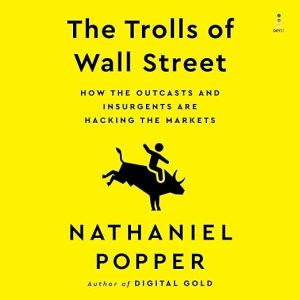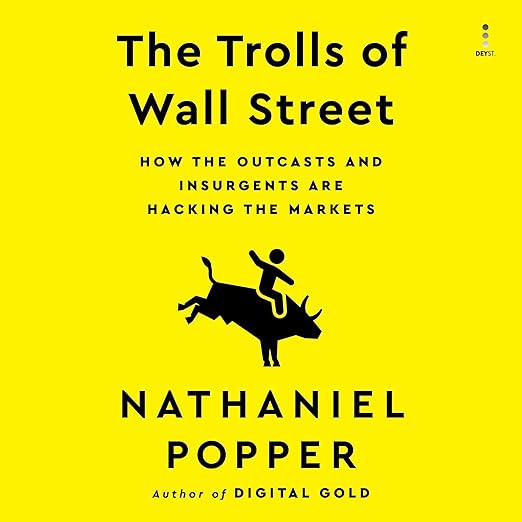
Nathaniel Popper's craft as a financial journalist is built around finding the human, often absurd detail inside a story that could easily collapse into pure market mechanics, and The Trolls of Wall Street applies that same instinct to one of the strangest financial stories of the last decade: how a crude, meme-driven subreddit called WallStreetBets ended up moving global markets and making the GameStop short squeeze a household story. Built around Jaime Rogozinski and Jordan Zazzara, the two men most responsible for turning WallStreetBets from an obscure trading forum into a genuine cultural movement, this ten-hour-and-thirty-seven-minute audiobook, narrated by Robert Fass, is deeply reported rather than a quick, cash-in account of a story everyone already half-remembers from the headlines.
Rogozinski and Zazzara's Fight for Control
What separates this from the wave of GameStop-adjacent content that followed the actual events is the reporting underneath it: Michael Hardiman's review calls out exactly this, describing “extensive interviews with nearly all the major players in the GameStop and related dramas with Reddit's WallStreetBets,” which tracks with how the book moves past the memes and catchphrases everyone remembers into the actual personalities, motivations, and internal conflicts of the people who built the community in the first place. Popper treats the self-proclaimed “degenerates” at WallStreetBets's core as real subjects worth understanding rather than punchlines, tracing how genuine distrust of Wall Street and a specific kind of online male alienation fed directly into the recklessness that eventually made the community famous.
The book's real argument extends past any single trading event into something with longer cultural staying power: an entire generation's relationship with money, investing, and institutional trust got permanently reshaped by watching an internet forum successfully take on Wall Street, at least for one chaotic stretch, and Popper traces how that shift outlasted the actual GameStop squeeze itself. The battles Popper documents aren't just WallStreetBets against Wall Street either; a meaningful part of the book covers the community's own internal power struggles, Rogozinski and Zazzara battling each other and their own moderators for control and credit as the subreddit's influence and stakes grew far beyond what either of them originally built it for.
The GameStop timeline itself, familiar in broad strokes to almost anyone who was online in early 2021, gains real texture from Popper's reporting: the stock's climb from single digits to well over four hundred dollars within days, Robinhood and other brokerages abruptly restricting trades at the peak of the frenzy, and the congressional hearings that followed all get treated not as a highlight reel of viral moments but as the direct, traceable consequence of specific decisions made inside WallStreetBets months and years earlier. That causal throughline, showing exactly how an obscure forum's internal culture produced a moment that briefly threatened hedge funds and drew federal scrutiny, is where the book's reporting distinguishes itself most clearly from contemporary headline coverage.
Popper's broader beat as a journalist has long tracked how internet-native financial movements form outside traditional institutions, and that background shows in how naturally he moves between the technical mechanics of a short squeeze and the sociological question of why so many young men found genuine community, however chaotic, inside a trading forum built on gallows humor and shared financial risk. The book treats those two threads, market mechanics and internet culture, as genuinely inseparable rather than alternating between a finance chapter and a culture chapter, which keeps the narrative moving even through its more technical stretches.
Fass Treats Memes and Markets Equally Seriously
Robert Fass narrates with a measured, professional register that resists the temptation to editorialize or amp up the drama artificially, letting Popper's reporting itself carry the tension rather than performing outrage or excitement over material that's already inherently dramatic. That restraint is a real asset for a story this online and meme-saturated in its source material; a narrator overplaying the internet-culture chaos could easily tip the whole thing into parody, and Fass instead treats even the more absurd details, the memes, the crude in-jokes, the trolling, with the same even-handed seriousness as the actual market mechanics, which keeps the book feeling like reporting rather than a highlight reel.
The pacing across ten and a half hours holds up well for a story with this many overlapping threads, the forum's origins, its explosive growth, the GameStop squeeze itself, and the personal and legal fallout for its founders afterward, since Fass's steady delivery gives a listener room to track who's who across a genuinely large cast of traders, moderators, and financial-industry figures without the narration itself adding confusion on top of an already complicated timeline. For anyone who followed the GameStop saga only through headlines and social media in real time, hearing the fuller sequence of events laid out in order is where the audiobook earns its length.
Investigative Journalism First, Entertainment a Distant Second
This assumes a baseline interest in financial markets and internet culture both, and while Popper explains the trading mechanics, short squeezes, options, the mechanics of how a stock's price actually gets pushed that high that fast, clearly enough for a general listener, someone with zero interest in either Reddit culture or market structure specifically may still find long stretches slower going than the cultural-movement framing promises. This is investigative financial journalism first, entertainment second, closer in spirit to a long-form magazine investigation than to a punchy business-book listen.
At a 4.3 rating from 73 listeners, response is solidly positive without being universal, and one review points at a real tension worth naming: some readers pushed back specifically on how outside press coverage characterized WallStreetBets during the actual events, which suggests Popper's own framing of the community, more sympathetic and more interested in root causes than a lot of contemporary headlines were, won't land the same way for every listener who came in with a fixed opinion about who the real villains of the GameStop story were.
Stays Firmly in Narrative Journalism Territory
Anyone who remembers the GameStop frenzy in real time and wants the reporting behind the memes, along with readers generally interested in internet culture's collision with traditional finance, will get the most out of this, and so will anyone curious about how a crude, chaotic online community can end up genuinely reshaping an entire industry's relationship with retail investors.
Anyone who already lived through the GameStop saga in obsessive real-time detail, reading every subreddit thread as it happened, might find some of the earlier scene-setting familiar rather than revelatory, even as the interview access and internal WallStreetBets power struggles still offer genuinely new material. It's a weaker fit, too, for a listener who wants a straightforward investing or personal-finance guide, since this stays firmly in narrative journalism territory rather than offering trading advice of its own.