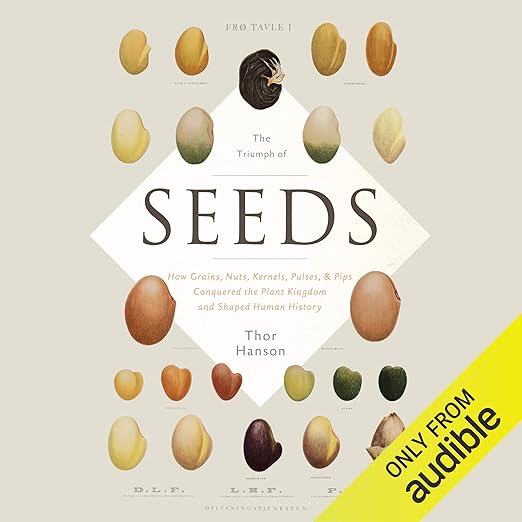
Quick Take
- Narration: Marc Vietor brings warmth and genuine curiosity to Hanson’s text, matching the author’s accessible enthusiasm without condescension.
- Themes: Plant evolution, human civilization and its botanical dependencies, the overlooked complexity of everyday life
- Mood: Curious and leisurely, the audio equivalent of a good garden walk
- Verdict: A quietly revelatory listen that will permanently change how you see the shelves of a grocery store, a meadow, or your own kitchen table.
I found myself listening to The Triumph of Seeds during a stretch of early morning walks I had started taking mostly to avoid screens before breakfast. I did not expect to end those walks thinking differently about the dandelion clock I was stepping around or the coffee I was carrying. By the time Thor Hanson had finished explaining how a gust of wind scattering dandelion seeds represents millions of years of evolutionary refinement, I had started looking at the ground in a fundamentally different way. That is the specific pleasure of natural history written by someone who genuinely loves their subject.
Hanson’s premise is deceptively simple: seeds are the most consequential objects in human history, and we have almost entirely stopped noticing them. From the nutmeg and peppercorn trades that drove the Age of Discovery to the cotton seeds that helped spark the Industrial Revolution to the wheat varieties that have shaped the rise and fall of civilizations, the argument builds steadily and convincingly. The book is not a polemic. It is closer to a guided tour led by a field biologist who cannot quite contain his enthusiasm for what he is showing you.
The Science That Earns Its Simplicity
One of the risks of popular natural history is that it flattens complexity in the name of accessibility. Hanson mostly avoids this. His chapters on seed dormancy, dispersal mechanics, and the evolutionary arms race between plants and the animals that eat or distribute their seeds are detailed enough to be genuinely informative without requiring a background in botany to follow. A reviewer who described the book as dealing with a scholarly subject in an unscholarly way meant it as praise, and that framing captures something true. The science is real and rigorous; the delivery is conversational and warm.
The historical thread is where the book becomes most surprising. Hanson traces how the search for specific seeds, particularly spices and grains, shaped trade routes, colonial ambitions, and economic systems in ways that most food history books treat as background noise. The section on wheat’s role in the Arab Spring struck me as particularly sharp: Hanson does not overstate the causality, but he makes the dependency visible in a way that sharpened my thinking about the fragility of food systems. This is nonfiction that extends beyond its stated subject without feeling like it has wandered off topic.
Personal Anecdotes and Their Cost
One reviewer noted, with some fairness, that Hanson occasionally wanders into personal stories that have limited connection to seed biology. There is a self-awareness about his role as a naturalist-father-observer that sometimes tips into the kind of cozy framing that feels like it is filling time. This is a minor complaint against a generally well-paced book, and Vietor’s narration handles these passages smoothly, but listeners who prefer sustained argument over personal narrative may find the transitions slightly uneven.
Marc Vietor is one of those narrators who understands that the goal of narrating nonfiction is not to perform enthusiasm but to embody it. He reads Hanson’s prose with a relaxed authority that suggests someone who has actually thought about what they are saying rather than simply delivering it. The descriptions of seed structure and dispersal, which could easily become dry inventory in the wrong hands, land with the kind of specificity that makes you want to find a maple seed and drop it to watch the spiral yourself.
Listening Context and Ideal Audience
The Triumph of Seeds works particularly well for listeners who read natural history but rarely feel it changes how they move through the world. Hanson has the gift of the observational pivot: he shows you something you already know exists and then explains why it is extraordinary, and by the end you are looking at your morning coffee, your cotton shirt, and the weeds in the garden bed with considerably more interest than you had before. One reviewer mentioned that the book sent them directly to the autobiographies of the botanists Hanson references, which is the mark of a natural history book doing its job properly.
At seven and a half hours, the runtime is generous but not exhausting. This is a book you can come back to across several sessions without losing the thread, which suits the episodic structure of its chapters. Each seed type or historical episode functions as its own contained argument, so returning to it after a day away feels natural rather than disorienting.
One of the book’s quieter achievements is its treatment of seeds that most listeners will know personally but have never thought about systematically. The section on coffee, and how the bean’s stimulant properties helped sustain the intellectual culture of the Enlightenment through the long hours that philosophical and scientific work requires, is the kind of connection that sounds obvious in retrospect but lands with genuine force when Hanson lays it out. The same is true of the cotton sections, where the distance between a seed and the Industrial Revolution’s labor practices becomes visible in a way that standard economic histories tend to skip. Hanson is not writing a history of exploitation, but he is honest about what seeds made possible and at what cost.
A Free Audiobook That Grows on You
This free audiobook pairs well with any season, though I listened to it most attentively in early spring when seeds were everywhere I looked and Hanson’s descriptions kept landing against real-world evidence. The combination of solid science, historical sweep, and an narrator who makes you feel the material is worth your full attention adds up to something genuinely nourishing. It will not change your life, but it will change at least a few of your walks.
Frequently Asked Questions
Do I need a background in botany or plant science to follow The Triumph of Seeds?
No. Hanson writes for curious general readers and provides enough context that anyone can follow the science. Gardeners and naturalists will find extra layers of recognition, but no prior knowledge is required.
Is Marc Vietor’s narration a good fit for this kind of natural history?
Yes. Vietor brings warmth and genuine engagement to Hanson’s text without overselling the enthusiasm. His pacing suits the discursive, chapter-by-chapter structure of the book.
How much historical material does the book contain alongside the botany?
Quite a lot. Hanson traces the influence of specific seeds on the Age of Discovery, the Industrial Revolution, and modern geopolitics, including a sharp section on wheat and the Arab Spring. The history and science are woven together throughout rather than separated.
Does the book advocate for any particular approach to gardening, farming, or conservation?
Not directly. Hanson’s goal is more observational than prescriptive. He makes the ecological importance of seed diversity visible without pushing a specific policy agenda, though the implications for conservation are clear.