
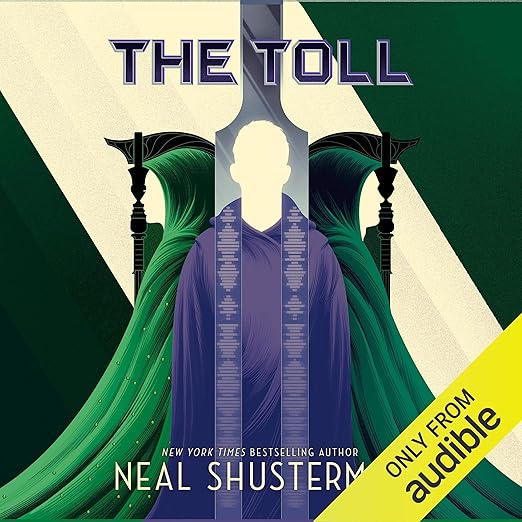
Endura is gone by the time this audiobook opens, Citra and Rowan have disappeared, and the description asks the only question that still matters: is anyone left who can stop Scythe Goddard? That is a great deal of furniture to move before a finale can even begin, and Neal Shusterman moves it in the first paragraph of the copy rather than in the first hour of the recording. Whatever else the third book in this trilogy does, it does not waste your time re-establishing a catastrophe you already watched happen.
Dystopia in the Arc of a Scythe books is administrative rather than cruel, and that is why they work. Death has been conquered, the Thunderhead runs the world competently, and the one job still requiring human judgment is the deliberate ending of lives. This volume inherits that machinery at the moment it breaks. The Thunderhead has fallen silent, the Great Resonance has shaken the earth, and the vacuum left behind is precisely the shape of a man like Goddard. A five-star entry from November 2019 names the political nerve of it exactly: the Scythe world is one where people wanted every decision made for them, and the story starts when the thing making the decisions stops speaking.
Nothing on this page is stranger than the rating panel. Fourteen people have graded a concluding volume of a trilogy the copy itself introduces as a New York Times best seller, and the average sits at 4.6. Fourteen. Whatever that counter is measuring, it is not the readership. More usefully, three of the five responses on display are not grading this book at all. They praise the trilogy, or all three books together, or the reading habit the series restored to someone. Subtract those and the evidence base for the finale specifically narrows to two opinions, which is thin ground for a decision of this size.
Greg Tremblay Alone Carries a Trilogy's Cast
Carrying a finale of this size is not a small assignment, and Greg Tremblay has it. The scythedom has fractured, the Thunderhead has stopped speaking, and one credited voice has to hold apart a cast the series spent two books distributing across a planet. Long books repay listening for an unglamorous reason. A trilogy closer spends a great deal of its length reminding you who somebody was two volumes ago, and a single reader who has already given each of them a shape does that work without stopping the story to explain itself. What you trade for it is a long sitting, and the copy makes no secret that the scale here is deliberate rather than accidental.
Strongest of the arguments for pressing play sits in a five-star entry filed in January 2020, and plot is not what it concerns. What that listener found realistic was never the technology, which the response cheerfully concedes might arrive on schedule anyway, but the human philosophies the technology produced. That is the correct read on this series, and it accounts for the weight the finale carries well beyond its age bracket. The dystopia is not built on a gadget. It is built on the observation that a species relieved of death would immediately construct a bureaucracy around killing, complete with a professional class, an ethics, competing factions and, eventually, its own demagogues.
PDF Extras the Audiobook Never Reads Aloud
Not everything closes. A four-star entry from October 2021 is generous about the ending and still walks away holding a question or two, describing a conclusion that arrives with a genuine sense of finality without being airtight. Knowing that in advance matters, because a commitment of this size to a trilogy conclusion sets a very specific expectation, and this book delivers resolution far more reliably than it delivers explanation. The same reader is careful to call the experience entertaining and flawed in the same breath, which is a fair description of what most series enders actually manage. In audio the effect is sharper than it would be in print, because you cannot flick back forty pages to check whether a thread was tied off or simply dropped. You either remember, or you accept the ambiguity and keep going.
Gaps appear in the listing itself. One genre field is filled and the tag list is completely empty, which on a dystopian finale with a large teen readership is an odd thing to leave blank. The description also closes with a production note that deserves your attention: buying this title places an accompanying PDF in your library beside the audio. Publishers attach those for maps, glossaries, family trees or chapter apparatus, and the copy never says which. What it certainly means is that some portion of this book is not read aloud to you at all, which is worth knowing if you listen exclusively on a phone while driving.
Finishing the Trilogy for Readers Who Value Institutions
Reach for it if you finished the second book and have been carrying the wreckage of that ending around ever since. Reach for it too if you read dystopia for its institutions rather than its chase sequences, because the governance questions are the engine here and the action runs downstream of them. The teen classification is accurate without being confining. The prose stays clean, the moral argument is legible to younger listeners, and the political content will hold any adult who has been following the same argument in the news for the past decade. It also suits classroom use unusually well, in the way the best young adult dystopias do, by handing a reader a set of ethical positions that are all defensible and all incompatible. Teachers looking for a novel that produces genuine disagreement rather than a consensus will find one here, and the recording makes the debate portable.
Give it a miss if you have not read the first two, since this description does not recap and could not sensibly try; the plot opens already mid-collapse. Give it a miss too if unanswered questions in a finale genuinely sour a series for you, because this one trades explanation for closure and makes no apology about the exchange. Buying for a younger listener means budgeting the hours honestly: it is one long continuous work rather than a set of episodes, and it assumes throughout that you can hold two books of history in your head while it runs.
Questions Listeners Ask
What does the title of this audiobook refer to?
The description ends its setup with a pointer rather than an answer: what resolves the story lies in the Tone, the Toll and the Thunder. Those three terms are the spine of the finale, introduced as a riddle the book then takes its time unpacking. If the second volume left you wondering what the silence meant, that line is the promise.
Is the audiobook appropriate for the younger end of the teen bracket?
The listing offers no advisory at all. The description itself names dictators and prophets, a society that has conquered death and a profession licensed to end lives, and the register sits closer to political tragedy than to adventure. Older teens are the natural fit; younger listeners will follow the plot but may find the ethics bleak.
Why is this audiobook so much longer than the average teen title?
It runs fifteen hours and twenty-two minutes, which is long for the category by any measure. A finale has to service every thread its trilogy opened, and this one is closing a premise built at world scale rather than a single character arc, so large stretches are consequence rather than incident.







