The Short Version
- Read by: L.J. Ganser brings steady intelligence to Michael Paterniti's layered narrative, navigating between the American journalist's self-aware digression and the earthy urgency of Ambrosio's story without losing the tonal distinction between them.
- At its heart: Obsession and the stories we tell ourselves, betrayal in a small community, the romance and delusion of the slow-food ideal
- Vibe: Rich and increasingly uneasy, like a perfect meal that arrives with complicated provenance
- Short version: A genuinely unusual work of narrative nonfiction that refuses to be the book its premise promises - listeners who can accommodate that refusal will find something more interesting than the cheese story they signed up for.
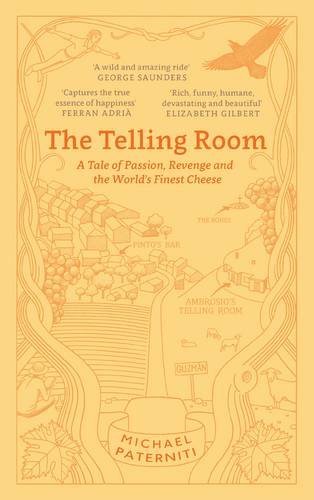
Ambrosio Molinos de las Heras, the Spanish cheesemaker at the center of Michael Paterniti's The Telling Room, is one of the more memorable figures in contemporary narrative nonfiction. Paterniti's audiobook, narrated by L.J. Ganser and running 13 hours and 29 minutes, begins with a quixotic premise: a piece of Paramo de Guzman cheese, reputedly the finest and most expensive in the world, encountered in a Michigan deli in 1991, sparks a decade-long obsession that ends with Paterniti and his family installed in the medieval Castilian village of Guzman, population 80, where the cheese was made in a cave from an ancient family recipe. The premise sounds like a gentle food-and-travel story. It is not that.
Ambrosio Dismantles the Slow-Food Fantasy
What Paterniti finds in Guzman dismantles the idyllic slow-food narrative he arrived expecting to document. The cheesemaker himself, Ambrosio, is volcanic and charismatic and ultimately heartbroken - a man whose story of betrayal at the hands of a former friend has consumed the village and reshaped everything around it. The cheese, which once carried a reputation as a kind of magical artifact, is no longer being made by the time Paterniti arrives. The story of what happened to the cheese business, and what happened to Ambrosio, is the story that the book slowly reveals is its actual subject.
Paterniti Becomes a Character in His Own Story
Paterniti is also honestly self-implicating about his own role in the story. He does not simply observe the village's dramas and Ambrosio's grievances from a journalist's detachment. He becomes, over the years he spends returning to Guzman, a participant, drawn into the orbit of Ambrosio's obsession, unable to write the book he thought he would write, unable to leave the story alone. Ganser handles this confessional register well, keeping Paterniti's voice self-aware without making it precious. The writer's growing implication in the mystery of what happened is more affecting than it might be because Ganser does not play it for comedy or for pathos but for something more accurate: the mild horror of a person who realizes the story found him rather than the other way around.
Ambrosio's account of his betrayal is presented through Ambrosio's own telling, which means it is partial, passionate, and possibly unreliable. Paterniti acknowledges this but does not resolve it - which is the honest choice for a story of this kind. Small village grievances rarely resolve into neat verdicts, and Ganser's narration preserves that ambiguity as one of the book's genuine strengths rather than a structural weakness to paper over.
Guzman's Cheese Turns Out to Be a MacGuffin
Narrative nonfiction of this kind, long and discursive and following an obsession more than a thesis, works particularly well in audio because the listening format naturally accommodates the digressive structure. Paterniti moves between the history of Castile, the mythology surrounding the cheese, the anthropology of the village, and the unfolding drama of Ambrosio's betrayal story with a freedom that some readers have found self-indulgent on the page. In audio, the digressions feel more like conversation than like authorial wandering. Ganser keeps each section grounded in a consistent voice, so the transitions between time periods and registers do not feel like gear changes.
The Spain that Paterniti describes, the particular texture of a small Castilian village in the 1990s and 2000s, the way local memory and local resentment calcify over generations, the economics of artisan food production meeting international gourmet markets, is rendered with enough specificity to feel like a place rather than a backdrop. Ganser's delivery respects the landscape passages without lingering in them, keeping the human drama central and the setting in service of character rather than the reverse. The cheese itself, after launching the narrative, recedes almost entirely from the story once Paterniti arrives in Guzman. Listeners drawn by the food-writing premise should know that the Paramo de Guzman is more MacGuffin than subject. The book is about what the cheese represented, what it cost, and what its disappearance meant to the people who built their identities around it.
Ganser Smooths Digressions Print Cannot Manage
This is a book about obsession that is itself somewhat obsessive in form, and listeners who prefer narrative nonfiction with clear forward momentum and a resolved mystery at the end may find Paterniti's structural choices frustrating. The book does not conclude neatly. Ganser also has to manage a considerable amount of historical and cultural material about medieval Castile, the specific wine and cheese traditions of the region, and the village's relationship to its own past - material that Paterniti uses to contextualize Ambrosio's obsession but that can slow the more immediate drama. These sections read as digressions in print; in audio, Ganser's steady delivery integrates them more smoothly into the continuous narrative, which is one genuine advantage of the format for this particular book.
The thirteen-hour runtime reflects a genuinely long immersion in this material, and the format rewards that kind of sustained commitment. Listeners who have tried and abandoned long-form narrative nonfiction in audio because the digressions broke their engagement should give The Telling Room a second consideration specifically because Ganser's management of the digressive structure is more effective than most.
McPhee and Orlean Fans Will Feel Satisfied
Readers who admire literary nonfiction in the tradition of works that treat obsession as a legitimate structural principle, writers like John McPhee or Susan Orlean who follow a subject until the subject becomes something else entirely, will find Paterniti's approach familiar and satisfying. Food-and-travel listeners who want something with more psychological and literary depth than standard culinary tourism will find this rewarding. Those looking for a Spain-based story that illuminates village life, rural memory, and the economics of traditional food production in a globalizing market will find the Guzman sections unusually specific and honest. Listeners who want a tightly plotted mystery or a clean food-writing narrative with a satisfying resolution should look elsewhere. This is a book that earns its complexity but does not simplify it for the listener's convenience.
Is The Telling Room audiobook primarily a food book or something else?
Something else, despite the premise. The cheese that prompted Paterniti's obsession is largely absent by the time he reaches Guzman, and the book becomes an investigation of betrayal, small-community memory, and the stories people construct about their own lives. Food writing fans should calibrate their expectations accordingly.
Is the audiobook of The Telling Room suitable for listeners with no knowledge of Spanish history or culture?
Yes. Paterniti provides substantial context for Castile, its history, and the specific culture of the village, and Ganser delivers that context without making it feel like an appendix. Prior knowledge enriches the listening but is not required.