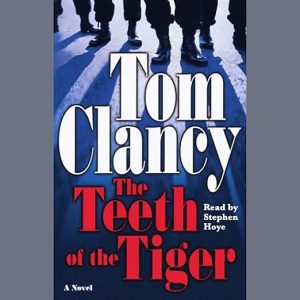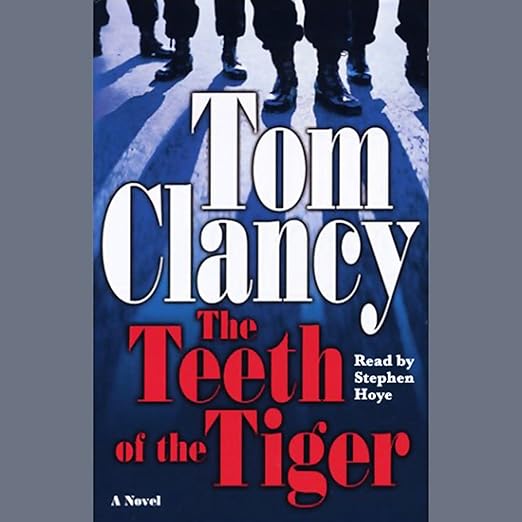
More than twenty-two years separate the oldest response on this page from the newest, and that gap explains the reception better than any plot summary could. One review went up in September 2003, fifteen days before this recording was released. The other four arrived between November 2025 and March 2026. The audiobook has been sitting quietly for two decades, and the people finding it now are approaching from a completely different direction than the people who found it then.
A Closer Look at The Teeth of the Tiger
Hendley and Associates looks like a financial firm somewhere in suburban Maryland, and the copy is blunt about the reality behind the letterhead: the outfit identifies and locates terrorist threats and then deals with them by whatever means the situation seems to require. The Campus, as the operation calls itself, recruits quietly, and its attention settles on the son of President John Patrick Ryan. That premise is the hinge on which the entire book turns, and it is also a neat solution to a structural problem, since a private outfit answers to nobody and therefore needs no bureaucratic permission to act.
Jack Ryan, Jr. arrives with a resume rather than a personality: years of exposure to special operations, intelligence analysis and, as the description puts it, the way the world really works. That is a great deal of competence to hand a debut protagonist, and it produces the central tension. He inherits his father's world without having earned admission to it, and the plot exists mainly to test whether that inheritance holds up under pressure.
Sixteen hours and forty-three minutes is the commitment, and Clancy spends it the way he always did, splitting attention between the operation itself and the geopolitics standing behind it. The copy sets up an alliance between Arab terrorist networks and Colombian drug cartels, giving the book two threat structures to braid together. Stephen Hoye carries the reading credit across that span, a substantial assignment on a thriller running this many parallel threads.
Amazon Customer, five stars in January 2026, located the appeal in a single observation: the writing makes an average reader wonder what was invented and what might have been real. That blurring is the durable Clancy product and the reason these books outlast the news cycles that produced them. Procedural texture, plausible institutions and an operational logic that feels researched rather than imagined are what the series sells, and this entry supplies all three.
Espionage thrillers reward listening more than most genres, because the pleasure lives in accumulating detail rather than in prose you want to slow down for. Briefings, surveillance work and the mechanics of a financial front all absorb well by ear. The dense passages here are informational rather than lyrical, so little is lost by taking them in while you are occupied with something else, and the considerable length turns into an asset instead of an obstacle.
Harris L. Burchell, five stars in November 2025, called it a very good read with plenty of twists leading toward the conclusion and noted it as the beginning of numerous novels. That is the honest pitch for a first entry in a sequence. The series number on the listing makes the same point more quietly, and anyone weighing whether to commit to a long-running series gets a fair sample of the formula right here.
Terrorism and narcotics occupied separate literatures in 2003, and the premise of merging them was the genuine novelty of the book at the time. Two decades later that convergence reads as an ordinary assumption rather than as speculation, which changes the listening experience considerably. What once played as forecast now functions as period detail, and the book is more interesting for it. You can hear what a well-briefed thriller writer believed was coming, then measure it against what actually arrived.
Things to Know Before Starting The Teeth of the Tiger
Patrick Shepherd's three-star review is the most substantial thing on this page and also the oldest. It argues that the early Ryan books, running from The Hunt for Red October through Executive Orders, delivered action, suspense, real people and believable catastrophic stakes, and that later entries lost one or more of those elements. The review credits this one with starting well and then registers a decline, which is the standard objection to this stretch of the series.
Arithmetic on the entry refuses to resolve. Five signed grades are visible, at five, four, five, three and five stars, summing to twenty-two. The page displays 4.2 across seven ratings. Whatever the two unseen votes happen to be, no pair of whole-star ratings produces a seven-vote average that rounds to 4.2, since the nearest achievable figures on either side are 4.1 and 4.3. The displayed number is not a plain mean.
EddieG demonstrates the other problem with a seven-rating sample. The review is five stars, and the entire body of it is the word Ok, which also serves as the title. That is a maximum grade attached to visible indifference, and it moves the average exactly as much as the detailed three-star critique does. On a page this thin, one shrug carries the same statistical weight as a considered argument.
Who Tom Clancy Is Writing For
Series readers working through the Ryan books in order have to pass through this one, and knowing it is the pivot helps enormously. This is where the franchise hands off from father to son, and from government service to a private operation working outside any oversight. If institutional detail has always been the appeal for you, that shift is genuinely interesting, and the new structure gets assembled here from the ground up, complete with recruitment, cover business and the rules the operation sets for itself.
Purists devoted to the submarine-and-summit era should manage expectations carefully. The most detailed response on the page argues precisely that case, and the change in scale is real: this is a smaller book about a smaller operation, with stakes well below a superpower confrontation. Anyone arriving for the geopolitics of the early novels will find the cartel and terror plot competent rather than sweeping, and competent is the operative word.
Clancy's later work rewards listeners who want the machinery of intelligence more than the machinery of nations, and this is the cleanest entry point into that phase of the series. Just do not read the 4.2 on the entry as a measured verdict, because seven whole-star ratings cannot produce that figure in the first place.