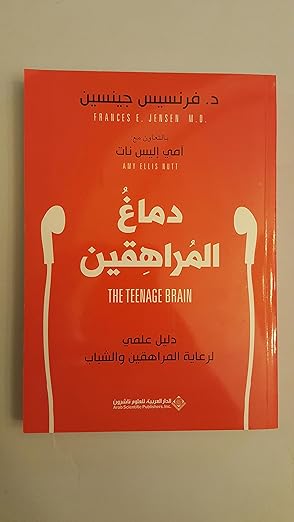
Frances E. Jensen spent her career as a neurologist studying brain development before turning that expertise toward a specific, chronically stressed audience: parents living with a teenager. The Teenage Brain audiobook arrived for this review with almost nothing in the listing itself, no synopsis, and only a handful of ratings on file, so what follows leans more heavily than usual on Jensen's documented expertise and what her book is widely known for covering rather than a page-by-page account.
The Verdict, Briefly
Jensen is generally known for grounding the book in the neuroscience of adolescent brain development specifically: the prefrontal cortex, the region responsible for judgment and impulse control, is among the last parts of the brain to fully mature, often not until the mid-twenties, which helps explain a great deal of what parents experience as inexplicable teenage risk-taking. Narrator Tavia Gilbert, whose prior nonfiction work in this file has been described as handling dense, technical material with an academic-meets-investigative neutrality, is a reasonable match for a book that has to make neuroscience accessible without oversimplifying it.
The appeal for parents is practical rather than purely academic: understanding why a teenager's brain processes risk, sleep, and emotional intensity differently than an adult's brain does is presented as the foundation for calmer, more effective responses to conflict at home. That reframe, from treating a teenager's behavior as willful difficulty to understanding it as a brain still under construction, is the kind of shift that tends to change how parents approach everyday friction, not just how they understand it intellectually.
Books built around brain development for a general audience tend to succeed or fail on how well they translate imaging studies and neurological terminology into everyday parenting language, and Jensen's dual background as both a clinician and a parent is generally what reviewers point to as her advantage here. Rather than presenting adolescent neuroscience as a purely academic curiosity, the material is typically framed around specific, recognizable situations: a teenager's poor decision after a late night, a sudden emotional overreaction, a new vulnerability to substance use.
The book is generally understood to draw on real imaging research into how myelination, the process that insulates neural pathways and speeds up brain communication, continues developing well into a person's twenties, later than earlier generations of parenting advice assumed. That timeline alone reframes a lot of assumptions about when adolescent judgment should be expected to match adult judgment.
Why Listen to The Teenage Brain
Books built around a single scientist's clinical framework carry an authority that pure parenting-advice titles often lack, and Jensen's dual position as both a research neurologist and a parent who raised two teenage sons herself gives the material a credibility that shows up in how confidently the book moves between hard science and lived experience. That combination is generally what reviewers and parenting educators point to as the book's core value.
Listeners drawn to evidence-based parenting resources, the kind that cite actual studies rather than just offering anecdotal wisdom, will likely find this a solid fit for that shelf. Gilbert's steady, unhurried delivery style suits material that asks listeners to sit with somewhat dense explanations of brain chemistry before getting to the practical payoff, rather than rushing toward advice before the reasoning behind it is established.
The book's popularity also speaks to a real gap parents have long felt: plenty of parenting advice addresses toddlers and young children in developmental terms, but far less mainstream guidance treats teenagers with the same developmental lens rather than simply as smaller, more difficult adults. Reframing adolescent behavior as a function of an actively developing brain, not a character flaw or a discipline failure, is the book's central reframe, and it's a genuinely useful one for parents in the middle of daily conflict.
Jensen's clinical focus also extends to specific risk factors many parents underestimate, concussion recovery taking measurably longer in still-developing teenage brains, for instance, and the elevated addiction risk tied to early substance exposure during this particular developmental window. Those concrete, high-stakes specifics are generally what readers cite as the most immediately useful material in the book, more than the general developmental theory alone.
What Might Not Land
The one listener review attached to this particular listing, written in Arabic, took a harder line: dense and clinical, more useful to researchers and specialists than to a parent looking for practical day-to-day guidance, and dated enough in its examples that some of the social pressures it discusses no longer quite match what teenagers face today. That's a fair caveat to weigh against the book's broader reputation, and it's worth taking seriously given how few listener accounts exist for this specific listing.
With only a few ratings on file for this listing, it's honest to say the usual crowd-sourced signal, dozens of listeners weighing in on pacing, narration quality, or how the material held up for their specific family, simply isn't available yet. Anyone considering this one should treat Jensen's own credentials and the book's broader reputation as the more reliable guide than the handful of ratings alone.
It's also worth stating plainly that this review was written without a plot synopsis for this specific listing to draw from, an unusually thin starting point even relative to most audiobook listings. What can be said with confidence rests on Jensen's well-documented professional background and the book's broad, consistent reputation rather than a detailed accounting of its structure.
Because this review had to lean so heavily on Jensen's general reputation rather than a synopsis, prospective listeners with access to a sample chapter should use it, more than usual, to confirm the specific tone and pacing suit their expectations before committing to the full runtime.
The Right Listener for The Teenage Brain
Parents of tweens heading into adolescence, teachers, school counselors, and anyone who wants the neuroscience behind teenage behavior rather than just another list of discipline tactics will get real value here. It also suits listeners who prefer their parenting advice grounded in a single expert's clinical framework over a patchwork of blog-era tips.
This also works well as a preventive read rather than only a crisis-response one; parents of younger kids approaching adolescence can absorb Jensen's framework well before the specific conflicts it describes actually arrive, building understanding ahead of the transition instead of scrambling to make sense of it once it's already underway. Educators working directly with teenagers may find the neuroscience just as useful for classroom management as parents find it for home.
For parents already stretched thin, the audio format itself is part of the appeal: a book about making sense of a teenager's behavior is more realistically absorbed during a commute or while making dinner than during dedicated reading time that exhausted parents of teenagers rarely have to spare.
Parents wanting quick bullet-point parenting hacks rather than the neuroscience behind them may find the density slow going at first.
Questions Listeners Ask
Why are there so few listener reviews for this particular audiobook?
This listing has only a handful of ratings on file, so this review leans more heavily on Frances E. Jensen's documented neurology credentials and the book's broader reputation than on a large body of listener feedback.
Is The Teenage Brain audiobook too scientific for a parent without a science background?
It leans genuinely clinical in places, and the one detailed listener review on file found it dense for non-specialists, though Jensen generally works to connect the neuroscience back to practical parenting takeaways.
Who narrates the audiobook version of The Teenage Brain?
Tavia Gilbert, whose prior nonfiction narration work has been described as handling dense, technical material with academic neutrality, a reasonable fit for a book moving between clinical explanation and parenting advice.