Quick Take
- Narration: Tom Brooks reads with a practical, unhurried clarity that suits instructional gardening content, professional without being dry.
- Themes: Permaculture design, seed saving, companion planting, chemical-free growing
- Mood: Encouraging and methodical, with an undercurrent of enthusiasm for working with natural systems
- Verdict: A well-structured three-book bundle that delivers genuine practical value for beginner and developing gardeners who want to move away from chemical dependency.
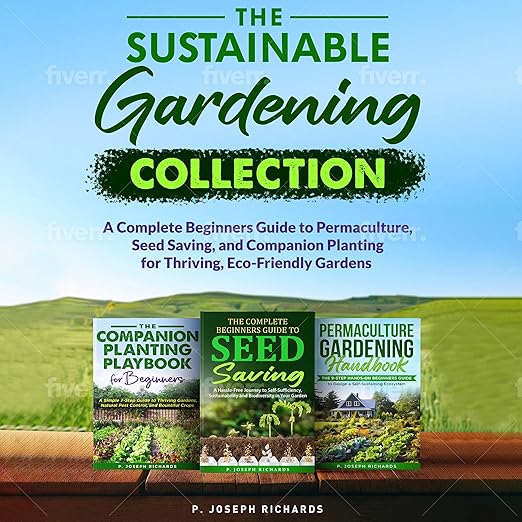
I came to this collection in late winter, when the seed catalogs were already stacked on my kitchen table and I had that particular restless feeling that arrives every February when I’m convinced this is the year the garden will finally behave itself. I’d grown vegetables for years with mixed results and a nagging sense that I was working against something rather than with it. The Sustainable Gardening Collection, P. Joseph Richards’ three-book bundle covering permaculture, seed saving, and companion planting, gave me a useful framework for that intuition: the problem wasn’t my effort, it was my approach to the soil.
The bundle contains three full books presented sequentially. The first covers permaculture basics, including the twelve principles and their practical application to home gardens. The second addresses seed saving, covering heirloom versus hybrid varieties, storage techniques, and the case for building a personal seed library. The third focuses on companion planting, specifically vegetable, herb, fruit, and flower combinations that support natural pest control and yield improvement. Together they form a reasonably coherent curriculum for moving from conventional gardening toward a more ecological approach, and the sequencing makes sense: you build the framework with permaculture, understand your inputs with seed saving, and optimize interactions with companion planting.
Our Take on The Sustainable Gardening Collection
What Richards does well throughout all three books is maintain a beginner-friendly voice without condescension. The permaculture section in particular takes a subject that can quickly become either utopian in framing or technically overwhelming and keeps it grounded in specific, actionable decisions: how to read your land, how to design for water retention, how to approach zoning in a small plot. One reviewer described it as providing ‘easy-to-understand explanations to break down the complex concepts involved in gardening,’ and that’s accurate. The book doesn’t require prior knowledge and doesn’t pretend the concepts are simpler than they are.
The seed-saving section was the most practically useful for me personally. The distinction between open-pollinated and hybrid varieties, and why only the former reliably reproduces true to type, is foundational to any serious seed-saving practice, and Richards covers it without oversimplification. The storage guidance is specific: temperature, humidity, container types, viability testing. This is the kind of detail that most gardening books gloss over because it isn’t glamorous, and its presence here is a mark in the book’s favor.
Why Listen to The Sustainable Gardening Collection
Tom Brooks narrates all three books in the collection with a consistent, measured delivery that works well for instructional material. He reads without embellishment, which is the right call for content that is primarily informational rather than storytelling. The pacing allows listeners to absorb specific techniques without feeling rushed, and the overall runtime of just under twelve hours across three books means each subject gets real development rather than surface treatment.
The audiobook also comes with a supplemental PDF, which is a significant feature for a gardening guide. Gardening instruction is inherently spatial, and some of the companion planting combinations and permaculture zone diagrams benefit from having a visual reference. Listeners who plan to use this book as an active gardening resource rather than background listening should download the PDF and refer to it alongside the audio. Several reviewers mentioned already starting to implement techniques from the book while listening, which is a good sign that the instruction is concrete enough to act on immediately.
What to Watch For in The Sustainable Gardening Collection
One reviewer noted that while the overall organization of chapters is logical, the within-chapter formatting could benefit from clearer separation between sections and ideas, with more use of bullet points and white space. In audio form, this limitation manifests as a tendency for some sections to feel densely packed with information that goes by quickly. Listeners planning to use specific techniques from the companion planting chapters in particular may want to listen with the PDF open, or revisit those sections before heading into the garden.
The book is aimed at beginners and developing gardeners, and experienced practitioners who already understand permaculture design, soil biology, and companion planting relationships may find the depth insufficient. This is not a text for the specialist; it’s a comprehensive starter guide, and its value is in breadth and accessibility rather than original or advanced content. The reviewer who noted it ‘gives you everything you need to know to start a garden’ is describing its scope accurately.
Who Should Listen to The Sustainable Gardening Collection
Beginner gardeners who want to avoid chemicals and build productive growing systems will find this one of the more complete starting points available in audio form. The three-book structure means you’re getting genuine depth across three related disciplines rather than a single overview. Listeners already practicing permaculture or with strong seed-saving experience may want something more advanced. Anyone who has been frustrated by gardens that require constant intervention and inputs will find Richards’ framework for working with natural systems rather than against them both practical and persuasive.
Frequently Asked Questions
Do the three books in the collection need to be listened to in order?
The sequencing is logical: permaculture first establishes design principles, seed saving covers your seed supply, and companion planting optimizes plant relationships. You can listen in any order, but the permaculture section provides useful context for the others, so starting there is recommended if you’re new to the subject.
Is this collection suitable for listeners with no prior gardening experience?
Yes. Multiple reviewers explicitly describe it as accessible to beginners, and the writing assumes no prior knowledge of permaculture, seed saving, or companion planting. It covers foundational concepts before moving into specific techniques throughout all three books.
What does the supplemental PDF contain, and do I need it to benefit from the audiobook?
The PDF accompanies the audio and provides visual references for concepts like permaculture zone diagrams and companion planting combinations that are harder to convey verbally. The audiobook works without it, but having the PDF available during relevant sections will help you absorb and apply the spatial and visual elements of the instruction.
Does the collection cover organic soil improvement, or is it primarily about plant selection and design?
It covers both. The permaculture book includes substantial material on soil health improvement, composting approaches including worm composting, water harvesting, and nutrient building. Plant selection and design are covered alongside the soil foundation rather than as separate topics.