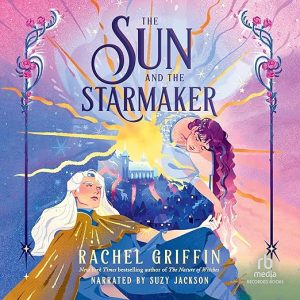
The Short Version
- Narration: A single-voice Recorded Books production credited to Suzy Jackson, released alongside the print edition in February 2026.
- Themes: A bargain made under duress, grief and longing, winter magic, forced proximity romance
- Mood: Aching, wintry, unhurried
- Verdict: A fairy tale built for feeling rather than plotting, with a slow middle that most listeners forgive by the end.
Sunlight has to be carried over the mountains by hand in this audiobook, and the first question it raises is the one every good fairy tale asks: what does the person doing the carrying get out of it? Rachel Griffin sets her romantic fantasy in Reverie, a village so far north that the Sun never reaches it, where a sorcerer called the Starmaker crosses a glacier each morning to pull light in over the peaks. Aurora Finch grew up on stories about him, and on the morning of her wedding she meets him in the frostbitten woods.
What We Made of It
Aurora's choice is what the February 19, 2026 response lays out most clearly, and it is a properly cruel one: leave her family, her friends, and the life she was about to begin in order to live an immortal existence alone, or refuse and die painfully of magic she never learned to use. She bargains instead, trading herself for her family's safety against the coming frost. That reader writes down 4.5 and the storefront keeps a 4, because half stars have nowhere to live in the rating system, so the stored score sits a notch under the intended one.
Romance sits at the center rather than the edge, and anyone treating this as a fantasy with a subplot attached will misjudge the pacing badly. The magic system exists to force two people into a castle together; the glacier exists so that one of them has a reason to leave every morning. Griffin is writing in the tradition where a cold, secretive man and a young woman with unrealized power circle each other for the length of a book, and she is doing it deliberately.
Fairy tale is the register the book keeps reaching for, and it mostly gets there. The description opens with a once-upon-a-time construction, the village has a name out of a dream, and the mountains are called the Lost Range, all of which signals that plausibility is not the standard being applied. Listeners who need their fantasy worlds to have economies and politics will find this thin. Listeners who want a story that behaves like a legend will find the thinness is the design.
The Best Parts of The Sun and the Starmaker
Longing is the word the February 26, 2026 response settles on after setting itself the exercise of picking just one, and it is the right one. That entry pairs it with grief, arguing that the two travel together and that the book carries an abundance of each, and describes the whole thing as a fairy tale of the kind that endures. Emotional intensity, rather than plot machinery, is what people are actually responding to here, and it is the most consistent note across every written grade.
Cold does real work in the writing. An ice-covered castle explored alone, a glacier crossed daily, a frost approaching that could end the village permanently: the physical conditions are also the emotional ones, and the book never has to explain the metaphor because the setting is already doing it. Winter fantasy is a crowded corner of the shelf, but very few entries in it make the temperature this structurally load-bearing.
Grief is handled with more care than the premise promises. What could have been a straightforward enchantment plot turns into something about loss, both anticipated and already suffered, and the written pool describes crying far more often than swooning. Two of the five reach for the word sobbing outright. That is a different transaction from the one a whimsical romantic fantasy usually offers, and it is the main reason this one lingers.
What Might Not Land
Pacing sags in the middle, and the most useful response says so plainly. That four-star entry, posted on February 22, 2026, describes a stretch where the momentum dragged and boredom set in, before the book recovered and delivered emotionally at the close. The same response admits to working out the destination early. Neither point is fatal in a character-driven love story, but a listener expecting constant forward motion across eleven hours should adjust.
Page edges and cover art turn up in the written pool, which tells you which edition at least some of these people bought. One five-star response spends its opening lines praising the beauty of the printed volume itself, down to the page edges and the cover under the jacket. That is fine as evidence about the writing and useless as evidence about the recording, so weigh the enthusiasm accordingly when it comes to production values.
Nearly 120 grades stand behind the 4.4 average and only five arrive with any words attached. Those five come to 4.6 between them, so the unwritten votes are pulling the figure down rather than up, which is the usual direction and a useful corrective to a review section that reads uniformly rapturous. The listing also records no series information, which turns out to be accurate: one reviewer specifically regrets that it is a standalone.
Who Should Listen to The Sun and the Starmaker
Fantasy romance readers who want emotional maximalism rather than a map should start here, and the February 18, 2026 response describes the experience precisely: captivated from the prologue onward, a magic system that felt genuinely unusual, and imagery the reader called whimsical and enchanting. Anyone who reads for atmosphere and aching restraint between two people will get exactly what they came for.
Plot-driven listeners should steer clear, and so should anyone impatient with a predictable arc. The middle stretch drags by at least one account, the destination announces itself early, and the pleasures are almost entirely in texture and feeling rather than in surprise. Anyone who needs a magic system with rules they can map will also find the mechanics gestural rather than engineered, since the enchantment exists to serve the feeling rather than the other way around.
Griffin has written the kind of book that makes readers sob and then complain that it ended, which is a strange sort of triumph. Take it slowly, ideally across cold evenings, and let the middle be slow rather than fighting it. The payoff, by consistent report from people who finished, is worth the stretch where nothing much happens except two people not saying what they mean.
Is The Sun and the Starmaker audiobook a standalone or part of a series?
A standalone, and the listing carries no series information to contradict that. Everything resolves inside this recording, so nothing is left hanging and no follow-up purchase is implied. The world is built to be left behind, which is unusual in a corner of the shelf where most titles open something longer.
Do you need to have read The Nature of Witches first?
No. That title is mentioned only to establish the author's track record, and the two books are not presented as connected in any way. Nothing in the premise, the setting, or the magic assumes prior reading, so treat this as a completely fresh starting point whatever your history with the author.
Is this audiobook suitable for younger teenagers?
It is classified for teens, but the content skews older. The protagonist is at her own wedding when the story opens, the central relationship is adult in shape, and the emotional weight falls squarely on bereavement and immortality. Older teens and adults are the comfortable audience; younger listeners may find it heavy going.
Who narrates this audiobook, and how is the performance?
Suzy Jackson is credited for the Recorded Books production. Not one of the five written responses discusses the reading, and several describe a printed copy instead, so no listener evidence about the performance exists on this listing. The sample is the only way to judge before buying.