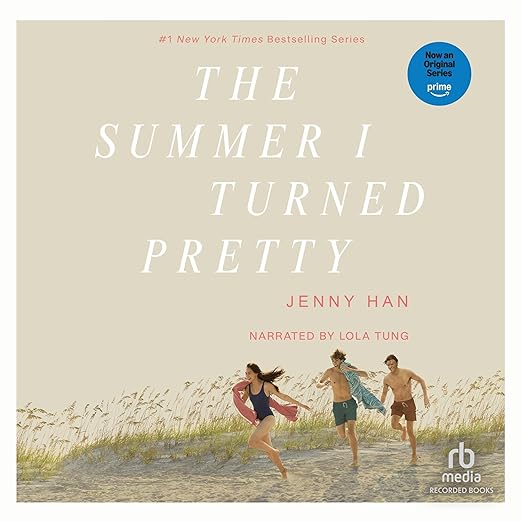
- Read by: Lola Tung, who plays Belly in the TV adaptation, brings an easy naturalism to the first-person voice that avoids performative emotion without sacrificing warmth.
- At its heart: First love, summer nostalgia, the slow alteration of childhood friendships into something more complicated
- Vibe: Sun-drenched and wistful, with emotional undercurrents that run deeper than the surface brightness suggests
- Short version: A well-crafted series opener that captures teenage longing with specificity and restraint; best heard in an uninterrupted stretch on a warm afternoon.
Belly Conklin's summers are the audiobook version of pressed flowers: vivid long after the season has passed. I listened to The Summer I Turned Pretty during a stretch of genuinely hot June days, windows down, doing nothing in particular, and Jenny Han's writing landed with the particular sweetness of nostalgia that hasn't quite calcified into cliche. This audiobook has been sitting in my queue for longer than I'd like to admit, and I'm glad I finally stopped delaying it.
Han built her reputation on the To All the Boys I've Loved Before trilogy, and this series opener has the same gift for capturing the specific gravity of teenage longing. Belly measures her life in summers spent at Cousins Beach, a place that exists in that magical register of childhood refuges: more real in memory than in the present. At the center are two boys, Jeremiah and Conrad, who have shifted in role across years from brother figures to crushes to something more complicated. The novel doesn't rush to resolve that complication, which is exactly right.
Jeremiah and Conrad Avoid the Predictable Triangle
What Han does with particular skill is render the specific texture of a summer that feels different before you can name why. Belly returns to Cousins as she always has, but something has changed in the molecular arrangement of things: her body, her confidence, the way the Fisher boys look at her. Han doesn't announce this shift with drama. It accumulates in small moments, an offhand comment, a held glance, a door that closes a beat too slowly. The novel earns its emotional weight by refusing to overstate it.
The love triangle here operates without the mechanical predictability that usually plagues the form. Jeremiah is warm, easy, generous. Conrad is closed off in that particular teenage-boy way that reads as profound rather than simple unavailability. Han writes both with enough interiority that choosing between them feels genuinely impossible, which is the correct feeling for this kind of story. She's also honest about Belly's limitations as an observer of her own feelings, which gives the whole narrative a pleasing ironic distance without tipping into satire.
Lola Tung Brings Light Naturalism to Belly
Lola Tung, who plays Belly in the Amazon Prime adaptation, narrates the audiobook, and that casting decision turns out to matter more than it might seem. Tung brings a light naturalism to the first-person voice: she doesn't perform the emotions so much as inhabit them. Belly's narration never becomes breathless or overwrought even in the novel's more charged scenes. Tung handles Han's conversational prose with the ease of someone who knows the character from inside rather than from the page, and it makes a genuine difference. At six hours, the listening time is tight enough that you can complete it in a long afternoon, and the pacing rewards that kind of uninterrupted session.
Han's attention to the friendship between the mothers, Belly's mom and Susannah, runs as a quiet countermelody beneath the teen romance. This subplot does more than provide context: it suggests that the summer house is a place where multiple kinds of love are being sorted out simultaneously, and that Belly's summer is not the only one with stakes. It gives the novel a depth that the romance genre scaffolding alone wouldn't provide. The Cousins Beach setting carries its own emotional weight, becoming a character in the traditional sense, a place whose meaning shifts as Belly herself shifts.
Tung's Dual Role Deepens Belly's Internal Voice
Listeners who come to this wanting resolution rather than complication will need to recalibrate their expectations. Han ends the first book mid-trajectory, which is honest to the experience of a summer that changes everything without concluding anything. Some reviewers have noted that the love triangle dynamics can feel unresolved to the point of frustration, and that's a fair read, though I'd argue it's a deliberate choice about how teenage love actually works. The wonderful and terrible summer of the synopsis doesn't deliver a tidy verdict; it delivers an accurate feeling. The novel is more interested in the quality of the experience than in where it lands.
Readers who have already seen the television series adaptation will find the audiobook a more interior version of the same story. Han's prose gives access to Belly's internal processing that the visual medium necessarily compresses. Knowing the plot doesn't diminish the experience of listening to Han's language work through it. Tung's narration gains an interesting layer in that context: she is simultaneously the character in the prose and the actress who inhabited her on screen, and the two registers coexist without contradiction.
Sarah Dessen Fans Will Feel Right at Home
Listeners who love character-driven coming-of-age stories with emotional honesty rather than melodrama will find exactly what they're looking for. This audiobook suits fans of Sarah Dessen, Kasie West, or Han's own To All the Boys series. Those looking for clean romantic resolution in a single volume may want to note that this is book one of a trilogy, and the arc continues across the subsequent installments. Adult listeners who enjoy revisiting the emotional terrain of teenage summers will find Han's writing generous and clear-eyed about what that territory actually feels like from the inside, rather than as adult memory reconstructs it. The six-hour runtime makes commitment easy; finishing it is not the challenge, stopping mid-listen is.
Listeners curious about how Han's prose style translates to audio after knowing her work through the screen adaptation will find the experience genuinely complementary. The novel's internal register, Belly's self-aware but not always self-honest narration, comes through more richly in audio than it might in a quick read, because Tung's delivery keeps the irony gently audible throughout.
Does this audiobook work if you've already seen the Amazon Prime series?
Yes, and in some ways it's richer for it. Han's prose gives access to Belly's internal monologue that the visual adaptation necessarily compresses, so knowing the plot doesn't remove the value of the listening experience.
Is this audiobook appropriate for readers who prefer clean romance?
Yes. The Summer I Turned Pretty stays well within clean teen romance territory. The emotional stakes are high, but the content is appropriate for readers on the younger end of the YA spectrum.
How does the audiobook hold up as a standalone, or do I need to commit to the full trilogy?
The first book works as a complete summer story with a definite emotional shape, but it ends mid-arc. The love triangle is not resolved, and the series continues across two more books. Listeners happy to invest in the full trilogy will get more satisfaction than those looking for a self-contained story.