In Brief
- Voice: Danny Campbell brings steady, professional authority to Canfield's material without overwhelming it; his delivery is clear and paced for long listening sessions, which matters for a 21-hour runtime.
- Big ideas: personal accountability, goal architecture, confidence-building through consistent action
- Atmosphere: Practical and energizing, built for sustained engagement over weeks rather than a single sitting
- Worth it?: At 21-plus hours this is a genuine commitment, but listeners who engage with all 64 principles rather than cherry-picking will find a coherent system rather than a collection of inspirational fragments.
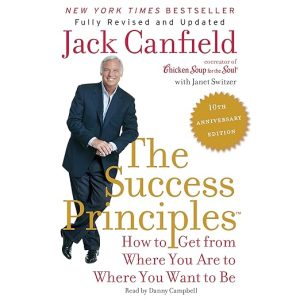
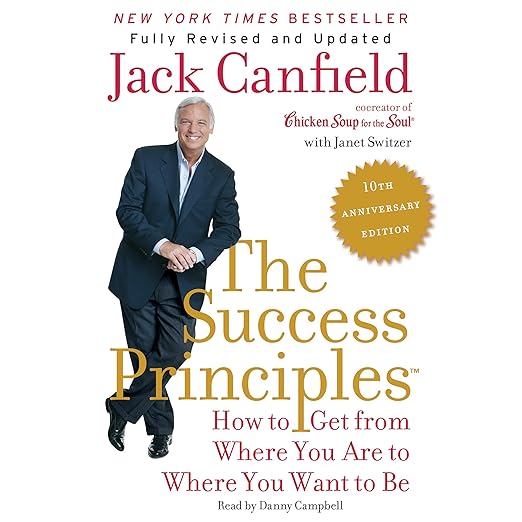
Jack Canfield's The Success Principles(TM) - 10th Anniversary Edition, narrated by Danny Campbell, is a different kind of project from the Chicken Soup for the Soul franchise Canfield co-created. This audiobook does not trade in short anecdotal uplift. It is a 21-hour-and-46-minute structured program, revised and expanded from its original publication to account for changes in how people work, communicate, and define success in the digital age. The 64 principles it presents are drawn from Canfield's decades of work with executives, athletes, celebrities, and people attempting significant life changes, and they are meant to function as an integrated system rather than a menu of independent suggestions.
What Jack Canfield Delivers
The most honest thing you can say about this audiobook is that its value scales directly with how seriously a listener engages with its homework. Reviewer Colleen Sorensen spent a full year with the material, worked through all the suggested activities, attended Canfield Training Group seminars, and credits the book with transforming her life in ways other books had not. That kind of investment is rare and is also exactly what Canfield is asking for. The 64 principles are not delivered as quick wins or two-minute habits; they are framed as the architecture of a life that has been deliberately designed rather than passively received. Listeners who approach this as ambient inspiration, playing it through once and moving on, will find it less useful than those who stop, reflect, and apply.
The revision for the 10th anniversary addresses digital life substantively rather than tokenistically. Canfield's original framework, built around themes of responsibility, vision, and consistent action, holds up well in a world of distraction, but the new afterword and updated examples bring the material into contact with social media, platform economics, and the realities of remote work in ways the original could not have anticipated. The core insight, that you cannot change outcomes without changing inputs and that the inputs you control most directly are your own choices and responses, remains the load-bearing beam of the entire structure. Reviewer Sergio S, who came to the book with both personal and professional improvement in mind, describes it as a handbook you want to carry with you; that framing captures the reference-quality aspect of a 64-principle framework that does not exhaust itself on a single pass.
What Jack Canfield Gets Right
Danny Campbell's narration is a considered choice for material of this length and density. His voice carries authority without stiffness, and he handles the transitions between principles, anecdotes, and direct instruction without losing listener orientation. Over nearly 22 hours, consistency of delivery is not a minor consideration; a narrator who tires or becomes mechanical partway through a long self-help text can cause listeners to disengage precisely when the material is building toward its more sophisticated points. Campbell holds the pace across the full runtime without significant drop in energy or presence.
The audiobook format serves this book well because it allows listeners to consume the material during otherwise uncommitted time, and then return to the print or digital version for the exercises. Reviewer GWC, who has bought multiple copies in different formats, is describing exactly this usage pattern: the audiobook for immersion and engagement, the physical copy for annotation and reference. The supplementary material Canfield references offers the exercises in a workable format, though some listeners find they need more space than a PDF provides and prefer a dedicated notebook. The famous stories of CEOs, world-class athletes, and everyday people that populate the book arrive with enough variety that the audiobook never feels like a single demographic's road map to success; the principles are designed to translate across industries and ambitions.
Where Jack Canfield Loses Some Ground
Twenty-one hours is a genuine commitment, and listeners should be honest with themselves about whether they will sustain attention across the full runtime without the structure of a reading group or scheduled study sessions. Reviewer Colleen Sorensen read the first section with her work team, which provided accountability and discussion that kept the material alive across months. Solo listeners may find the second half of the audiobook harder to engage with than the first, not because the material deteriorates but because the sheer accumulation of principles can create a sense of saturation without a processing mechanism in place.
Some of the anecdotes illustrating the principles involve celebrities and executives whose specific situations are distant from the average listener's life. Canfield is careful to frame each principle as universally applicable, and the everyday success stories he intersperses do ground the material, but listeners who find aspirational distance between the examples and their own circumstances may need to actively translate rather than directly apply. That translation work is worth doing; the principles themselves are not class-dependent even when the examples sometimes are. The audiobook is best treated as the beginning of an ongoing practice rather than a one-time experience, and the 4.7 rating from listeners who have returned to it repeatedly reflects that.
Who Should Pick Up The Success Principles(TM) - 10th Anniversary Edition
This audiobook is best suited for listeners who are genuinely ready to commit time and reflection to a structured self-development program rather than a quick motivational refresh. It works well for people at a significant transition point who need a comprehensive framework for redesigning their approach to work, goals, and personal responsibility. Listeners looking for a short, breezy listen or a narrow focus on a single aspect of personal development will find the scope too broad. Those who have tried shorter self-help content and found it evaporates quickly after listening may find Canfield's 64-principle architecture the more durable structure they have been looking for.