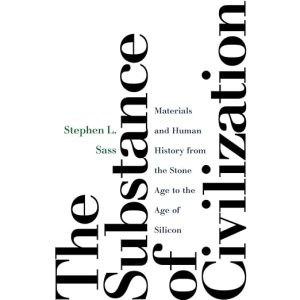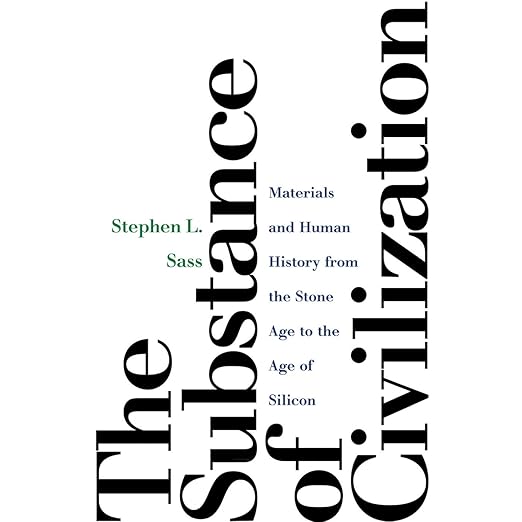
Ancient civilizations once prized iron more highly than gold, back when the metal was rare enough to work only from meteorites, and that inverted hierarchy is the kind of detail Stephen L. Sass builds this whole audiobook around. The Substance of Civilization argues that materials, not just ideas or leaders, actually steer history: stone, bronze, and iron lend their names to entire ages, while glass, paper, steel, cement, and gunpowder quietly redirect the course of empires without ever getting equivalent credit. Sass writes like a materials scientist who genuinely loves stories, and narrator John Haag treats that dual identity, half chemistry lecture, half historical narrative, as the book's real selling point rather than a tension to smooth over.
Haag's Unhurried Delivery Balances Science and History
The pleasure of this one is in its specific, almost trivia-grade connections, delivered with enough context that they never feel like trivia. Sass traces celluloid, the material behind early movie film, back to a 19th-century contest to find a substitute for ivory billiard balls, and points out that the same clay potters used in antiquity turns up again in the silicon-adjacent chemistry of modern computer chips. Moving from the Stone Age to what Sass calls the Age of Silicon, the book keeps circling back to one idea: humans have never really been in control of history so much as constrained and enabled by whatever substances they could master at a given moment.
John Haag narrates with a clear, unhurried delivery well matched to a book that alternates between genuine science writing and narrative history sometimes within the same paragraph. He doesn't rush the technical passages, on smelting temperatures or crystal structure, but he also doesn't let them slow into a lecture register; the momentum of Sass's storytelling instinct carries through even when the subject turns genuinely chemical. One reviewer, Israel Ramirez, describes the book's tone precisely as 'generally non-technical with a strong emphasis on how these materials influenced people's lives,' and that balance is exactly what Haag's performance protects.
Studded With Quotations From the Bible
Sass has a real gift for finding the human stakes inside a material's properties, and reviewer Joseph G. Liscouski credits the book with 'putting some life into history' compared to the fact-heavy version most listeners were taught in school. The book isn't shy about its stranger sources either: reviewer Israel Ramirez points out it's 'studded with quotations, many from the Bible and other' ancient texts, which gives the material history an unexpected literary throughline alongside the chemistry and archaeology.
Gunpowder's Quiet Assault on Castle Walls and Nobility
What makes this worth a listen rather than a skim is how directly Sass connects deep history to the present tense. The book doesn't stop at bronze swords and stained glass; it carries the argument up through nanotechnology and asks, with real specificity, what substances will matter most across the century ahead. For a listener who has ever wondered why iron mattered before steel existed, or why glass changed how buildings and telescopes both worked, this is the rare popular-science audiobook that answers the question instead of just posing it.
The synopsis frames its central puzzle as a direct question: how would history have unfolded without glass, paper, steel, cement, or gunpowder? Gunpowder alone makes a useful test case for how Sass's mind works throughout the book, since its arrival didn't just change battlefield tactics, it undermined the military logic behind castle walls and armored nobility, quietly accelerating a shift toward centralized, gun-owning states. That's the pattern the book repeats across a dozen different materials: a substance changes history not because someone had a clever idea, but because the substance itself made a previously impossible outcome suddenly cheap and available.
Breadth Wins Out, and You Start Noticing
At 8 hours and 54 minutes, the book covers roughly ten thousand years of material history, which means breadth wins out over depth almost everywhere. Any single material, iron, glass, cement, gets a chapter or a section rather than a book-length treatment, so listeners hoping for an exhaustive metallurgical deep dive on any one substance should expect a survey instead. The genre tags attached to this listing span technology, social science, and engineering, which looks scattered at first glance but actually reflects how genuinely interdisciplinary Sass's approach is rather than a miscategorized listing.
Reviewer John Richmond warns that this 'is not one you read and forget the plot in a few hours' but actually causes you to think about what's around you, which is a fair description of the book's real demand on a listener: the value compounds after the fact, when you start noticing the material history embedded in ordinary objects, rather than landing in one big dramatic reveal during the listen itself.
Three Reviewers, Three Different Favorite Chapters
The Substance of Civilization sits inside a specific, well-loved nonfiction subgenre, the single-material microhistory, the kind of book that takes one substance and traces an entire civilization's story through it. What makes Sass's approach distinct is scope: rather than picking one material and following it deep, he moves across a dozen or more, iron, bronze, glass, paper, gunpowder, cement, silicon, treating each as a chapter in one larger argument rather than a book unto itself. That breadth-over-depth choice is a real trade-off, but it means a listener gets several compact microhistories in one sitting instead of committing to a single narrow thread for the entire runtime.
All three attached reviews single out a different favorite entry point into the material, which is itself a useful signal: Joseph G. Liscouski responds most to the book's broad civilizational sweep, Israel Ramirez highlights the metals-and-glass chapters specifically, and John Richmond calls out the Biblical and ancient-text references as a personal highlight. No single chapter has to carry the whole book's appeal for a given listener, which makes this a forgiving pick even for someone whose curiosity about material history is narrower than the book's full scope.
For Bill Bryson Fans of Everyday Objects
Anyone who enjoyed Bill Bryson's A Short History of Nearly Everything, or who likes the kind of documentary that connects an everyday object to a genuinely deep historical thread, will find a natural home here. It's also a strong pick for curious generalists who want their history delivered through objects and substances rather than kings, wars, or ideologies, and for anyone genuinely curious why one particular material, rather than some rival substance, ended up defining an entire era.
Listeners chasing cutting-edge nanotechnology detail or a rigorous materials-engineering textbook will find Sass's treatment of the present day comparatively brief, since the book's real strength sits in the long historical sweep rather than the contemporary chapters. This one rewards patience and curiosity more than it rewards a listener looking for a single dramatic argument, and it's best approached as a series of connected essays rather than one continuous narrative thread.
Good to Know
Does this audiobook require a science or engineering background to follow?
No. Stephen L. Sass writes for general readers, and narrator John Haag keeps the technical passages, on smelting, chemistry, or crystal structure, clear rather than lecture-heavy.
Does the audiobook focus on any one material in depth, like iron or glass?
Not for long. Given the roughly nine-hour runtime covering thousands of years, each material, stone, bronze, iron, glass, paper, cement, gunpowder, gets a focused section rather than an exhaustive treatment.