Quick Take
- Narration: Daniel Wisniewski delivers reliable, punchy pacing that suits Orodan’s bulldozer personality; character differentiation is functional rather than exceptional.
- Themes: Persistence without strategy, time-loop progression, gods as antagonists
- Mood: Relentlessly kinetic, occasionally exhausting in the best way
- Verdict: A step up from Book 1 in emotional depth while keeping the brutal skill-grinding loop mechanics that made the series click.
I started listening to this on a Friday evening with the vague intention of getting through the first hour or so. I finished it on Sunday afternoon having done almost nothing else in between. That is not an endorsement of my impulse control, but it is a fairly accurate description of what X-RHODEN-X has built in this series: a loop structure that functions the same way slot machines do, except the payout is a number going up on a skill screen and somehow that is enough.
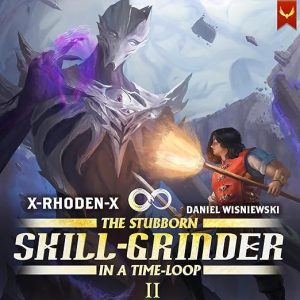
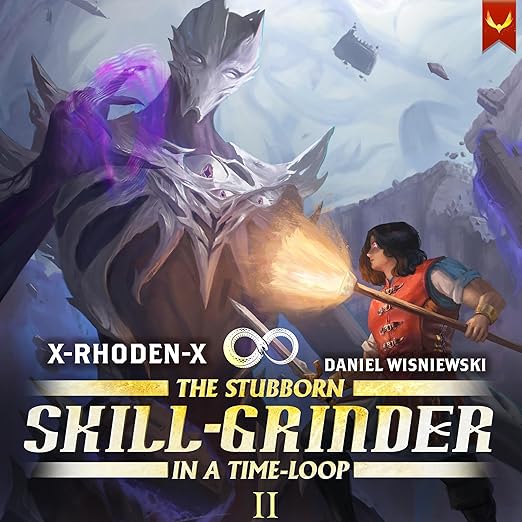
The Stubborn Skill-Grinder in a Time Loop 2 is published through Aethon Audio, narrated by Daniel Wisniewski, and runs just under seventeen hours. It picks up directly from the first book, with Orodan facing hostile divinities, an encroaching Eldritch Avatar, and the ongoing corruption of his world. His solution to all of this remains the same: run at the problem until either the problem or his skull gives way.
Our Take on The Stubborn Skill-Grinder in a Time Loop 2
What reviewer Benjamin Barreth identifies as the series’ central appeal is also its central limitation: there is little character development in the traditional sense, and the author is not pretending otherwise. Orodan’s stubbornness is a character trait, not a character arc. What Book 2 adds, according to multiple reviewers, is that the emotional sequences feel more real and immersive than they did in Book 1. Reviewer Tomo notes specifically that while characters are still introduced somewhat shallowly, the emotional register has improved. That is a meaningful upgrade for a series built on a protagonist who processes everything through the filter of “hit it again.”
The time-loop mechanic here is not played for paradox or philosophical weight; it is a pure progression engine. Each loop Orodan dies and respawns with accumulated skill knowledge but not full power, forcing incremental gains through attrition. For listeners who find this kind of systematic progression satisfying on an almost neurological level, the series delivers consistently. Reviewer J describes the pacing and worldbuilding as fantastic, and the world of Inuan does have more texture than the genre typically offers at this speed.
Why Listen to The Stubborn Skill-Grinder in a Time Loop 2
Daniel Wisniewski is a good fit for this material. Orodan’s voice needs to project stubborn momentum rather than cleverness, and Wisniewski does not oversell the emotional moments or undercut the action ones. At nearly seventeen hours, the narration needs to sustain energy across a lot of combat sequences, and it does. Aethon Audio titles tend to prioritize production quality, and that holds here.
The power escalation is handled better in Book 2 than Book 1, at least according to Benjamin Barreth, who worried in Book 1 that Orodan was gaining power too fast. Book 2 apparently recalibrates the pacing of that growth so that the end of the book leaves listeners feeling the story is “just getting started” rather than already at its ceiling. That is good series management and suggests the author is paying attention to feedback.
What to Watch For in The Stubborn Skill-Grinder in a Time Loop 2
This is not a series for listeners who want rich secondary characters or nuanced antagonists. The hostile gods and the Eldritch Avatar function as obstacles rather than characters, and the supporting cast exists primarily to react to Orodan. If you need ensemble depth or moral complexity in your fantasy, this series is not designed to provide it.
The “cultivation aspects” mentioned in the synopsis signal that the progression system draws on xianxia conventions as well as Western LitRPG, which adds flavor but can also create complexity around the skill trees that may not be immediately legible to listeners unfamiliar with that genre tradition.
Who Should Listen to The Stubborn Skill-Grinder in a Time Loop 2
This is targeted squarely at readers who loved Book 1 and want more of the same with improved emotional grounding. Listeners who enjoy progression fantasy with detailed skill systems, brutal action loops, and a protagonist whose primary virtue is refusing to quit will find exactly what they came for. It also works well for listeners who want something that moves fast and does not require active interpretation.
New listeners should begin with Book 1. Readers who need character development as a primary driver, or who find the “numbers go up” reward loop tedious rather than satisfying, will not find Book 2 has converted the formula into something else.
Frequently Asked Questions
Does Book 2 work as a standalone, or is Book 1 required first?
Book 1 is required. The loop mechanics, Orodan’s established power level, and the threat of the Eldritch Avatar are all ongoing from the first installment. Dropping into Book 2 cold would deprive listeners of the context that makes the incremental progression meaningful.
How does the time-loop mechanic actually work in the story? Does Orodan remember previous loops?
Yes, Orodan retains skill knowledge and experiential memory across loops, which is what allows the progression system to function. He dies, resets, and carries forward accumulated expertise, making each loop a ratchet rather than a reset. This is closer to a cultivation-progression framework than a traditional Groundhog Day structure.
Reviewers mention little character development. Is the series worth the time investment if that matters to me?
Probably not. The series is deliberately built around action and progression rather than character interiority. Reviewers who enjoy it consistently describe the appeal as brutal battles and skill accumulation. If character arcs are a primary requirement, this series is not designed to satisfy that need.
Is Daniel Wisniewski’s narration significantly different from other Aethon Audio LitRPG narrators?
Wisniewski has a direct, momentum-forward style that suits progression fantasy particularly well. He is reliable rather than transformative, which is appropriate for material this action-dense. Listeners familiar with other Aethon Audio titles will find his performance consistent with the label’s production standards.