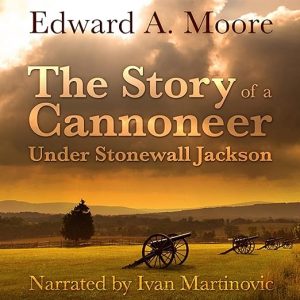
Six hours and thirty-nine minutes of Confederate artillery service sit behind one of the odder product descriptions on any audiobook listing I have worked through this year. The copy carries no summary at all. It is a stack of period press notices praising the book's honesty, followed by a first-person testimonial from a man who served in the same battery for nine months of 1862, the whole thing signed off with the name Robert E. Lee. The two voices run together with no space between them, so a sentence about future historians slides straight into a memory of shared mess duty. A buyer comes away certain that Edward A. Moore was truthful. A buyer comes away with no idea what he recounts.
A Rare Case Where the Badge Matches the Grades
The written responses do the job the copy skipped. A five-star filed in 2012 gives the shape of the book in three sentences: a private in the Rockbridge Artillery, followed from the day he enlists to the surrender at Appomattox Courthouse, serving in the unit that same response describes as Stonewall Jackson's own, staffed with his artillery students from the Virginia Military Institute. That is the paragraph the publisher owed this page. Instead the page offers a nineteenth-century notice explaining that the book has not been marred by argument about the causes of the war, which tells a modern buyer plenty about the frame and nothing about the content.
The shelving is its own problem. This memoir is filed under biographies and memoirs, which is right, and also under sports and outdoors with a tag reading Adventurers, Explorers and Survival, which is not. A listener browsing outdoor adventure will find a Confederate artilleryman's war; a listener hunting military history may never surface it. The badge reads 4.4 across 115 ratings, and the five written grades average precisely that figure, which is a rarer alignment than it sounds and suggests the visible column really does represent the crowd behind it.
Martinovic Keeps Virginia Place Names Legible
What survives from 1862 here is a register rather than a thesis. A four-star from 2011 puts it better than I can: Moore speaks of his experiences much as you or I might speak of our time in high school, and he does not paint a picture of glamour and romance as so many Civil War books do. Horrors and ordinary annoyances arrive in the same tone of voice. Camp, the march, and action, which is the division the old notice on this page uses, take up roughly equal room, and that balance is exactly why the book has outlived its era.
Reading a memoir this dense in place names is a specific assignment, and Ivan Martinovic is the one credited with it. Manassas, Appomattox, the Rockbridge battery, and the run of Virginia place names that go with them: the audio has to keep all of it legible while a listener drives or washes dishes. At six hours and thirty-nine minutes the book is short for a campaign account, which works in its favor. Three sittings covers it, and the episodic construction means picking it up cold after a week costs nothing.
Another five-star, this one from 2020, supplies the practical measure a buyer actually wants: detail without tedium, and a clear sense of what wartime life was for the battery and for the man writing about it. That is the correct compliment for the form. Moore is not building toward a revelation and never pretends to, so the pleasure has to come from accumulated specifics, and the responses that admire the book admire it for the same reason rather than for any single set piece. Nothing in the written column disputes what the book is. The disagreement runs only to whether that is enough.
A Superb Witness, a Poor Guide to War
Criticism arrives from the three-star, and it names the ceiling honestly. This is one man's honest assessment, valuable as testimony, but it lacks the sweeping perspective of Sam Watkins' Company Aytch, and its author seems puzzled as to how the Confederacy lost when most of the engagements he took part in were won. That puzzlement is the book in miniature. Moore is a superb witness to a battery and a poor guide to a war. Anyone expecting causes, strategy, or a reckoning with what the Rockbridge Artillery was fighting for should be told plainly that none of it is here, and that the publisher's own copy treats the absence as a virtue.
Nobody in the written column has said a word about the recording. Every response reaches for reading vocabulary, so the performance itself remains untested in public. Worth noting too that a memoir following a battery from one campaign to the next ships with nothing to keep that geography straight. No map travels with the file, and the place names come at a listener with no way to fix them in space.
What a Private Ate and How Far He Walked
Collectors of soldier testimony will want this, and one of them says so on the page: a 2019 five-star who loves old first-person accounts of war, regrets only that the author is long gone and cannot be told, and singles out the hardships of weather and roads rather than any battle. If the appeal of the period lies in what a private ate, how far he walked, and what he noticed while doing it, this is close to an ideal example, and it is short enough to work as a first step into a very large field.
Pass on it if you want the war explained. Pass on it too if you are new to the period and need a spine of events to hang the anecdotes on, because Moore assumes his reader already knows why the army is where it is. And approach it knowing what it is: a Confederate veteran's account, packaged in praise written by his contemporaries, sold with a description that never once tells you a story happens inside.