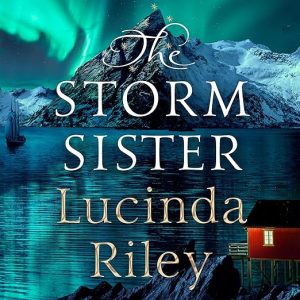
Second books in a seven-part series carry a specific burden: they have to justify the architecture. Lucinda Riley's The Storm Sister is the entry where the Seven Sisters design either proves itself or exposes itself as a formula, and at nineteen hours and forty-seven minutes the audiobook gives itself plenty of room to make the case. Ally D'Aplièse is about to start a yacht race the copy calls one of the world's most perilous when word arrives that Pa Salt, the elusive billionaire who adopted her and five other daughters, has died. Hattie Morahan reads. The trail Ally follows leads to Norway, and to a singer who lived there more than a century before.
The Verdict, Briefly
Two timelines run through the book, and Riley keeps them at very different temperatures. Ally's story is contemporary, mobile and grief-stricken: a competitive sailor pulled off the water by a death and a cryptic bequest. Anna Landvik's story sits more than a hundred years earlier in Norway, belonging to a young unknown singer who ends up performing in the first staging of Grieg's music for Ibsen's Peer Gynt. The connection between the two is the engine, and Riley refuses to rush its reveal. Anyone who found the first volume's structure appealing will recognize the shape immediately; anyone who found it contrived will meet nothing here to change their mind.
Detail is what one four-star reader singles out, praising descriptions exact enough that, in their account, every word created a compelling visual and left them lost in every part of the story. The same response carries the line that best captures Riley's method, reporting having been 'devastated and filled with riotous indignation at all the correct times.' That phrase is generous and faintly critical at once. Riley is a precision instrument for producing a specific emotional reaction on schedule, and a reader who notices the schedule can still enjoy the ride. Nineteen hours in that company is either exactly what you wanted or considerably too much.
Every book in this series runs on the same device: Pa Salt, dead before the first page, leaving each adopted daughter a clue pointing toward the origins he never explained. The design is unusually disciplined for a saga, one sister per volume, which means each entry holds a self-contained investigation inside a larger unresolved question. The Storm Sister is where that design gets its first real test, because a second instance is what turns a premise into a pattern. It holds, mostly, and the Norwegian material is strong enough to carry its own weight independent of the frame.
Why The Storm Sister Works as an Audiobook
Story within a story is how one five-star reader puts it, and the phrasing is worth quoting exactly: 'a wonderful story within a wonderful story.' They add that the characters, the depth of feeling, and what they call so many degrees of love are the draw. That last phrase describes Riley's actual subject better than the romance shelf does. The book is less interested in courtship than in the full range of attachments people form, including the adoptive, the parental, and the ones formed with a dead man who left instructions behind.
Macmillan puts the reader's name in the copy, which is worth noticing. Hattie Morahan is credited there alongside two other productions, The Burning Chambers and Girl with a Pearl Earring, and a publisher only lists a back catalog when it expects the name to sell something. The job itself is demanding: two eras, two countries, a Norwegian cast and a contemporary international one, all held apart across nearly twenty hours. That is a casting decision with consequences, which explains why the house treated it as a feature rather than as a line in the credits.
Music gives the historical thread its own gravity. A young singer at the first performance of a score the copy calls iconic, written for an Ibsen play, is a strong premise on its own, and Riley uses it to anchor the Norwegian chapters in something verifiable rather than in invented court intrigue. Encountering a novel built around a voice by hearing it, rather than by reading it, adds a layer the printed edition cannot supply. The production never pretends to be a musical one, and the resonance is real regardless.
Points to Consider
Nineteen hours and forty-seven minutes deserves weighing first. That is a substantial commitment to a book that is itself the second of seven, and the dual structure means a listener invested in Ally gets moved a century away from her for long stretches. Readers who prefer one thread over the other, and most do, should expect a rhythm of engagement and patience rather than uninterrupted momentum. The length is not padding. Riley genuinely has two novels' worth of story here. It is simply a great many hours to hand over for a premise.
Blurbs on this record need reading carefully. The praise quoted in the product copy sits under a heading announcing praise for the Seven Sisters, which is both the series name and the title of the first book, so a listener cannot tell from the page whether a given line was written about this volume or about its predecessor. Below those, a block of five-star reader quotes appears with no names attached to any of them. None of that is unusual publishing practice, and none of it is evidence about The Storm Sister specifically. Weigh the named responses instead.
Something similar applies to the attached reactions. One five-star response explains that they came to Riley late, on a personal recommendation, and had already started book three by the time they sat down to write. That is a reader captured by a series rather than one assessing a single installment, and it is a common mode of enthusiasm around long sagas. Useful information about the pull of the whole. Much less useful when the question is whether this particular volume stands up on its own.
Should You Listen to The Storm Sister?
Saga readers are the obvious audience, and a five-star response maps the intended trajectory precisely: enjoyed the second book as much as the first, kept interested by the twists and turns, already looking ahead to book three. If that is the relationship you want with a series, Riley supplies it reliably. Add listeners who like historical fiction with a verifiable spine, since the Norwegian strand is built around a real premiere and a real score rather than invented history. And add anyone who wants a long book to live inside for a week or two rather than a tight novel to finish in an evening.
Impatient listeners should walk on by. The pleasures here are cumulative, the pacing is generous, and nothing about the structure rewards someone hunting for a fast resolution. Anyone who wants the central mystery closed will also come away frustrated: the questions about who Pa Salt actually was, and about the sister who is missing, stay open by design and get handed forward to the next volume. And readers who found the first book's coincidences hard to swallow should know this one asks for the same suspension, applied to a fresh pair of timelines.
- Narration: Hattie Morahan arrives with two prior productions named in Macmillan's own copy, and the job spans two countries and more than a century of register across nearly twenty hours.
- Themes: adoptive family and inherited identity, a forgotten singer recovered from history, grief as an inheritance
- Mood: Expansive, romantic, unhurried
- Verdict: The volume where the Seven Sisters design proves it can hold, carried by a Norwegian strand strong enough to stand alone.
Do you need to hear The Seven Sisters before starting The Storm Sister audiobook?
It helps considerably. One reader calls this one exciting and captivating like the first sister's story but very different, which suggests the volumes are distinct in flavor while sharing a frame. The Pa Salt setup and the sisters' relationships are established in book one, and starting here means assembling that background as you go.
How does the historical strand work inside the audiobook?
Riley alternates between Ally in the present and Anna Landvik in Norway more than a hundred years earlier, with the link between them withheld for a long stretch. In audio the switches arrive without a visible chapter marker, so expect the opening of each section to do the orienting work.
Does the book resolve the mystery of Pa Salt?
No. The identity of the adoptive father and the whereabouts of the missing seventh sister are series-level questions, deliberately left open. This volume closes Ally's own investigation into her origins, then points forward to The Shadow Sister, which the publisher names as the next entry.