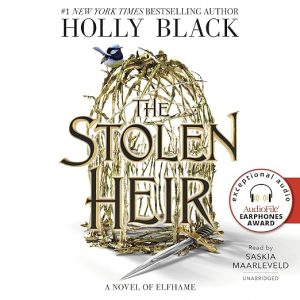
- Performance: Saskia Maarleveld is a natural fit for Holly Black's Elfhame, she handled the Folk of the Air series with distinction and brings the same precise emotional register to Wren's fractured interiority.
- What it covers: Trauma and feral survival, manipulation and trust, the cost of belonging
- Feel: Cold and atmospheric with bursts of dark tenderness
- Our call: A slower, stranger entry in the Elfhame universe that rewards patience with a protagonist unlike anything Black has written before.
I finished The Stolen Heir on a gray Saturday when the weather outside felt like it was auditioning for a Fairyland production, cold, uncertain, with that particular quality of light that makes everything feel slightly wrong. It turned out to be exactly the right conditions for a book about a girl who has been living feral in the woods, eating scraps, and trying to forget she was once a queen.
Suren, who goes by Wren, is not the kind of protagonist Holly Black usually centers. She is not Jude Duarte's controlled fury or Taryn's compromised ambition. She is something rawer and stranger, a child who survived the Court of Teeth through dissociation and numbness, who has rebuilt herself into something that functions in the human world but does not belong to it. One reader compared her to Wednesday Addams filtered through Adventure Time's Marceline, and that is not a bad map of her particular frequency.
Black is doing something careful here with Wren's perspective. The prose registers her hypervigilance, her difficulty interpreting sincerity, her tendency to interpret kindness as tactical maneuver. When Prince Oak enters, charming and beautiful and described by the narrative itself as manipulative, the tension between what Wren perceives and what might actually be true is doing significant work. Oak is not a reliable protagonist in the way Jude is, his charm is real but so is his calculation, and the reader/listener is positioned slightly outside certainty about his motives for much of the book.
This is where some readers have struggled. Reviewers who came from The Cruel Prince expecting the same propulsive forward momentum found the pacing slower and the central dynamic harder to lock onto. Wren is deliberately opaque, and Oak's reliability is deliberately questionable. If you read this as a failure of characterization rather than as intentional design, the experience becomes frustrating. If you read it as a portrait of what extreme childhood trauma does to a person's ability to interpret reality and accept help, the book is quietly devastating in a way that The Cruel Prince, for all its pleasures, never quite attempted.
The Strengths
Saskia Maarleveld is the single best argument for choosing the audio format for this book. She gives Wren a quality of contained stillness that on the page can read as flatness, in audio it reads as the performance of someone holding themselves together with specific deliberate effort. The scenes in the human world where Wren observes her former foster family from a distance carry a particular ache in Maarleveld's handling that I am not certain would land as fully in print. She also manages the shift in tone when Bogdana appears with quick effectiveness, and the icy-north sequences in the later act benefit from a delivery that suggests genuine coldness without theatrical frost.
The Elfhame world-building here extends in directions the Folk of the Air trilogy did not explore. The Court of Teeth, glimpsed briefly in The Wicked King and The Queen of Nothing, receives real attention, its specific cruelties, its political structure under Lady Nore, and what it cost Wren to survive it. For listeners who wanted more of that world's corners filled in, this is a genuine reward.
Weak Spots in The Stolen Heir
Listeners who have not read the Folk of the Air trilogy will not be lost, Black provides enough context, but they will miss the weight of certain callbacks and the significance of certain character appearances. The book functions on its own terms but functions better with context. The romantic tension moves slowly and some readers have found Oak's charm unconvincing rather than deliberately constructed; your experience will depend significantly on how you read manipulation in fantasy romance. There is also a late-book event involving Oak and Wren that has divided readers sharply, one reviewer called it sick, another called it riveting, so emotional stakes should be expected.
Recommended For
This is for readers who want Holly Black in a more patient register and who are interested in a protagonist shaped by genuine trauma rather than a protagonist who merely references it. Listeners who loved The Cruel Prince primarily for its pace and Jude's bravado may find this a more demanding experience. Those who love Maarleveld's narration and want more Elfhame world depth will find both in abundance. The duology is complete, so no open-ended wait required.
Do I need to read the Folk of the Air trilogy before The Stolen Heir?
Not strictly required, Black provides enough context to follow the plot. However, the emotional resonance of several character appearances and callbacks is significantly stronger with prior knowledge of Jude, Cardan, and Madoc.
How does Saskia Maarleveld's narration here compare to her work on the Folk of the Air trilogy?
Maarleveld handled both with the same distinctive precision, but Wren's fractured, guarded interiority gives her more to work with emotionally. Many listeners consider this her best performance in the Elfhame world.
Is the pacing in The Stolen Heir comparable to The Cruel Prince?
No. The Stolen Heir is deliberately slower and more interior, reflecting Wren's hypervigilant perspective. Readers expecting the propulsive forward drive of The Cruel Prince should adjust expectations.