Quick Take
- Read by: Dozens of viewpoint characters across two rebuilt societies, all held together by one credit, Grover Gardner, for forty-seven hours and forty-seven minutes.
- At its heart: An engineered pandemic, society rebuilt twice, good and evil made literal, dreams that summon people across a continent.
- Vibe: Vast, slow-burning and biblical.
- Short version: The complete text of King's biggest book, and the wrong door entirely for anybody sampling King for the first time.
Captain Trips escapes a government laboratory and takes ninety-nine percent of the human race with it. The copy puts the cause at a nanosecond of computer error in a Defense Department laboratory, followed by a million casual contacts forming what it calls a chain letter of death. What remains afterward is the actual book: a world stripped of its institutions, a handful of panicky survivors choosing sides or being chosen, and two figures at opposite poles of a continent pulling them in. This audiobook runs forty-seven hours and forty-seven minutes, which sounds absurd until you realize King is not writing an apocalypse so much as a civilization being rebuilt twice over.
Five Hundred Restored Pages Buy a New Ending
Shape is the unusual part, and a five-star from October 2018 maps it more clearly than the publisher's copy manages: a flu strain empties the world, the survivors begin dreaming of two beings, one angelic and one demonic, and each dream summons them somewhere. An old woman of 108 in Nebraska gathers her people in Boulder, Colorado and leads them in peace and happiness; Randall Flagg gathers the rest and leads them in hate and fury, killing everyone who opposes him. That is a moral fable wearing a pandemic novel's clothes, and King commits fully to both halves rather than picking one.
Which edition you are buying matters enormously. The copy is explicit about it: the 1978 publication was incomplete, with more than 150,000 words cut, and this text restores over five hundred pages of deleted material along with new writing King added while reworking the manuscript for a later generation. It has, in the copy's own words, a new beginning and a new ending. So this is not simply a longer version of the book people remember. Parts of it are a different book, with new characters and familiar ones given considerably more room to move.
Does it need all of that? Honestly no, and that hardly matters. The Stand works by accumulation, and the pleasure comes from living alongside two dozen people long enough to know exactly how each will behave under pressure, so shortening it would improve the plot while destroying the effect. Nearly forty-eight hours is the price of the effect. Listeners who resent slow middles should understand that the middle here is the point rather than the delay before the point arrives.
Gardner Reads What Feels Like Three Novels
A five-star from June 2020 spends its opening paragraphs on where this novel sat in King's career, and the context genuinely helps. By 1978 he had published Carrie, Salem's Lot and The Shining inside four years, was already being called the Master of Horror, and had achieved the thing he wanted, which was writing full time. The Stand reads like what an author produces once the money problem is solved and the ambition is not. That same entry notes King had grown tired of the horror label, and this book is part of the evidence: apocalyptic, theological, and only intermittently frightening.
Grover Gardner has the reading, and the scale creates a problem no amount of vocal range solves on its own. A five-star from March 2021 describes the experience as similar to reading three shorter novels, with numerous characters and storylines, and separately praises a narrative style it calls easily followed modern conversational American English. Both observations bear directly on the recording. That plain style is a genuine advantage in audio, since nothing needs rereading to parse. The character count cuts the other way: somebody introduced in hour six may not reappear until hour twenty-two, with no page to flip back to and no chapter heading carrying a name. Character recognition sustained across two weeks of real time is the job here, ahead of everything else.
Print Copyright Notices Leak Into an Audio File
Two of the five written responses are describing a different product. A five-star from June 2013, written in German, discusses a Kindle version running about 1300 pages at a price around three euros; a five-star from May 2019, written in Italian, praises how well that same edition was produced and notes that the images from the original book appear in it. Both are useful opinions about the novel and neither says a word about any recording. On a page whose badge sits at 4.6 across 57 ratings, that is a distinction to hold on to before reading the column as a verdict on the audio.
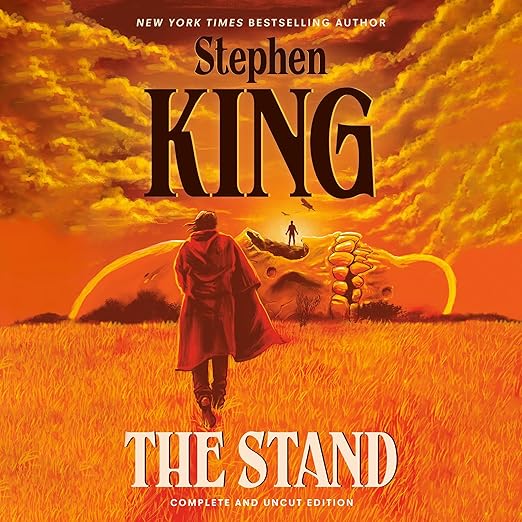
Discovery is the second problem, and it starts in the title field. This record displays The Stand, while nearly every substantive sentence of the description concerns The Stand: The Complete And Uncut Edition, a materially different text. The runtime turns out to be a buyer's only dependable signal that the longer version is the product on offer. The cover line compounds it: the description closes with a copyright notice for cover artwork dated 2020, sitting on a recording released in February 2012. Artwork was evidently swapped for a later tie-in and the notice stayed behind in the copy.
Print framing runs through the rest of that description too. It counts the restored material in pages rather than hours, five hundred of them, and addresses itself to the hundreds of thousands of fans who read the original version, which tells an audio buyer nothing about how forty-seven hours will actually feel. The categories, meanwhile, file this under literature and fiction, under mystery, thriller and suspense, and under science fiction and fantasy, with a Horror tag on top. Four shelves is one way of conceding that nobody is certain which one it belongs on.
Time and Patience Are the Only Requirements
Listeners with time and patience make up the entire audience, and the reward scales with both. If you want a novel to live inside for a month, with a cast large enough that several of them will irritate you and a moral argument that takes itself completely seriously, this is close to the best available version of that experience. Anyone who lived through a real pandemic may find the opening chapters uncomfortably plausible, which is either a reason to listen or a reason to wait. The uncut text is also the one to choose if you already know the story, since a new beginning and a new ending give a reread somewhere to go.
Newcomers to King should start somewhere else entirely. Forty-seven hours and forty-seven minutes is a serious commitment for a first attempt, and the material sits firmly in adult territory. Listeners who need tight plotting will find the middle third indulgent, and anyone allergic to explicitly theological stakes should know that good and evil here are literal, dreamed, and named out loud. What this recording offers is the largest thing King ever built, restored to the size at which he first wrote it. Forty-eight hours is a lot to ask, and this is one of the few books constructed to justify the asking.