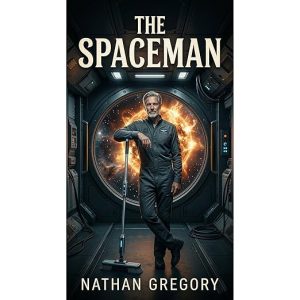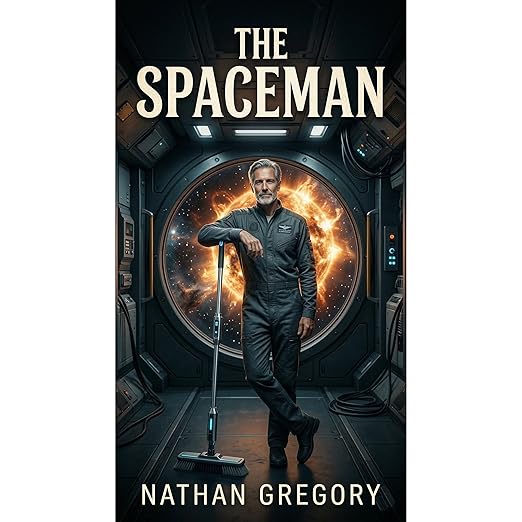
Max has been scrubbing the decks of the Vigilant for sixteen years. He does not tweet. He does not click. He most certainly does not surf. In Nathan Gregory's The Spaceman, a 29-minute satirical fable narrated by Virtual Voice, Max is the last man on a high-class starship who actually knows where the bolts are, what the hull sounds like when something is wrong, and how to fix it when something goes sideways. This audiobook is short enough to fit in a lunch break and precise enough to leave a mark. Gregory is working in a register that speculative fiction once used regularly and has largely abandoned: the short social fable, compressed to the point where every detail serves the argument.
A Janitor Fired for Lacking a Digital Footprint
Gregory's premise is elegant in the way the best satire tends to be: take a familiar anxiety, remove the familiar context, and place it somewhere extreme enough that the stakes become clear. A janitor who understands physical reality is dismissed from a high-status starship because he lacks a digital footprint. The new tech-obsessed Captain sees Max's analog competence not as a complementary asset but as a social liability, a mark of irrelevance in a world measured by clicks and engagement. That setup will resonate with anyone who has watched genuine expertise get outranked by the appearance of connectivity, and Gregory does not overexplain it. He trusts the situation to carry the argument.
At 29 minutes, The Spaceman operates more like a short story than a novel, which is precisely what it is. Virtual Voice narration suits the fable register better than it might suit a longer narrative work. The flat delivery is almost appropriate for a story told in the deadpan tradition of classic sci-fi social satire; Gregory is clearly writing in the tradition of authors who used outer space as a mirror for contemporary anxieties rather than as a canvas for adventure. The brevity sharpens the satire rather than truncating it. A story about a world where everyone is too busy clicking and surfing to look out the window does not need extensive scene-setting to make its point.
Practical Wisdom in a World of Metrics
The specific joke Gregory is telling is about metrics replacing judgment. The Vigilant's crew are so absorbed in their screens that nobody looks out the window. Status is digital. Expertise is invisible unless it generates data. Max, cast out into the space docks with his severance and his dignity, carries knowledge that the ship actually needs, and the story's arc hinges on whether that practical wisdom can reassert value in a universe that has decided not to notice it. That is a recognizable story dressed in a spacesuit, and Gregory earns the satire because he commits to Max as a character with genuine professional pride rather than making him a simple victim.
The phrase "practical wisdom" in the synopsis functions as the book's governing idea. Max is not nostalgic or helpless; he is competent in ways that the ship's residents have collectively decided not to value, and the distance between what they dismiss and what they actually need is where the comedy and the critique live together. For listeners who enjoy short-form literary satire in the tradition of speculative fiction as social commentary, The Spaceman is a brisk and pointed listen. It does not overstay its welcome, which is itself a small achievement in a cultural moment defined by content that cannot stop padding its runtime. The digital illiteracy that gets Max fired becomes, by the end, the most honest relationship with reality that anyone on the ship possesses.
Virtual Voice Works Fine at Twenty-Nine Minutes
The 29-minute format means that Gregory has to work economically. The supporting characters, including the tech-obsessed Captain, are sketches rather than portraits. Listeners expecting layered secondary characters or extended worldbuilding will not find them here. What Gregory does well within the constraint is establish Max's point of view quickly and clearly, so the satire lands without needing extensive setup. The universe of the Vigilant is rendered in enough detail to make the class dynamics legible; the ship's hierarchy of digital engagement, where status is measured in footprints and followers rather than in competence or contribution, is sketched efficiently enough that the story can move directly to its consequences.
Virtual Voice narration at this length produces a complete listening experience without the fatigue that can accumulate over hours of AI delivery. For a short satirical fable, the stripped-down performance does not significantly harm the experience. Listeners who are sensitive to the flatness of AI narration will notice it, but the shortness of the runtime limits the exposure. Gregory's prose is clean enough to carry the story even without expressive narration. The satirical frame is clear from the opening and does not develop into anything more ambiguous or complex; this is a pointed fable with a specific target, and readers looking for narrative complexity should adjust their expectations accordingly.
A Single-Session Listen, Not a Character Study
Fans of short-form speculative fiction with a satirical edge will find The Spaceman a satisfying single-session listen. Anyone who enjoys the tradition of social satire using science fiction as its vehicle will recognize what Gregory is doing and appreciate how cleanly he does it in 29 minutes. Listeners who need substantial character development or narrative complexity in their fiction should look elsewhere; this is a fable: pointed, brief, and intentionally simple in service of a specific idea. For listeners who want to hear a tight, contemporary take on the oldest anxiety in technology culture, that the tools built to serve us might quietly reclassify us as irrelevant, this short audiobook makes its argument with more economy than most full-length books on the same subject manage.
Quick Take
- Narration: Virtual Voice suits the deadpan fable register surprisingly well; the flat delivery almost functions as a stylistic choice.
- Themes: analog expertise vs. digital status, common sense in automated worlds, social satire
- Mood: Dry and pointed
- Verdict: A brisk, well-aimed satirical fable that earns its 29-minute runtime without a wasted word.