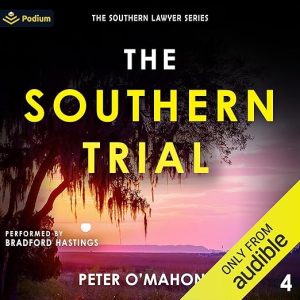
Joe Hennessy has waited twenty years for the name behind his ten-year-old son's murder, and Charleston finally hands him one: Senator Richard Longhouse. The Southern Trial is the fourth audiobook in Peter O'Mahoney's Southern Lawyer series, and it wastes little time getting Hennessy back into the kind of dangerous, evidence-chasing investigation that's defined the series, this time with the added weight of two decades of grief attached to the outcome. At seven hours and fifteen minutes, it's a tighter listen than a lot of legal thrillers, moving briskly between courtroom maneuvering and Hennessy's own dogged digging through corrupt cops and buried evidence.
O'Mahoney leans into Charleston as more than backdrop, and reviewers consistently mention the city's history as one of the series' real pleasures alongside the plotting. Richard Longhouse, described by one reviewer as up to his old tricks, appears to be a recurring antagonist across the series rather than a one-book villain, which gives this installment the satisfaction of a long-simmering grudge finally coming to a head rather than a case built entirely from scratch.
Charleston's specific history, its antebellum architecture, its fraught relationship with its own past, its reputation as both tourist destination and old-money power base, gives O'Mahoney more than scenery to work with. Longhouse's influence in the novel reads as an extension of exactly the kind of entrenched, generational Southern power the city's history makes plausible, and the setting does real thematic work rather than functioning as a postcard backdrop for an otherwise interchangeable legal thriller plot. Reviewers consistently cite this sense of place as a defining feature of the series, distinguishing it from more generically located courtroom dramas that could be set almost anywhere with minimal rewriting.
What Works
Bradford Hastings narrates with a pace that suits legal thriller conventions well, keeping Hennessy's personal stakes distinct from the procedural mechanics of the case without letting either overwhelm the other. The courtroom-adjacent material moves with the clarity a genre like this depends on, and Hastings doesn't over-dramatize Hennessy's grief in a way that would tip the book into melodrama.
Reviewers who've followed the series praise its consistency, including its treatment of family dynamics and legal procedure alongside what one calls a genuine charm and history of Charleston running through every installment. Brenda Hawkins, reviewing this specific book, frames the central question sharply: whether a grieving widow's refusal to accept a payoff will finally bring Longhouse down, or whether he escapes accountability again as he reportedly has before.
The courtroom sequences specifically benefit from O'Mahoney's background writing procedurally grounded thrillers; depositions, evidentiary questions, and the specific mechanics of building a case against a politically protected figure like Longhouse are handled with enough plausible detail to satisfy readers who care about procedural accuracy, without the pacing ever slowing to a crawl the way more research-heavy legal fiction sometimes does. Hastings paces those sequences with the same brisk control he brings to the rest of the book, treating the legal mechanics as one more source of tension rather than an obligatory technical interlude between the more emotionally charged scenes.
O'Mahoney has built the Southern Lawyer series specifically around the tension between formal legal process and the informal, relationship-driven power structures that a small, old Southern city like Charleston can sustain. Hennessy's investigation works because it has to route around those informal channels as much as through the formal court system, and Hastings' narration keeps that distinction clear even during the book's more procedurally dense stretches, differentiating the measured language of courtroom testimony from the rougher, more urgent register of Hennessy's off-the-books digging.
Before You Commit to The Southern Trial
Some listings file this under literary fiction and world literature, tags that undersell what's actually a fairly straightforward genre legal thriller in the Southern courtroom drama tradition associated with writers like John Grisham. Listeners expecting literary prose or an international scope should adjust expectations; this is a plot-forward genre read, and that's exactly where its strengths lie.
As the fourth book in an ongoing series, The Southern Trial assumes at least passing familiarity with Hennessy's history with Longhouse and the broader cast built up over the previous three installments. New listeners can likely follow the central case without confusion, since O'Mahoney recaps enough to orient newcomers, but the emotional payoff of finally confronting a twenty-year-old antagonist lands harder for readers who've been with the series from the start.
Readers of Grisham or David Baldacci looking for a similarly plot-forward legal thriller with lower page counts and faster pacing than either of those authors typically deliver will find The Southern Trial a reasonable fit, though O'Mahoney's prose stays more functional than literary throughout, prioritizing momentum over the kind of stylistic flourish some legal thriller readers specifically seek out.
Who Peter O'Mahoney Is Writing For
Existing Southern Lawyer listeners are the obvious audience, and this installment delivers the payoff a lot of series fans have likely been waiting for. Fans of Southern-set legal thrillers generally, with a preference for brisk pacing over sprawling casts, will also find plenty to like even coming in cold.
Listeners who enjoy series where a single antagonist accumulates history across multiple books, gaining weight with each return rather than being freshly introduced each time, will appreciate how directly this installment leans on Longhouse's established presence. That kind of long-form antagonist payoff is one of the more satisfying structural choices ongoing thriller series can make, and O'Mahoney uses it well here. Listeners who prefer to start series from book one should still go back to the beginning of the Southern Lawyer series rather than jumping in here, since the Longhouse conflict carries real history.
- Narration: Bradford Hastings keeps Hennessy's simmering personal stakes distinct from the courtroom procedure without over-dramatizing either.
- Themes: legal thriller, long-delayed justice, political corruption
- Mood: Tense and steadily paced
- Verdict: A satisfying entry for Southern Lawyer regulars, less essential as a first stop in the series.
Do I need to listen to the earlier Southern Lawyer audiobooks first?
It helps but isn't strictly required. O'Mahoney recaps enough for new listeners to follow the central case, though the emotional payoff of confronting Longhouse lands harder with the earlier books' context.
Who is Bradford Hastings and how does he narrate this audiobook?
Hastings narrates with a brisk, controlled pace suited to legal thriller conventions, keeping Hennessy's personal grief distinct from the procedural courtroom material without overplaying either.