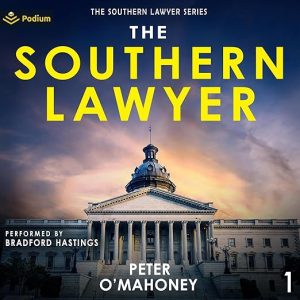
Joe Hennessy walked away from the law more than twenty years ago, after his ten-year-old son was murdered in Charleston, South Carolina, and this audiobook opens with drought forcing him back into the one profession he swore off. The Southern Lawyer is the first book in Peter O'Mahoney's series of the same name, and it hands Hennessy two cases at once: a powerful man accused of possessing stolen artwork, and a young woman charged with stabbing her ex-boyfriend in a violent rage.
Two Cases, One Father's Unhealed Grief
O'Mahoney builds the book around two cases that do not obviously connect at first. Hennessy defends a wealthy, notorious client accused of possessing stolen artwork, a case Kindle Customer's review describes as coming with enough money attached to help save Hennessy's vineyard, his fallback profession since leaving the law. At the same time, he takes on a young woman charged with first-degree murder in the stabbing death of her ex-boyfriend, a case one reviewer notes involves a white defendant and a black victim with a criminal background of his own, and Hennessy comes to believe both clients may be telling the truth despite what the evidence suggests. Kindle Customer's review lays out the setup in more detail: Hennessy has real misgivings about representing a slippery, notorious criminal, but takes the case anyway once the money on offer becomes tied directly to saving the vineyard he depends on for his livelihood. That financial pressure keeps Hennessy's decision from reading as pure heroics; he needs this case as much as his client needs him, and the book seems more interested in that compromised motivation than in painting him as a reluctant white knight.
Running underneath both cases is Hennessy's grief. BSmith's review is explicit about wanting closure for Joe and his colleague Wendy over the death of Luca, presumably the son referenced in the synopsis, and about wishing the characters could find more peace with that loss even while reminiscing about him. That emotional throughline is what pulls this out of pure procedural territory and toward the literary character study its genre tag suggests. The synopsis frames the stolen-artwork case as only the start of Hennessy's problems, hinting that the deeper he digs into the evidence, the more the case widens beyond a simple charge, which gives the book room to build tension without relying purely on courtroom theatrics.
Hastings Narrates While Charleston's Details Do the Work
Bradford Hastings narrates the entire audiobook, carrying both courtroom scenes and Hennessy's private reckoning with his son's death in the same voice, though the performance itself goes unmentioned in the visible reviews, a common gap for a legal thriller where listeners tend to review plot and character over delivery. That leaves the writing itself to carry the tension across 8 and a half hours, and reviewers seem satisfied with how it holds up: BSmith describes staying absorbed and focused despite an attention span that does not always cooperate, crediting the storyline and the relatable, mostly likable characters for the pull.
What several reviewers do comment on is the specificity of place. Babs's review notes that the Southern setting changed things a little, never having lived there personally, and found that difference part of what kept the book interesting rather than a barrier to it. Richard T.'s review calls it a good courtroom drama outright and commits to picking up the next book in the series, a vote of confidence for a series opener that has to do double duty, telling a complete story while setting up more to come. Richard T. singles out the story, the characters, and the writing all by name as reasons to continue, which is a fairly complete endorsement for a debut entry in a new series.
Slow Start, Split Focus Test Some Readers
Not every review here is glowing, and the dissent is worth hearing. One reviewer, rating the book 3 out of 5, calls it fair but not great, describing a slow start and moments that felt not very plausible, while still enjoying the courtroom passages enough to finish the book, just not enough to continue with the rest of the series once the verdict was in. That is a useful counterweight to the more enthusiastic reviews, and it lines up with a common pattern in series openers: strong courtroom material carrying a setup that takes a while to earn its stakes.
Splitting attention between two cases is itself worth flagging before you start. Listeners expecting a single, tightly focused mystery should know this one splits its attention between the stolen-artwork case and the murder case from fairly early on, which some readers may find enriches the book and others may find divides its momentum. Reviewers land on both sides of that question, so it is worth weighing against your own preference for parallel plots before committing. Babs's review adds a related caution: not knowing whether this is meant to launch a series going in, only realizing partway through, which suggests the listing itself could be clearer about what The Southern Lawyer Series actually promises a new listener before they press play.
Grief-Driven Legal Thriller Fans Should Bring Patience
Legal-thriller listeners who want real emotional weight are the clearest audience here, drawn to a protagonist defined as much by a decade of grief as by his courtroom skill, and happy to follow two cases running in parallel rather than a single streamlined plot. At 8 hours and 34 minutes, it is a reasonable single-entry commitment, and the 4.3-star rating from 27 ratings suggests a solid, if not universal, reception for a series opener. Readers of literary fiction who want their plot mechanics grounded in character, Hennessy's guilt, his colleague Wendy's presence, the specific texture of a South Carolina courtroom, will likely get more out of this than readers looking for a pure page-turning procedural with nothing else on its mind.
Patience is the real prerequisite: slow-building setups and courtroom plausibility questioned outright by at least one reviewer may test some listeners here. Everyone else, especially readers drawn to Charleston as a setting and to Hennessy's specific brand of reluctant return to a profession he swore off, should find enough here to make a case for continuing into book two. The vineyard subplot alone gives the series an unusual second setting to draw on going forward, one reviewers have not yet had much reason to discuss in depth but that O'Mahoney has clearly built room for as the series continues.
Frequently Asked Questions
How long is The Southern Lawyer audiobook?
It runs 8 hours and 34 minutes, covering both of Hennessy's cases, the stolen-artwork charge against a wealthy client and the murder charge against a young woman accused of killing her ex-boyfriend. One reviewer calls the pacing slow to start, though the courtroom scenes carry the back half of the book once both cases are fully underway.
Is The Southern Lawyer audiobook the start of a series?
Yes. It is the first book in Peter O'Mahoney's Southern Lawyer series, introducing Joe Hennessy and Charleston, South Carolina, as the setting for future installments. One reviewer confirms committing to the next book after finishing this one, though another reviewer says the opposite, finding the plausibility of this first entry enough to skip the rest of the series.
Does this audiobook focus on one court case or more than one?
Two. Hennessy defends a powerful client accused of possessing stolen artwork while also representing a young woman charged with first-degree murder in her ex-boyfriend's stabbing death. The two cases run in parallel rather than one following the other, which some reviewers found enriched the book and others found split its focus.
What rating does The Southern Lawyer audiobook have?
The listing shows 4.3 stars from 27 ratings, drawn from reviews ranging from a critical 3 out of 5 to a full 5. The mix reflects genuine disagreement among listeners about pacing and plausibility rather than a runaway consensus, so reading a few of the actual reviews is worth the extra few minutes before you commit.