Before You Press Play
- Read by: Graham Winton delivers Dengel's business case with a clear, authoritative register that matches the book's executive-audience pitch; he handles the technical terminology fluently without mechanical stiffness.
- At its heart: voice-first technology as infrastructure shift, human-centered design in enterprise contexts, lessons from the internet and mobile revolutions
- Vibe: Optimistic and energized, with the concrete specificity of someone building in the space rather than predicting from outside it
- Short version: Dengel makes a convincing case that voice interfaces represent a structural shift, not a feature, and his industry examples give the argument real weight.
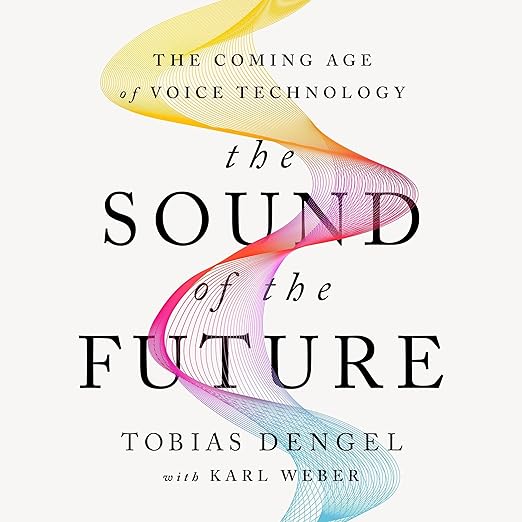
Tobias Dengel's The Sound of the Future opens with a claim that its narrator Graham Winton delivers without flinching: voice technology is the next platform shift, comparable in scope to the internet in the late 1990s and mobile computing a decade later. This audiobook, ten hours and nine minutes of business analysis and industry forecast, is narrated by a technologist who has spent years building voice interfaces for major enterprises. That practitioner perspective is what distinguishes The Sound of the Future from the category of speculative tech books; Dengel is not describing a future from a distance but one he has been constructing from the inside. The 4.9-star rating across 113 reviews reflects an audience that found the book's concrete industry applications more useful than typical technology evangelism.
What Tobias Dengel Delivers
Dengel's most important move is declining to center his argument on Siri and Alexa. He explicitly treats the consumer voice assistants that most listeners are familiar with as early, incomplete versions of what voice technology will become - "tantalizing but incomplete precursors," in his phrasing. This framing does important analytical work: it asks readers to stop judging voice-first design by the limitations of a frustrating smart speaker interaction and start thinking about what the underlying technology could do when applied to logistics, manufacturing, customer service, and sales with purpose-built precision. The enterprise use cases he develops are more convincing than any number of predictions about how people will eventually talk to their refrigerators. Dengel is fundamentally making an infrastructure argument, and infrastructure arguments benefit from specificity, which he provides.
The comparison to previous platform shifts is handled with more nuance than the marketing framing suggests. He does not simply assert that voice will be as big as mobile; he works through the structural parallels - the existence of an enabling technology that is not yet widely deployed, an early-majority audience that has demonstrated appetite, a set of incumbent industries whose processes are inefficient in ways that voice-first design specifically addresses. One reviewer who describes herself as a UX content designer found the insights directly applicable to her practice, and that specificity of professional use is a reliable signal that the book is grounded rather than visionary in the loose sense. Another reviewer stayed engaged through the entire book specifically because the examples did not repeat or become generic, which is a notable achievement for business writing.
What Tobias Dengel Gets Right
Graham Winton brings a focused, executive-register narration that suits Dengel's intended audience. This is a book aimed at business leaders, product strategists, and technologists who need to make platform decisions; Winton reads it with the authority those audiences expect. He does not editorialize or inject enthusiasm that isn't already in the text; he narrates with steady forward motion that matches Dengel's argumentative pace. The ten-hour runtime is substantial for a business audiobook, but the structure is organized to reward sustained listening rather than spot consultation. The audio format works particularly well for the extended case study sections, where Dengel walks through specific deployments with enough detail that the narrative benefit of continuous listening is real.
The book's practical orientation toward business strategy means the audiobook format delivers what its audience actually needs. Dengel is not building a philosophical argument that requires slow, annotated reading; he is building a business case that benefits from being presented as argument, with momentum and sequence intact. Winton's pacing reflects this: he moves through each section with enough energy to maintain the sense of cumulative argument without rushing past the specific examples that ground each claim. For listeners who typically skim business books for key points, this is one that is more valuable listened to than skimmed, because the supporting examples are where the persuasive weight sits.
Where Tobias Dengel Loses Some Ground
The book was published in 2023, which places it before the full explosion of large language model applications that has since reshaped the voice technology landscape. Dengel's argument is about voice as an interface layer, not specifically about LLM-based natural language processing, and many of his structural points remain valid. But listeners in the post-2023 environment may find some of the competitive landscape descriptions require updating against current developments. The core framework is durable; the specific product and company positions have moved. Treat the enterprise case studies as examples of the underlying logic rather than current market analysis.
The book is explicitly aimed at business decision-makers and product leaders rather than general technology enthusiasts. If you come to it expecting a consumer-oriented tour of where voice technology is headed in your daily life, you will find the frame narrower than expected. Dengel's version of "the future" is an enterprise future, and while the broader implications are present, the argument is organized around business deployment and competitive strategy. Listeners who find their interest engaged by the business applications should get significant value from the full ten hours. Those who want a broader societal analysis of voice technology will need to supplement this with other sources.
Who Should Pick Up The Sound of the Future
Product managers, UX designers, technology executives, and business strategists thinking about voice-first interfaces will find this directly applicable. Listeners in the early stages of evaluating voice technology for enterprise deployment will get more concrete orientation here than from any amount of general prediction. Technology generalists who want a practitioner's perspective on why voice interfaces have not yet delivered on their promise will find Dengel's framework clarifying. Listeners without professional interest in enterprise technology strategy are likely to find the focus too narrow; the book does not hide its target audience and does not apologize for addressing it directly.
A Few Questions About The Sound of the Future
Is this audiobook primarily about consumer voice assistants like Alexa and Siri?
No. Dengel explicitly positions consumer voice assistants as early, incomplete versions of the technology. The book focuses on enterprise and business applications, and its most detailed examples are in logistics, customer service, and manufacturing contexts.
Is this audiobook worth the full ten-hour runtime, or is it padded?
Reviewers specifically note that the examples stay concrete and varied rather than becoming repetitive. One reviewer stayed engaged past the first third specifically because of this quality. The runtime reflects the breadth of industry applications covered, not filler.