Quick Take
- Narration: Donald Corren delivers Ruhlman’s reportorial prose cleanly and with genuine appetite for the subject matter, no false dramatics.
- Themes: Mastery and its cost, the art of professional cooking, the tension between technique and creativity
- Mood: Intense and immersive, like watching a competition you didn’t know you cared about
- Verdict: Ruhlman’s three-part structure is unconventional but each section pulls you in differently, and the Thomas Keller portrait alone justifies the runtime.
I remember the exact moment I became invested in Brian Palcyn passing the Certified Master Chef exam. I was somewhere in the middle of a long afternoon of yard work, earbuds in, half-listening, and then suddenly I wasn’t half-listening anymore. I had stopped raking and was just standing there, slightly ridiculous, genuinely tense about a cooking test I’d learned about forty minutes earlier. That’s the Ruhlman effect.
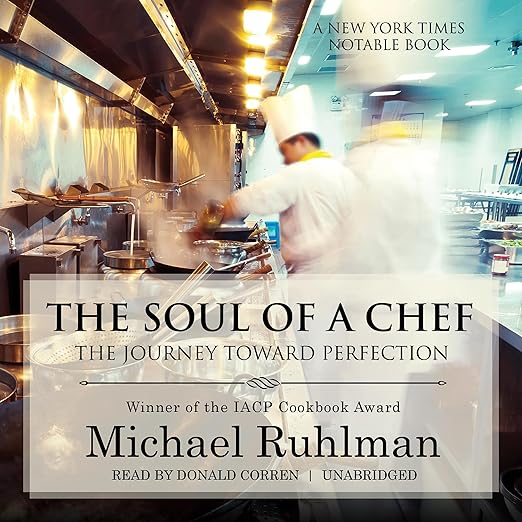
The Soul of a Chef is Michael Ruhlman’s second deep investigation of the professional kitchen, following The Making of a Chef. It’s structured in three distinct sections, the Certified Master Chef exam at the Culinary Institute of America, a portrait of rising star Michael Symon in Cleveland, and an extended study of Thomas Keller at the French Laundry. These aren’t thematically unified in any tidy way, but each section works on its own terms, and together they build toward something like a philosophy of what it means to cook at the highest level.
The Exam That Reads Like a Sports Event
The CMC exam section is the most immediately gripping. Ruhlman embeds himself with a cohort of seven chefs attempting what he describes as the most difficult culinary certification in America, a week of twice-daily tests that evaluate not just taste but technical exactitude at an almost obsessive level. He follows Brian Palcyn particularly closely, and the tension he builds around the exam is genuine narrative craft. One reviewer compared reading it to watching a sports event, and that’s accurate. The stakes feel real, even for listeners who have never given a thought to certified mastery of consomme clarification.
What Ruhlman understands, and what makes this section more than just food writing, is that the exam is actually about identity. What does it mean to a working chef to pursue this credential? What does failure cost, and what does passing actually prove? These questions run beneath the technical detail like a current.
Michael Symon, Thomas Keller, and Two Kinds of Greatness
The Symon section is lighter in tone, warmer, more anecdotal, shaped around the personality of a chef who at the time of writing was building his reputation in Cleveland rather than occupying the summit. It functions as a kind of interlude between the exam’s severity and the Keller portrait’s almost reverential weight.
The Keller section is where Ruhlman’s ambitions are most fully realized. Thomas Keller at the French Laundry is presented not as a celebrity chef but as something stranger and more interesting: a man for whom cooking has become a form of spiritual practice, a near-monastic pursuit of perfection that shapes every aspect of how he lives and works. Ruhlman doesn’t romanticize this uncritically, he’s too good a reporter for that, but he conveys it with a vividness that has stayed with me. One reviewer said they learned more about what drives Keller from this book than from any profile or cookbook, and I’d agree.
Donald Corren and the Sound of a Good Food Writer
Donald Corren’s narration is well-calibrated to Ruhlman’s prose style. Ruhlman writes with a journalist’s clarity and a food lover’s enthusiasm, and Corren reads it with appropriate energy without tipping into performance. The 12-hour runtime feels justified: these are dense, detail-rich sections that benefit from being absorbed slowly rather than skimmed. If you’re the kind of listener who finds yourself pausing to think about what you just heard, this will give you plenty of those moments.
The audio format also suits the kinetic quality of the kitchen sequences. When Ruhlman describes the controlled chaos of French Laundry service, or the anxious precision of an exam prep session, hearing it read aloud adds a forward momentum that the page might not convey as immediately.
There’s a passage in the Keller section where Ruhlman describes the French Laundry’s approach to the simplest preparations, the way a properly made vinaigrette or a correctly seasoned sauce reveals more about a cook’s fundamental skill than any elaborate composed dish. That observation stuck with me because it captures something Ruhlman understands deeply: that mastery at the highest level is mostly invisible. It doesn’t announce itself in complexity; it reveals itself in the quality of attention brought to the apparently simple. That philosophical current runs through all three sections of the book, linking the CMC exam’s obsessive technical standards to Symon’s generosity in the kitchen to Keller’s near-spiritual perfectionism. Ruhlman is writing about different chefs and different cooking cultures, but the underlying question is always the same: what does it mean to give yourself fully to a craft? Few food writers ask it so clearly or answer it so well.
Who This Audiobook Is For
Listeners who enjoyed Anthony Bourdain’s Kitchen Confidential will find this a natural companion, it’s less bawdy and more earnest, but shares that quality of genuine insider access. Anyone who has wondered what separates a very good cook from a truly great one will find Ruhlman’s analysis useful and honest. The three-part structure rewards listeners who can adjust their expectations: this isn’t a single sustained narrative but three long, immersive essays.
Listeners looking for a fast-moving food memoir with celebrity gossip or behind-the-scenes scandal will be disappointed. The tone is serious and the pace is deliberate. And if you’re not interested in the mechanics of professional cooking at the technical level, the way a stock is built, why a sauce breaks, some of the CMC exam sections may test your patience. But if you are interested, or willing to become interested, Ruhlman makes the case compellingly.
Frequently Asked Questions
Do I need to have listened to The Making of a Chef before this one?
No. The Soul of a Chef stands on its own. Ruhlman provides enough context for new listeners, though fans of the first book will enjoy seeing how his thinking about professional kitchens has evolved.
Is the three-part structure, CMC exam, Symon, Keller, confusing to follow on audio?
Not at all. Each section is clearly defined and functions as a self-contained story. The shift from the exam’s tension to the Symon portrait to the Keller study gives the listening experience genuine variety.
How does Donald Corren handle the technical cooking passages?
Very well. He reads the kitchen sequences with pacing and energy that convey the pressure of professional service without melodrama. The technical vocabulary comes across as lived-in rather than foreign.
Is the Thomas Keller section as strong as reviewers say?
Yes. The French Laundry portrait is the emotional and intellectual peak of the audiobook. Ruhlman’s access was exceptional, and Corren’s reading honors the weight of those passages.