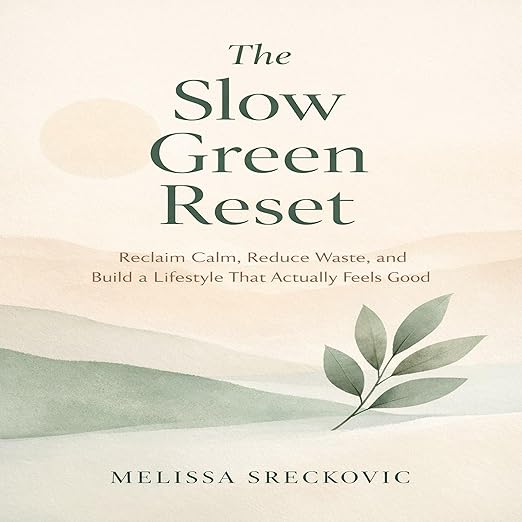
Quick Take
- Narration: Scott LeCote brings a calm, measured tone that matches the book’s anti-urgency philosophy, though at under ninety minutes the listen passes before the narration has much time to establish itself.
- Themes: Sustainable living, anti-perfectionism, mindful consumption
- Mood: Gentle and reassuring, deliberately unhurried
- Verdict: A brief and compassionate reframe of sustainability that will appeal to listeners exhausted by eco-guilt, though its brevity means it functions more as a perspective shift than a practical guide.
I listened to The Slow Green Reset on a Sunday morning when I had exactly the kind of low-grade environmental anxiety the book is designed to address. The guilt of unrecycled packaging, the sense that any individual habit is too small to matter, the creeping exhaustion of trying to live more sustainably in a system that makes it structurally difficult. Melissa Sreckovic’s short audiobook arrived at the right moment for me, and at an hour and twenty-nine minutes, it is almost exactly the length of a slow walk.
The book’s central argument is simple and worth stating plainly: speed, stress, and perfectionism drive overconsumption, and slowing down is itself a form of sustainability practice. Sreckovic is not asking you to commit to a zero-waste lifestyle or completely overhaul your home. She is asking you to stop performing environmentalism under pressure and start making choices from a place of calm and clarity. For a particular kind of listener, one who is already motivated but feels crushed by the weight of what the motivation demands, that reframe is more useful than another prescriptive list.
Our Take on The Slow Green Reset
Sreckovic is working in a genre that has recently crowded up with anti-perfectionist sustainability content, and what distinguishes her approach is the consistent priority she places on self-compassion as a prerequisite for environmental action rather than an indulgence to be earned. She frames sustainable habits not as obligations imposed by a climate crisis but as a natural extension of living more intentionally and more slowly. The book argues, convincingly, that guilt-driven environmentalism burns people out before they can sustain any meaningful change, and that the alternative is small, consistent habits grounded in personal values rather than external pressure or trend cycles.
Why Listen to The Slow Green Reset
Scott LeCote narrates with a stillness that suits the material. The slow cadence is not passivity; it mirrors the book’s argument that unhurried attention produces better results than anxious effort. For a short audiobook, narration pacing matters more than it would in a longer work because there is no time to acclimate. LeCote gets the tone right from the beginning. The lack of user reviews at time of publication means the community response is still forming, but the 4.9 rating across 66 listeners is a strong early signal that the content is reaching its intended audience rather than generating disappointed responses from the wrong one.
What Sreckovic avoids, which deserves acknowledgment, is the trap of replacing one form of pressure with another. Many anti-perfectionist sustainability books end up substituting the tyranny of zero-waste checklists with the tyranny of constant self-reflection. Sreckovic is clear that the point of the reset is to reduce cognitive load rather than redirect it, and the book holds to that intention fairly consistently through its short runtime.
What to Watch For in The Slow Green Reset
The brevity is the book’s primary limitation. At under ninety minutes, Sreckovic can establish a philosophy and introduce several practical areas, including reducing waste, rethinking consumption, and building lasting habits, but she cannot develop any of them with significant depth. Listeners looking for specific how-to guidance on composting, low-waste shopping practices, or home energy reduction will need to supplement with more detailed resources. This is a mindset book rather than a manual, and it works best when that distinction is understood going in. The conceptual framing is strong; the practical instruction is light.
Who Should Listen to The Slow Green Reset
The ideal listener is someone who is already motivated to live more sustainably but finds the current discourse around environmentalism exhausting or shame-inducing. It also works as an introductory listen for people who want to explore sustainable living without being confronted by extreme demands from the outset. The ninety-minute runtime makes it genuinely low-commitment, which lowers the cost of finding out whether it resonates. Skip it if you are looking for specific, actionable green living strategies with step-by-step implementation, or if you already have a well-developed and guilt-free sustainability practice. As a reframe and permission structure, it delivers; as a how-to guide, it does not.
Frequently Asked Questions
Is The Slow Green Reset a practical how-to guide or more of a philosophical reframe?
It is primarily a philosophical reframe. Sreckovic covers general areas like reducing waste and rethinking consumption but does not provide step-by-step instructions for specific practices. Think of it as a mindset shift rather than a sustainability manual.
At only 89 minutes, is this audiobook long enough to be substantive?
It covers its central argument fully within the runtime, but the brevity means depth in any single area is limited. It functions well as an orientation or reset, particularly for listeners experiencing eco-burnout, but pairs best with more detailed resources on specific sustainable practices.
How does Scott LeCote’s narration style fit the content?
LeCote’s calm, measured delivery matches the book’s anti-urgency philosophy. The pacing is deliberate without feeling slow, which reinforces Sreckovic’s argument that unhurried attention leads to better choices than anxious effort.
Does the book address any specific sustainable living practices, or is it entirely conceptual?
Sreckovic touches on areas including waste reduction, consumption habits, and creating a lighter home environment, but the treatment is general rather than instructional. The specific practices are framed as examples of the broader philosophy rather than as a checklist.