Quick Take
- Narration: Kirby Heyborne brings his characteristic warmth and range to Jason’s first-person narration, his ability to voice a frightened twelve-year-old without condescension is what makes the book’s emotional honesty land.
- Themes: Undocumented immigration and family separation, identity and belonging in America, unexpected friendship as survival
- Mood: Urgent and emotionally raw, with moments of unexpected gentleness
- Verdict: A tightly constructed middle-grade novel about immigration fear that trusts young listeners with real complexity, Heyborne’s narration is essential to why it works.
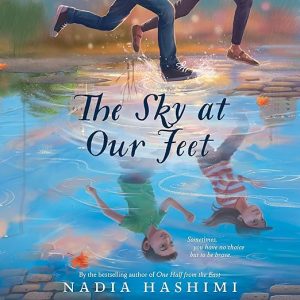
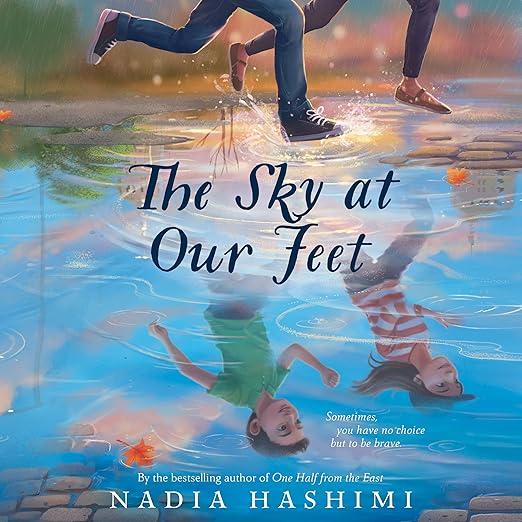
I listened to The Sky at Our Feet during a period when immigration detention was front-page news, which made the experience more visceral than it might otherwise have been. Nadia Hashimi is a physician and bestselling adult novelist who has turned her attention to middle-grade fiction, and the transition is not a simplification. The Sky at Our Feet asks young listeners to sit with fear, uncertainty, and injustice without offering easy resolution, and Kirby Heyborne’s narration holds the space for that discomfort with enough warmth that it does not become overwhelming.
Jason is twelve years old, American-born, and the son of an Afghan mother who has been living undocumented in the United States since his father was killed in Afghanistan. When Jason sees his mother being escorted from her workplace by two officers, he panics and boards a train to New York City to find his aunt. He has never been to New York. He does not know the city. And almost immediately, he is in the hospital after an accident, which is where he meets Max, a fiercely independent girl who becomes his unexpected partner in planning a hospital escape and navigating the city.
The City as a Testing Ground
Hashimi uses New York City with genuine craft. Penn Station and the surrounding streets are not backdrop, they are obstacles, confusions, and occasionally revelations. Jason’s bewilderment at the scale of the city maps onto his larger bewilderment at the situation he finds himself in: too large, too loud, and full of people who have no idea what he is carrying. The skyscraper jungle the synopsis refers to is not just a metaphor; it is experienced as a child alone would experience it, with both awe and terror.
What Hashimi manages, and what is genuinely difficult to do in fiction for young readers, is to keep the immigration stakes from becoming didactic. Jason is not a symbol of undocumented immigration; he is a boy who loves his mother and is terrified of losing her. The systemic context is present throughout, but it operates as the atmosphere in which a very specific story takes place rather than as the story’s primary point. A reviewer who has read Hashimi’s other adult novels called this one different in that the entire story takes place in America while still including the Afghan background, that observation identifies the book’s structural elegance.
Kirby Heyborne’s First-Person Afghan-American Boy
Heyborne is one of the most versatile narrators in middle-grade audio, and The Sky at Our Feet is a strong showcase for what that means in practice. Jason’s narration is first-person and immediate, we are inside his fear as it happens, not looking back on it from safety. Heyborne maintains the quality of a twelve-year-old’s thought process without ever sounding childish: the observations are specific, the emotional responses are unguarded, and the moments of connection with Max feel genuine rather than performed. His reading of the scenes where Jason processes his mother’s possible deportation, the shock, the denial, the desperate planning, are the audiobook’s strongest moments.
Heyborne also handles Max well. She is a distinct voice from Jason, wry and impatient where he is cautious and frightened, and the contrast between their personalities is the engine of the book’s second half. Narrators who handle a single first-person voice confidently often lose something when secondary characters need to feel equally real; Heyborne does not lose that ground here.
The Comparison to Inside Out and Back Again
The publisher’s comparison to Thanhha Lai’s Inside Out and Back Again and Erin Entrada Kelly’s Counting by 7s is accurate in terms of emotional register and intended audience, though Hashimi’s novel is more plot-driven than either of those comparators. All three deal with children navigating American identity from an immigrant or outsider position, but where Lai and Kelly are interior and lyrical, Hashimi is propulsive. The Sky at Our Feet moves. The 6-hour-and-51-minute runtime does not drag.
Who Should Listen / Who Should Skip
For children ages nine through thirteen. The immigration anxiety at the story’s center is real and the book does not resolve it with a false comfort ending, listeners who need narrative safety may find the stakes too high. For young readers who want their fiction to engage with contemporary America honestly, this is exactly the right book. Adults who work with children from immigrant families, or who want to open conversations about immigration with their own children, will find this a more useful and honest starting point than many explicitly issue-driven books. Heyborne’s narration makes the listening experience actively involving rather than merely informative.
Frequently Asked Questions
Is The Sky at Our Feet appropriate for a nine-year-old, given the immigration and family separation themes?
It is on the younger edge of appropriate, and co-listening with a parent is recommended for nine-year-olds. The fear of parental deportation and the child navigating a city alone are genuinely stressful scenarios. By ten and eleven, most readers can handle the emotional content independently, though the themes will still prompt conversation.
Does the book have a resolution, or does it leave the immigration situation unresolved?
Without providing spoilers: the book does not offer a politically convenient ending, but it does provide emotional resolution. Hashimi understood that an unrealistically happy ending would undermine the story’s honesty. The conclusion is hopeful but honest about the ongoing uncertainty that Jason’s family faces.
How does Kirby Heyborne handle Jason’s Afghan-American identity in the narration?
Heyborne voices Jason as an American boy who carries his Afghan heritage as part of his identity rather than an exotic attribute. The narration does not exoticize Jason’s background or his mother’s. When Afghan culture and context enter the story, Heyborne treats them as matter-of-fact elements of Jason’s life rather than special explanatory moments.
Is this book part of a series by Nadia Hashimi, or is it a standalone?
The Sky at Our Feet is a standalone middle-grade novel. Hashimi has written other adult novels set in Afghanistan and Afghan diaspora communities, but this is a separate work with its own complete story.