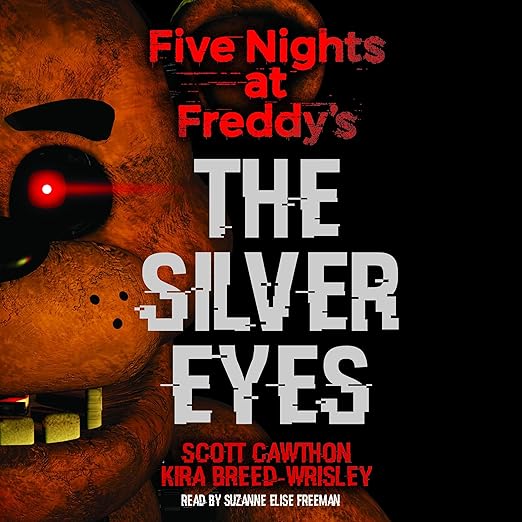
Charlie, returning to her hometown ten years after the murders at Freddy Fazbear's Pizza, is a character carrying something most horror protagonists are spared: specific, childhood-shaped grief. That particularity is what makes The Silver Eyes work as an audiobook rather than just a video game tie-in, and it is what Suzanne Elise Freeman captures so precisely in her performance of Scott Cawthon's source material. The prose version of Five Nights at Freddy's is not the game's lore transcribed into chapters. It is a story about what it costs to go back.
Freeman's narration leans into the YA horror register without overselling the scares. She lets the animatronics build slowly, allows the atmosphere of the sealed and hidden pizza restaurant to settle before it becomes threatening, and grounds the horror in the specific vulnerability of teenagers who thought they had put childhood behind them. The performance suits the material's pacing, which is deliberate in the first half and considerably more urgent in the second.
A Closer Look at The Silver Eyes
Cawthon, working with Kira Breed-Wrisley, constructs the novel with an understanding that the FNAF game's horror operates almost entirely through implication and environment. The animatronic animals, the dark corridors, the sense that something is watching from the stage: all of that translates to prose because the source material was always more atmospheric than action-driven. The Silver Eyes commits to building Freddy Fazbear's as a genuinely sinister place while keeping Charlie's emotional reality at the center. Her father built these machines, and the question of what he knew, or did not know, or could not prevent, haunts the book throughout and gives it weight the game format cannot supply.
Reviewer K Orion Fray noted that the novelization has 'better lore than the next six games put together,' which is perhaps slightly hyperbolic but reflects something real: the novel has room to develop character relationships and backstory that the game's format does not allow. Charlie's friendships, the collective memory of the group returning to their hometown, the weight of the anniversary: these are novelistic concerns, and the book handles them with more care than the horror genre typically demands.
Freeman's audiobook performance is particularly effective at holding the tonal shifts the novel requires. The early sections are almost elegiac: a group of friends reconnecting, revisiting places that were once safe, processing a shared childhood trauma. Freeman keeps that register warm and human even as the evidence accumulates that the pizza restaurant has not been the sealed-off relic everyone assumed. When the horror accelerates, she does not abandon the character work that preceded it, and the result is that the fear lands harder because the people at risk feel real.
Reviewer Adelaide Metzger pointed to Cawthon's skill in 'showing a story through a video game and through a novel' as distinct challenges met with different strengths. That observation is perceptive. The novel does not attempt to reproduce the first-person surveillance tension of the game. Instead it uses the freedom of third-person fiction to show what the game never could: what happened before the player arrived, and what the place means to the people whose lives were shaped by it.
Things to Know Before Starting The Silver Eyes
Listeners who come to this audiobook without familiarity with the FNAF game series will find it a self-contained story, though the mythology deepens considerably with game knowledge. The pacing in the first half is genuinely slow by horror standards: the atmosphere is built carefully, but impatient listeners may find the first several hours more coming-of-age than horror. Freeman handles the transition when the animatronic threat materializes, but the setup is long. For fans already invested in the FNAF universe, that deliberateness is part of the pleasure.
The novel's resolution also gestures toward sequel material, so listeners should understand they are beginning a trilogy rather than receiving a fully self-contained narrative conclusion. The Silver Eyes establishes the world and the central threat; the full arc plays out across three books. Freeman's narration gives you reason to continue, but you should arrive knowing the complete story is larger than this first volume.
Freeman's handling of the book's most unsettling passages is also worth specific attention. The animatronic animals that Charlie and her friends encounter in the sealed restaurant are not described with graphic horror; they are described as familiar things gone wrong, which is considerably more effective. Freeman lets that wrongness accumulate in her delivery rather than signaling it with dramatic vocal shifts, and the result is that the threat feels genuinely inhuman in a way that outright menace would not. That restraint is a craft choice, and it reflects well on both Freeman's performance and the material she is working from.
Who Scott Cawthon Is Writing For
FNAF fans who have wanted the lore expanded and developed through prose fiction will find this audiobook exactly what they hoped for. YA horror listeners who enjoy atmosphere-forward stories with genuine character investment will also find it rewarding. Casual horror listeners who need a more immediate pace and less setup may want to sample before committing to ten hours. Freeman's narration is a real asset regardless of entry point: she treats the material seriously, and the audiobook is better for it throughout.
Do you need to know the Five Nights at Freddy's games to follow this audiobook?
No. The Silver Eyes is a standalone story that introduces the world, characters, and animatronic mythology from scratch. Game knowledge adds depth but is not required to follow the plot.
How does Suzanne Elise Freeman handle the horror elements in the audiobook?
Freeman builds the threat slowly and deliberately rather than relying on dramatic vocal effects. The result is atmospheric rather than jump-scare driven, which suits the novel's pacing and makes the horror feel more grounded when it arrives.
Does the audiobook resolve the story completely, or does it end on a cliffhanger?
The main narrative of The Silver Eyes concludes, but the book is the first of a trilogy and gestures toward events in the subsequent volumes. Listeners should know they are beginning a larger story.