In Brief
- Voice: Andy Serkis reads the full unabridged text across nineteen hours and twenty-four minutes.
- Big ideas: creation mythology, Middle-earth history, the fall of Numenor
- Atmosphere: Dense and mythic
- Worth it?: An essential unabridged listen for established Tolkien readers, though half its visible reviews are actually about print editions, not the audio.
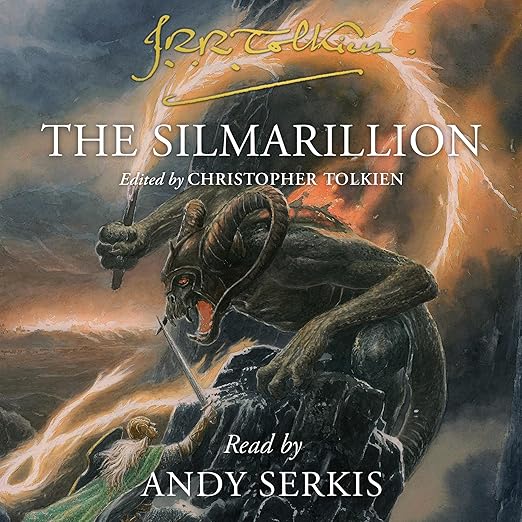
The Silmarillion was never built for narration in the conventional sense: it is closer to a written mythology, chronicles and genealogies spanning multiple ages of Middle-earth, than a novel with a single throughline, and turning nineteen and a half hours of that material into a listenable audiobook is its own kind of craft problem, closer to narrating an encyclopedia of a world than performing a single story with a beginning, middle and end. HarperCollins released this specific recording as a brand-new unabridged edition in June 2023, with the synopsis crediting the reading to Andy Serkis, described there as an acclaimed actor, director and author.
First, the Big Picture
The synopsis frames the book plainly as the forerunner to The Lord of the Rings, covering the earlier history of Middle-earth in detail and introducing characters who reappear later on, Galadriel, Elrond, Elendil and Sauron among them, while centering on Morgoth, the first Dark Lord, and the war the High Elves waged against him for the Silmarils, jewels holding the pure light of Valinor. The recording also includes several shorter works: the Ainulindale, a creation myth; the Valaquenta, describing the nature and powers of the gods; the Akallabeth, covering the fall of the island kingdom of Numenor; and a section on the Rings of Power at the close of the Third Age, covering ground that the synopsis notes gets narrated more fully within The Lord of the Rings itself. That is a lot of distinct material to hold together in one continuous listen, structured more like a mythology compiled from multiple sources than a single narrative. The page shows a 4.8 average across twenty-four ratings, among the highest in this set, and five written reviews sit underneath it, a figure worth noting here without drawing conclusions from it, since a wide split between glowing and lukewarm responses can sit behind the same average as a tightly clustered one.
The Best Parts of The Silmarillion
One reviewer describes the book as deepening their understanding of the world and characters encountered in The Lord of the Rings, tracing the account from the creation of the world by Iluvatar and the Children of Iluvatar through the beginning of elves, men and dwarves, and specifically praises how it expands on the brief mentions the Silmarils get in the earlier trilogy, calling the added context essential rather than optional background reading. A second reviewer, writing from the Netherlands, keeps it short and simply calls the book excellent and reports being extremely happy with it overall. The synopsis itself frames this specific recording as a brand-new unabridged edition, which matters for Tolkien readers who have encountered abridged or excerpted versions of this material before; nothing here is trimmed down. Andy Serkis, credited in the synopsis as an acclaimed actor, director and author, reads the full text, putting someone with directing and writing credits behind a book that functions as much as a reference work and mythology as a story.
A Few Reservations
Three of the five write-ups here never engage with the audio recording at all. One is explicitly framed as a review of physical editions, comparing a 1998 print edition featuring illustrations by Ted Nasmith against a newer Harper Collins edition, discussing cover art and used pricing in the twenty to thirty dollar range. Another describes a copy arriving damaged, having to bend the physical book back to read words printed close to the spine, and still judges it a tidy, worthwhile book despite that rough start. A third, written in Spanish, praises Harper Collins editions specifically for their beautiful cover art and satisfying physical dimensions, explicitly framed around hardcover editions worth the extra effort to acquire. None of the three engages with Serkis's reading, the nineteen-and-a-half-hour runtime, or anything specific to the audio format at all, down to which chapters landed well or dragged, which leaves only two of the five reviews, Hailey's and Kayleigh's, actually responding to this as a listening experience rather than as a physical object on a shelf. Anyone weighing this purchase heavily on the five-review count should know that count effectively shrinks by more than half once you separate out the reviews actually about the audiobook rather than about the paper it once came printed on.
Who Should Listen to The Silmarillion
Established Tolkien readers who want the deeper mythology behind The Lord of the Rings are the clearest audience, particularly listeners curious about Galadriel, Elrond and Sauron before their later, more familiar appearances, and anyone who wants an unabridged pass through material often encountered only in excerpts. It also suits listeners specifically interested in hearing Serkis read Tolkien, given Serkis's own standing as an actor and director in film adaptations of this same world, and listeners who specifically want the full, uncut version of material other editions have sometimes trimmed down. This is not the place to start with Tolkien, either; the dense genealogies, multiple ages and mythological framing assume at least some prior familiarity with Middle-earth, ideally through The Lord of the Rings itself first, since names like Elendil and Numenor land with far more weight, and carry more forward momentum, once you already know what they eventually lead to in the later story. Skip the print-focused reviews entirely when judging the audio specifically, since three of the five currently on the page are evaluating hardcover editions and cover art, illustration quality and shipping condition, rather than anything Serkis actually reads aloud.