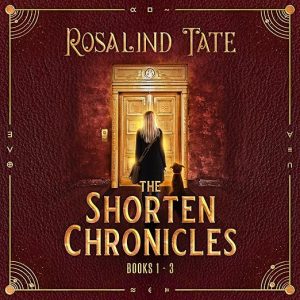
I have a fondness for time-travel stories that treat the mechanics of displacement seriously, the social rules you cannot break, the technology you cannot explain, the impossible gap between what you know and what people around you are allowed to know. The Shorten Chronicles does not go deep into paradox theory, but it does something I find harder to pull off: it grounds a fantastical premise in the texture of a specific historical moment and makes that texture feel genuinely constraining.
I listened to Books 1 through 3 over the course of a long weekend, picking up the second book the same evening I finished the first, which tells you something about the pacing. The story begins simply enough: Sophie Arundel steps into what she thinks is an ordinary lift and ends up in a grand English manor house in 1925, dog in tow, with fellow student Hugo for company.
What Rosalind Tate Delivers
What distinguishes the setup here is not the time travel itself but the social specificity of where Sophie lands. Upper-class England in 1925 is not a neutral backdrop. It comes with rules about who speaks first, who pours tea, who may and may not be alone with whom, and Sophie's ignorance of all of it is not played purely for comedy, though there is comedy. It is also a source of genuine danger as she navigates courting suitors she has no interest in while trying to locate the hidden portal that will take her home. The complication of history unfolding differently, with mobs ruling the streets and revolution threatening anyone inside a grand house, raises the stakes beyond the romantic. Reviews from readers who devoured all three books in sequence confirm what the structure suggests: Rosalind Tate has built a series where each book ends with enough forward momentum that stopping feels like a deliberate act of self-discipline.
Hugo's evolution from annoying and privileged to genuinely necessary is handled with more nuance than the synopsis suggests. He is not simply the love interest who transforms under Sophie's influence. He has his own ignorances and his own investments in the world they are navigating, and watching those collide with Sophie's twenty-first-century assumptions is where the better scenes happen.
What Rosalind Tate Gets Right
Katy Sobey's narration is the right choice for this material. She plays Sophie's frustration and affection in close proximity without blurring them, which matters in a story where the character is simultaneously trying to escape and, increasingly, finding reasons to stay. The 1920s register, the faint formality that Sophie cannot quite match, comes through in Sobey's handling of dialogue, and it makes the historical setting feel inhabited rather than costumed. Thirty hours is a real investment, but the pacing across all three books holds well enough that the length does not become a tax.
Where Rosalind Tate Loses Some Ground
The boxset format means you are committing to the full arc upfront. The first book leans most heavily on the fish-out-of-water setup, and some listeners may find the early chapters slow before the revolutionary threat sharpens the narrative. The romantic subplot follows familiar patterns for the genre, and readers who have spent time with Cassandra Clare or Deborah Harkness, both cited as comparable, will recognize the beats. The series is also clean in content, which the fanbase appears to value and which is worth knowing if you are recommending it to younger listeners.
Who Should Pick Up The Shorten Chronicles: Books 1-3
This series suits readers who want their time travel wrapped in social tension rather than scientific logistics, and who do not mind a slow build in the early hours. If you enjoy period settings with actual period friction rather than just aesthetics, and if you are willing to commit to a 30-plus hour boxset with a satisfying payoff, this is a reliable choice. Skip it if you need a grittier or more morally complex heroine, or if clean romance leaves you cold.
Can I listen to The Shorten Chronicles boxset without having read other books in the series?
Yes. Books 1 through 3 make up a complete arc. The boxset is labeled as Shorten Chronicles Boxsets Book 1, meaning it is the first boxset in the series, but all three novels included here form a self-contained story from Sophie's initial displacement through her resolution.
How does the 1925 England setting affect the story compared to a more generic fantasy time-travel plot?
The period is load-bearing rather than decorative. Sophie's unfamiliarity with upper-class Edwardian social rules creates genuine tension and occasional danger, not just comic misunderstanding. The alternate-history twist, mobs and revolution threatening the manor-dwelling class, adds political stakes to what might otherwise be a purely romantic adventure.
Is the romance between Sophie and Hugo a central focus or a secondary element?
It is central but not exclusive. The romance develops slowly across all three books and competes with the urgency of finding the portal and surviving the historical chaos around them. One reader notes that the series keeps you guessing about who is good and who is bad in ways that complicate simple romantic expectations.
Does Katy Sobey's narration handle both the modern and 1920s registers of speech convincingly?
Based on reviewer feedback, yes. The performance is described as phenomenal in at least one listener review, and the contrast between Sophie's twenty-first-century cadence and the period formality of the manor's residents comes through as a deliberate tonal distinction rather than inconsistency.