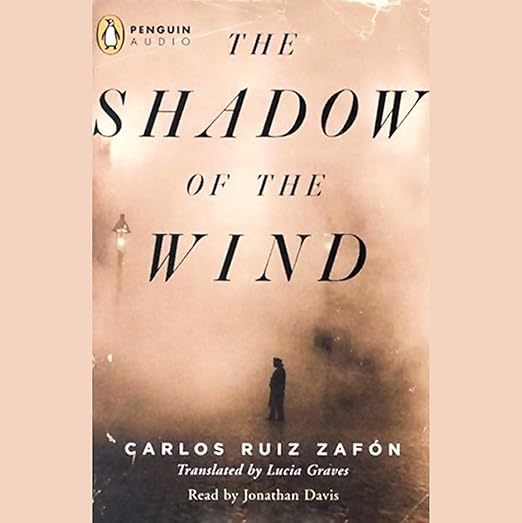
Daniel Sempere is ten years old when his father takes him to the Cemetery of Forgotten Books for the first time, and the novel he chooses from among the thousands archived there will reorder his life. The audiobook of Carlos Ruiz Zafon's The Shadow of the Wind, narrated by Jonathan Davis across eighteen hours, is built around this central metaphor: that a book can be as catastrophically important as a person, that the act of reading can be as irreversible as falling in love, and that Barcelona in 1945, still healing from the Spanish Civil War, still populated by secrets too heavy to carry and too dangerous to put down, is the perfect city in which to learn this lesson. I started this one on a gray afternoon with no intention of listening for more than an hour. I surfaced four hours later, genuinely surprised by how far I had traveled without moving.
Daniel's discovery of Julian Carax's novel sets him on a quest that will consume years of his adolescence and early adulthood. Someone has been systematically destroying every copy of every book Carax ever wrote. Daniel may have the last one in existence. Who Carax was, why someone wants his work erased from history, and what that erasure has to do with Barcelona's darkest decades, these are the questions that draw Daniel deeper into a story of murder, obsession, doomed love, and the kind of grief that does not announce itself but gradually reorganizes everything around it. The plot is elaborate and the atmosphere is dense, but Zafon holds both together with the discipline of a writer who genuinely loves the story he is telling, and it shows in every chapter.
What Works
Jonathan Davis is a narrator with the range and patience that Zafon's novel requires. The Shadow of the Wind is not a thriller that moves by momentum, it is a literary mystery that moves by accumulation, building atmosphere and character across a long runtime before the plot's full architecture reveals itself. Davis manages the tonal shifts across eighteen hours with consistency: the comedic presence of Fermin Romero de Torres, the gothic dread of the antagonist figure hunting Carax's books, the tenderness of Daniel's early romantic life, and the weight of the historical material all receive the differentiated performance they need without ever feeling like demonstrations of range for its own sake.
The embedded narrative sequences are particularly well handled. Zafon includes multiple first-person accounts within the overarching story, characters who tell Daniel what happened to Carax directly, in long confessional sequences that function almost as novellas within the novel, and Davis maintains the distinction between narrators without losing the sense that all these voices are converging on the same central tragedy. One reviewer noted that when all the qualities of a novel come together, language, setting, characters, narration, plot, you lose your heart to it. The audiobook format amplifies exactly those qualities, and Davis seems to understand that his job is to stay out of Zafon's way while making every word land.
Things to Know Before Starting The Shadow of the Wind
The eighteen-hour runtime reflects the novel's actual scope and should not be treated as a deterrent. This is not a book that can be summarized or rushed. Listeners who approach it as a fast-paced thriller will find the pacing frustrating; listeners who approach it as a literary experience that rewards slow accumulation will find it among the most satisfying audiobooks in the genre. The Barcelona atmosphere, the labyrinthine plot structure, and Zafon's prose style all work best at the tempo Davis sets, which is deliberate and rich without being indulgent.
The Cemetery of Forgotten Books itself, the library where lost, forgotten, and outlawed books are archived, is both setting and symbol, and Zafon deploys it with care throughout the novel's arc. The book's affection for reading as an act of survival, of memory, of resistance against erasure, is not incidental to the plot. It is the plot's emotional core. Listeners who share that affection will find the book speaking directly to something they recognize. Listeners who want a leaner, faster mystery should look elsewhere, this is a full immersion experience, not a quick investigation.
A note on the audiobook as the specific format for this novel: Zafon's prose is often described as cinematic, but the more accurate comparison is operatic. The narrative builds in layers and each layer has its own emotional register, from the comedy of Fermin Romero de Torres to the gothic darkness of the character pursuing Carax's books, from the tenderness of Daniel's early romances to the historical weight of post-war Barcelona. Jonathan Davis holds all those registers in relationship to each other across eighteen hours in a way that gives the novel's structure genuine shape rather than treating each emotional key as a separate exercise. The audiobook reveals the architecture of the novel in a way that silent reading sometimes obscures.
Who It's For
This audiobook is built for readers who love literary historical fiction with a mystery spine, where the prose quality, the atmosphere, and the characters are at least as important as the solution to the central puzzle. Entertainment Weekly named it an Editor's Choice and described it as a love letter to literature intended for readers as passionate about storytelling as its young hero. That description is accurate and is the best single guide to whether this is the right audiobook for you.
Listeners who want a fast, plot-forward thriller with minimal atmospheric investment should look elsewhere. The Shadow of the Wind operates at a specific temperature, slow, gorgeous, heavy with implication, and Jonathan Davis's narration honors that temperature across every one of its eighteen hours. If you have ever lost yourself in a book and wanted to read about someone else having the same experience in a city that holds all its books and all its secrets in equal measure, this is where to go.
Frequently Asked Questions
Is The Shadow of the Wind audiobook a good choice for someone new to literary historical fiction?
Yes, and it may be one of the best entry points available. The mystery spine gives the literary atmosphere a plot to anchor it, and Zafon's prose is dense but not inaccessible. Jonathan Davis's narration paces the material in a way that brings new readers into the Barcelona world without requiring prior familiarity with the historical period or the genre.
How does Jonathan Davis handle the multiple narrators embedded within this audiobook?
Skillfully. The novel contains several extended first-person confessional sequences, characters telling Daniel what happened to Carax directly, and Davis differentiates these narrators vocally while maintaining the sense that all the voices are converging on the same central tragedy. The shifts are clear without being distracting.