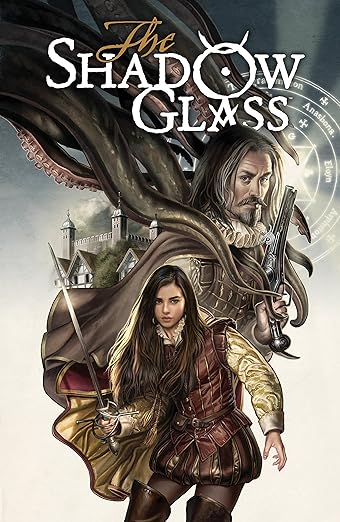
Dark Horse Books is the publisher printed on this listing, and once you notice that, the rest of the page starts to explain itself. The Shadow Glass carries a page count of 200, a thirteen-digit ISBN, a hardcover-shaped price and a series field that simply repeats the title with no number attached. Then it carries a stated duration of thirteen hours and thirty-seven minutes and a narrator credit for Emily Woo Zeller. One of those two sets of facts describes a printed graphic novel and the other describes an audiobook, and a buyer deserves to know which one arrives before paying.
The written responses settle the question of what the reviewers received. All five of them grade an object made of paper. The most enthusiastic is a single line about the artist, saying each page just sings. A two-star grants the artwork and refuses the story. A four-star from March 2026 spends its first half on the condition of a parcel's damaged edges before getting to the book at all. Nobody in that column has heard anything.
What We Made of It
The story underneath the packaging is a good hook, and it is compressed to the point of severity in the description. Rose, a student to the greatest occultist in England, discovers that the man who raised her is not her father, ignores his warnings about the secrets of her own past, and goes to her childhood teacher Dr. John Dee, the queen's occult advisor, for answers. That is a court occult thriller in three sentences, with a protagonist whose entire motivation is a question about her own origins.
Chupeco's premise is the kind of dark historical fantasy that ought to reward a full-length reading, and the premise here has the ingredients: a court, a magician with official standing, a devil's bargain in the family, and a young woman who cannot be talked out of finding out. Whether the execution matches is where the column splits. The two-star from April 2017 gave it two chapters, kept going in hope of a rescue at the end, and reports that no rescue arrived, calling the story boring, flat and predictable. A four-star from the same month, three weeks earlier, calls the story great and the artwork gorgeous in the same breath.
That disagreement is worth reading closely, because both responses are grading a script drawn by somebody else. In a graphic novel, pacing lives in panel layout, and a story that feels flat on the page can be a scripting problem, an art-direction problem, or a compression problem. None of those diagnoses transfer cleanly to a reading, which is a strong argument for treating this column as evidence about a comic rather than as evidence about a recording.
Why Listen to The Shadow Glass
If a genuine full-length audio edition of this story exists at the runtime stated, it solves a real problem. The four-star from March 2026 explains what that problem is: this began as a comic serialization that stopped after the first three of a planned six issues, leaving readers who followed it in that form without an ending, and unwilling to switch to a digital edition to get one. A complete narrative version, in any format, is what that reader was hunting for.
Sound suits this material better than it suits most fantasy of its type. Occult court intrigue is dialogue-driven, the cast is small, and the central relationship is a teacher and a student talking, which is a structure that survives translation to audio without losing its shape. Thirteen and a half hours would give the world the room the compressed description implies it needs, and Chupeco's period register is the kind of thing a skilled reader can lift.
What Might Not Land
Verify the format before you buy. Along with the page count and the ISBN, this record carries stray invisible formatting marks ahead of the publisher, language and ISBN values, which is the signature of a print catalog row copied into an audio slot. The duration is even written in a different style from the rest of this catalog, abbreviated rather than spelled out. A 200-page illustrated book that takes thirteen hours and thirty-seven minutes to read aloud would be a remarkable ratio, and that mismatch is the single loudest signal on the page.
Then look at what is missing. The most enthusiastic write-up on this listing is entirely about Aly Fell's artwork, and Aly Fell appears in no credit field anywhere. On a graphic novel, the artist is a co-author. A record that names the writer and a narrator while omitting the person whose pages one reviewer says sing is not describing the work accurately in either format.
Finally, weigh the 4.2 for what it is. Twenty-seven grades sit behind it, five of them explained, and those five range from a wordless five-star saying only thanks to a two-star warning buyers off the purchase outright. That is a genuinely split reception, and the split is about the writing, not about a performance. Anyone buying on the strength of the average should know it was earned in a different medium.
Should You Listen to The Shadow Glass?
Chupeco's existing readers are the natural audience, along with listeners who want court occult fantasy with a teenage protagonist at the center rather than at the edges. Anyone who followed the original three issues and never got an ending has the strongest claim of all, and this is the version that finishes the story.
Everyone else should hold off until the format question is settled by the seller rather than by guesswork. Taken as a graphic novel, this is a well-drawn, unevenly received historical fantasy whose art carries a share of the appeal that no recording can reproduce; taken as a thirteen-hour audiobook, it is a claim the page does not fully support.
Quick Take
- Narration: Emily Woo Zeller holds the only audio credit on a listing whose every other field, and every review, describes a printed graphic novel.
- Themes: Court occultism and a queen's advisor, a disputed parentage, a student's dangerous curiosity
- Mood: Dark, courtly, compressed
- Verdict: A sharp premise on a record whose format is unresolved, so confirm what actually ships before buying.