Quick Take
- Narration: Amara Charles narrates her own work, and her voice carries the ceremonial register of the material without tipping into performance. She sounds like someone initiating rather than instructing, which is a different kind of authority and one that works here.
- Themes: Sexual energy as spiritual practice, anatomical diversity as sacred, Mesoamerican-influenced sexuality and healing
- Mood: Reverent, intimate, and slightly otherworldly, this is the listening equivalent of a late-night workshop rather than a classroom
- Verdict: Unusual and demanding, this eleven-hour exploration of Quodoushka teachings is not for everyone, but for listeners drawn to the intersection of sexuality, spirituality, and indigenous-informed practice, it offers something most audio guides in this space don’t attempt.
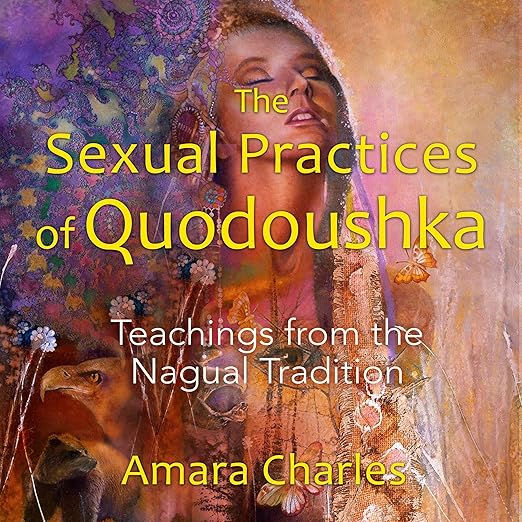
There are books that are hard to place, and this is one of them. Amara Charles opens The Sexual Practices of Quodoushka by explaining that these teachings come from the Twisted Hair Nagual Elders of the Sweet Medicine Sundance Path, passed down through Mayan, Olmec, and Toltec lineages, and that she is an initiated instructor sharing what was once considered secret knowledge. I was listening during an evening walk, and I’ll admit that by the time I reached the description of the nine male and female genital anatomy types, Coyote Man, Buffalo Woman, and the seven other types the tradition identifies, I had stopped walking and was just standing on the sidewalk, trying to recalibrate my expectations.
This is not a sex guide in the usual sense. It is a cosmology with a sexual component, a healing system that uses orgasm and erotic energy as its primary instruments, and a set of practices that the tradition claims can repair emotional wounds, revive flat relationships, and connect the practitioner to something beyond the immediate physical. Whether or not you believe any of that framing, the practices described are detailed, the theoretical structure is internally consistent, and Amara Charles is clearly a careful and respectful transmitter of what she was taught.
The Nine Anatomy Types and What They Mean
The classification of male and female genital anatomy into nine types, each with its own name, energy signature, and optimal approach for pleasure, is the most distinctive element of the system. One reviewer described having been an active participant in Quodoushka workshops for thirty years, and called Charles the perfect writer to bring these teachings into accessible form. The skeptical reader will note that this typology doesn’t map onto conventional anatomy in any scientific sense, and the book doesn’t claim that it does. The framework is phenomenological rather than anatomical: these are descriptions of energetic and relational tendencies, not measurements.
The nine variations of orgasmic expression, from avalanche to forest fire, follow the same logic. They’re qualitative maps rather than clinical categories. Whether they’re useful depends entirely on whether the reader is willing to engage with the system on its own terms. One reviewer framed this clearly: ‘Don’t believe this because I told you; only believe it if it actually grows corn for you.’ That Quodoushka phrase, if it grows corn for you, recurs throughout the book and functions as its epistemological foundation. The system asks to be tested in lived experience, not accepted on authority.
The Breathwork, Chakras, and Healing Dimension
The Firebreath exercise, described as a method for reaching full-body orgasm through breathwork, is one of the more extensively developed practices in the book. It draws on chakra theory and what Charles calls the light body, connecting Quodoushka to broader traditions of somatic and energetic healing. A reviewer who described themselves as a researcher and practitioner of multiple healing modalities noted that the book weaves Daoist and Buddhist elements with the Mesoamerican framework in a way that clarifies rather than obscures. For listeners already familiar with those adjacent traditions, the connective tissue will be recognizable.
Charles narrates all of this with a composed authority. She doesn’t strain for drama or mysticism in her delivery; she reads as someone for whom these things are simply true and worth sharing carefully. That self-narration is important, this material in the hands of a professional actor reading someone else’s words would lose something essential about the pedagogical relationship the book is trying to establish.
Who This Eleven Hours Is For
This is not a book for listeners who want evidence-based sex advice or practical technique guides without a spiritual framework. The entire architecture assumes that sexuality is a site of healing and spiritual development, and that premise is load-bearing throughout. Listeners who approach it skeptically but with genuine openness, the ‘it works for you’ standard, seem to find the most in it. Listeners who approach it either as devout believers or as committed materialists tend to find it frustrating in different ways.
Who Should Listen and Who Should Skip
Listen if: you’re drawn to the intersection of sexuality and spiritual practice, you’re curious about how non-Western frameworks understand erotic energy, or you’re in a relationship that has become routine and want a genuinely different way of thinking about intimacy. The 4.6 rating across 248 reviews suggests a substantial and appreciative audience.
Skip if: you require scientific backing for claims about sexuality, you’re uncomfortable with a cosmological frame, or you want practical technique without philosophical context. This is a substantial commitment at over eleven hours and it rewards listeners who stay curious rather than resistant.
Frequently Asked Questions
Do you need to believe in the spiritual framework of Quodoushka for the practices to be useful?
The book’s own answer is no. The repeated Quodoushka phrase is ‘only believe it if it grows corn for you,’ and the tradition explicitly asks practitioners to evaluate the teachings through experience rather than acceptance. Multiple reviewers describe arriving skeptically and finding the exercises genuinely useful regardless of whether they adopted the cosmological framework.
What are the nine genital anatomy types, and are they based on biology?
The nine types, including Coyote Man and Buffalo Woman as examples, are described as energetic and relational tendencies rather than biological categories. They don’t map onto conventional anatomy and the book doesn’t claim they do. The framework is phenomenological: a way of understanding how different people tend to relate to pleasure, not a medical classification.
Is Amara Charles an appropriate narrator for this material?
She is the only appropriate narrator. Charles is an initiated Quodoushka instructor who has taught these practices for decades. Her voice carries a ceremonial authority that a professional actor reading the same text simply couldn’t replicate. The relationship between teacher and student that the format relies on requires her presence.
How does The Sexual Practices of Quodoushka compare to other spiritual sexuality guides?
It’s more specifically rooted in a particular lineage than most. Where books like Taoist or Tantric guides tend to present their systems as self-contained practical frameworks, Quodoushka places significant emphasis on the transmitted nature of the teachings and the specific Mesoamerican lineage from which they come. That specificity is either a selling point or an obstacle depending on what the listener is looking for.