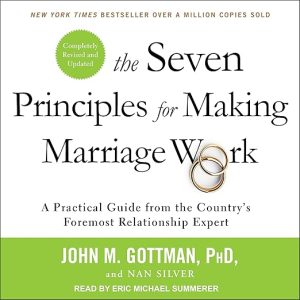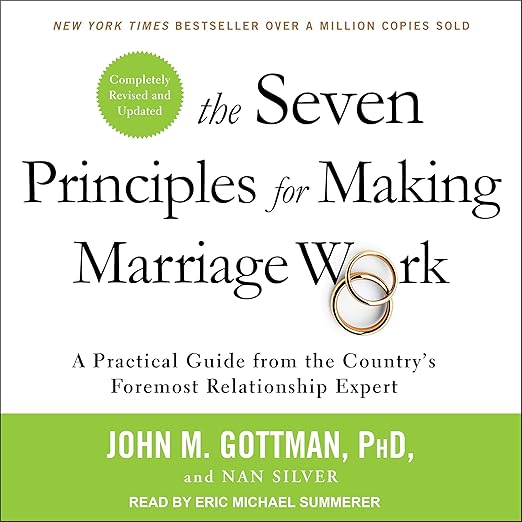
I have a stack of relationship books that I have started and set aside because they offered either too much anecdote or too much abstraction, and not nearly enough of what actually helps. I came to The Seven Principles for Making Marriage Work by John Gottman cautiously, aware of the book's reputation but also of the gap that often exists between a book's reputation and what it actually delivers in audio. I started it on a Sunday morning while doing things around the apartment, the kind of low-key listening I usually reserve for podcasts. Within an hour I had stopped what I was doing to give it proper attention.
Gottman is not a self-help writer who happened to study couples. He is a research psychologist at the University of Washington who built the Seattle Marital and Family Institute and spent decades studying married couples in conditions of unprecedented rigor. The Love Lab, his observation facility where couples were monitored physiologically while discussing conflict, produced data that upended a lot of assumptions about what makes relationships work. The seven principles in this book are not therapeutic intuitions. They are derived from that data, and that matters for how you hear the advice. When Gottman tells you that couples who maintain positive sentiment override during disagreements are more likely to stay together, he can point to the numbers behind that claim. That evidentiary grounding changes the listening experience in a way that is difficult to explain and easy to feel.
Four Horsemen That Predict Divorce with Data
What distinguishes Gottman's approach from most relationship guidance is that he can tell you not just what healthy couples do but also what specific patterns predict divorce with uncomfortable accuracy. The Four Horsemen, his framework for identifying the communication behaviors that most reliably damage relationships, contempt, criticism, defensiveness, and stonewalling, shows up early in the book and carries significant weight because he has the data behind it. Reviewers who came in skeptical of self-help consistently cite the research grounding as what converted them. One reader who bought the book while taking a couples communication class noted that knowing the research base made the advice feel trustworthy in a way that gut-feeling relationship guidance never does. Another described wanting to become a better partner before marriage and finding this the only book that gave him tools specific enough to actually practice. The difference between principles you believe and principles you can apply is the distance this book travels.
Small Daily Bids Matter More Than Drama
The book's central insight, that the quality of a marriage is built primarily in the small daily interactions rather than the large dramatic events, is not a surprising one once stated, but Gottman makes it operational in ways that are genuinely useful. Turning toward your partner's bids for connection, building a shared map of each other's inner lives, maintaining positive sentiment override during conflict: these are concepts that sound simple but require attention to practice. The audio format means you cannot do the workbook exercises embedded in the print version in real time, though the accompanying PDF noted in the listing is available in Audible's library. Listeners who want the full experience of the exercises should plan to download that resource alongside the audio. Several reviewers describe using the audio for the conceptual framework and returning to the print edition for the exercise sections, which is a sensible approach for couples who want to work through the material together at their own pace.
Summerer Keeps the Repetition from Feeling Long
Gottman is a researcher who knows how to write accessibly, but several reviewers note, accurately, that the book repeats itself. Points that have been made clearly get made again. The self-help genre has a tradition of this that borders on a formula, and Gottman is not entirely free of it. At ten hours and seventeen minutes the book is longer than it strictly needs to be, and a listener with a strong memory may find certain sections feel familiar by the time they arrive. This is not a fatal problem, and Summerer's narration keeps the repetition from feeling laborious. But it is worth knowing that the book could be perhaps a third shorter without losing its core content, and that is a real editing gap even in an otherwise excellent work that has helped thousands of couples.
Healthy Couples Use This as a Check-In
This works for couples at any stage, not just those in difficulty. Multiple reviewers describe using it as a check-in for relationships that were already healthy, finding it useful for identifying things they could do better rather than things that were going wrong. It is also genuinely useful as premarital listening. Listeners who want pure theory without exercises should know that the practical application components are central to the book's value. Those who want a quick overview might find the runtime demanding, but the content justifies the investment for anyone who takes relationships seriously enough to examine them with real rigor. The free audiobook availability makes it accessible as a first resource for couples who are not sure where to begin, and the research foundation gives it a longevity that opinion-based relationship books simply cannot match. Gottman has updated the book across multiple editions, and the core findings have held up as his lab's research continued. For couples who take the exercises seriously, this is not a book you listen to once and file; it is one you return to at different stages, finding different sections newly relevant as the relationship changes.