Quick Take
- Narration: Matt Hicks reads John Hopson’s insider account with a conversational ease that matches the book’s approachable, anecdote-driven tone.
- Themes: UX research in game development, data-driven design, the gap between player perception and game studio practice
- Mood: Friendly and illuminating, like a behind-the-scenes tour given by someone who actually ran the experiments
- Verdict: A lean, genuinely revealing look at the research science behind video games that works equally well for players trying to understand what’s happening to them and developers trying to do it better.
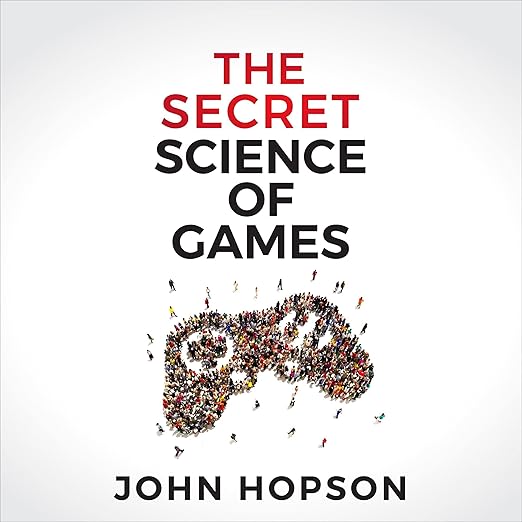
I listened to this one over two evenings, which felt appropriate given that it’s a book about how games are designed to be consumed in sessions. My partner plays a lot of games, and I’ve watched the particular way they’ll say ‘just one more’ and mean it with complete sincerity each time. The Secret Science of Games is, in part, a book that explains exactly what’s happening in that moment, and more importantly, who put it there.
John Hopson is a games researcher who has spent his career inside development studios, doing the UX work that the industry almost never talks about publicly. That last point is the book’s central conceit and its main selling point: game developers are secretive about their research in a way that other product industries are not. The book exists because Hopson decided to pull back the curtain.
The Research That Shapes What You Play
At five hours and change, this is not a long listen, and Hopson uses the space efficiently. He moves through the mechanics of games research with the confidence of someone who has run these studies hundreds of times: playtesting, behavioral data collection, difficulty tuning, the iterative loop between player behavior and design adjustment. The behind-the-scenes stories are the real draw here. Without specifying which games or studios are involved in every case, Hopson gives you enough texture to understand that the decisions you experience as a player, the moment a difficulty spike eases off, the exact way a reward arrives, are the product of deliberate empirical work, not intuition or accident.
Reviewer June M. Russell makes an astute point: most gamers have a distorted idea of how game testing actually works. The popular image involves lucky testers playing unreleased games in a room. The reality is far more methodologically rigorous, and far more continuous. Research doesn’t end at launch; it informs ongoing updates, seasonal content, and the live-service design philosophy that has come to dominate major titles.
Frameworks That Stick
Edmund Helmer’s review calls out the book’s elegant frameworks, and this is accurate. Hopson has the academic’s instinct for conceptual clarity: he introduces ideas in a way that makes them immediately portable. After a few hours with this book, you’ll find yourself applying his vocabulary to games you’ve played for years, recognizing the structures that were always there but unnamed. The framework for thinking about player engagement types, for instance, feels obvious in retrospect but clarifies distinctions that most gaming discourse elides entirely.
Matt Hicks’s narration keeps pace with this quality. He reads with a warmth that prevents the more technical passages from becoming lectures, and the book never feels like it’s fighting with its own format. Short books about specific subjects sometimes feel padded to justify their length; this one doesn’t. Hopson knew exactly how long his argument needed to be.
The Audience Question
Mike Doom’s review comes from a professional context, recommending this to game development teams. That’s an accurate use case. But the book works just as well for players with no professional connection to the industry, which is a harder design challenge and one Hopson navigates carefully. He never condescends to readers who don’t know what a p-value is, but he also never oversimplifies the work to the point of misrepresenting it. That balance is genuinely difficult to strike in technical nonfiction aimed at mixed audiences.
There are places where you’ll want more. The book’s commitment to insider discretion means that the specific games behind the best stories are sometimes unnamed, which is understandable but occasionally frustrating. And five hours moves quickly past topics that could sustain whole chapters: the ethics of engagement optimization, the relationship between research findings and monetization design, the ways in which the same tools used to improve player experience can also be used to extend session length past the point of enjoyment.
Who Should Listen, Who Should Skip
Listen if you’re a game designer, product researcher, or simply a player who has ever wondered how the studios know exactly what they know about you. This is the most honest account of games research I’ve encountered in audio form.
Skip if you want deep ethical analysis of game design or a policy argument about behavioral economics in live-service titles. Those are adjacent books that don’t quite exist yet. This one is the foundation.
Frequently Asked Questions
Do you need to be a game developer to get value from this book?
Not at all. Hopson writes for curious players as much as for professionals. The frameworks he introduces are accessible without technical training, and the behind-the-scenes stories are interesting regardless of whether you work in the industry.
Does the book name specific games or studios in its case studies?
Sometimes, but not always. Hopson is careful about industry confidentiality, which means some of the most interesting stories are told in general terms. You get the research insight without always getting the commercial context that produced it.
How does this relate to the broader conversation about addictive game design?
The book acknowledges the connection but doesn’t dwell on it. Hopson’s framing is primarily about improving player experience, not about the ethics of engagement optimization for its own sake. Readers who want a critique of behavioral manipulation in games will find this a useful foundation but not a complete argument.
At five hours, is this substantial enough to justify a full audiobook format?
Yes. The pacing is lean rather than thin, and Hopson doesn’t pad the material. If anything, the short length makes it a good candidate for two focused listening sessions rather than background listening, since the frameworks benefit from attention.