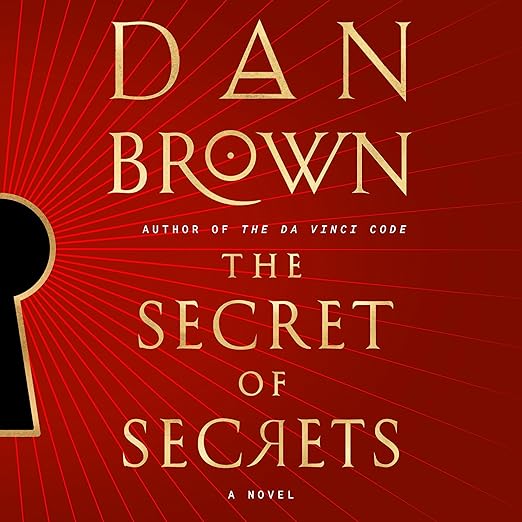
Does Dan Brown still know how to make you stay up past midnight turning pages, or has the Robert Langdon formula finally run dry? The Secret of Secrets, the sixth Langdon novel, arrives as the most anticipated Brown release in years, and the audiobook, narrated by Paul Michael, offers a useful test case for both questions. The answer to the first is mostly yes. The answer to the second is more complicated.
The Los Angeles Times called this 'perhaps his most ambitious undertaking yet: a dense thriller that is also a meditation on the nature, and the possible future, of human consciousness.' That description is accurate, and it helps explain why the book will divide readers who come with different expectations. Katherine Solomon, last seen in The Lost Symbol, returns here as a noetic scientist on the verge of publishing a breakthrough book about human consciousness. She is also, in a new development for the series, romantically involved with Langdon. The murder of an unnamed figure at her Prague lecture, the disappearance of Katherine and her manuscript, and the subsequent chase across Prague, London, and New York are the thriller architecture. But the philosophical scaffolding about consciousness, perception, and the possible future of the human mind occupies more space here than in previous Langdon novels. Reviewer Nona put it clearly: 'if you come to this novel expecting nonstop puzzles and constant code-breaking like The Da Vinci Code, you may feel that something is missing.' The puzzle density is lower. The ideas get more room. Whether that is a welcome evolution or a dilution of what makes the series work is a genuinely subjective call.
Michael Makes Exposition Sound Natural
Paul Michael is an excellent fit for Langdon. His voice carries authority without pomposity, which is exactly what the professor of symbology requires. Brown's dialogue can be expository, particularly when Langdon is explaining codes, symbols, or historical context to someone who needs the information for plot reasons. Michael makes those passages feel natural rather than mechanical, which is a harder technical challenge than it sounds. At 22 hours and 50 minutes, this is the longest Langdon novel to date, and Michael's pacing manages the runtime well. He does not rush the Prague atmospheric passages that give the novel its opening texture, but he also maintains enough forward momentum in the chase sequences to keep the listening experience from stalling. The romantic dimension between Langdon and Katherine is new territory for the series, and Michael handles it with appropriate restraint. Brown has not historically written romance well, and the more sentimental passages here are not the book's strongest moments, but they do not derail the audiobook either. Reviewer Confused, who said the novel made them 'question reality' and felt 'that familiar pull again,' represents the experience most Langdon readers will have: the pleasure of return to a reliable formula, even as that formula is being stretched in new directions.
Prague Replaces Brown's Usual Western Cities
The Prague setting in the first act is genuinely strong. Brown has always been better at atmospheric cities, where centuries of layered history provide material for Langdon's expertise, and Prague's mythology and medieval architecture give him excellent raw material. The shift to London and then New York in the later acts slightly dilutes this, though the New York sequences have their own propulsive energy. The 'powerful organization' hunting Langdon is one of the thriller elements that will feel familiar to series veterans, and the assailant 'sprung from the city's ancient mythology' is among the book's most imaginative creations. The consciousness science at the heart of Katherine's research is presented with Brown's characteristic mixture of genuine scientific reference and significant narrative license. Readers with backgrounds in neuroscience or philosophy of mind may find the treatment impressionistic. Readers who enjoyed the noetic science angle in The Lost Symbol will find it developed further here. The 22-hour runtime, while well-handled by Michael, does mean the novel has more room to settle into its ideas than Brown's tighter earlier entries, and the pacing in the middle sections is more leisurely than some listeners will prefer.
The setting choice of Prague deserves attention as a departure from Brown's usual Western European locations. Rome, Paris, and Florence have featured prominently in earlier Langdon novels, and each of those cities carries centuries of Catholic institutional history that feeds naturally into the symbology framework Brown has built. Prague offers something different: a city with its own rich occult and alchemical tradition, a history of religious conflict that includes the Hussite Wars and the Thirty Years' War, and a mythology that has produced creatures like the Golem and figures like the Emperor Rudolf II, who collected astrologers and alchemists the way other monarchs collected paintings. Brown taps into this tradition through the chilling assailant 'sprung from the city's ancient mythology,' which is one of the novel's more inventive choices. Paul Michael's narration of the Prague sequences has appropriate atmospheric weight, and the city's specific texture comes through in a way that Brown's European settings do not always achieve. Whether the consciousness science at the novel's heart ultimately earns the philosophical weight Brown invests in it is the question the book poses to its readers, and it is a question worth sitting with after the audiobook ends.
Fans Already Inside the Langdon Series
Existing Robert Langdon fans are the natural audience, and most of them will find this a satisfying addition to the series. New listeners can start here without prior context, though the Katherine Solomon relationship will land better with familiarity from The Lost Symbol. Those who loved the relentless puzzle-solving of The Da Vinci Code should be prepared for a slightly different balance in this entry. At nearly 23 hours, it is a significant audiobook commitment, and Paul Michael's narration makes it an enjoyable one.
Quick Take
- Read by: Paul Michael is an excellent fit for Langdon, bringing authority without pomposity to the expository dialogue and maintaining strong momentum across a nearly 23-hour runtime.
- At its heart: Human consciousness and its possible futures, codes and symbols in the service of philosophical inquiry, romantic stakes in a familiar thriller framework
- Vibe: Propulsive and atmospheric, with more intellectual weight and slower puzzle-pacing than earlier Langdon novels
- Short version: The sixth Langdon novel stretches the formula toward bigger ideas at the cost of some puzzle density; Paul Michael's narration makes the commitment worthwhile for fans willing to meet Brown on new terms.