
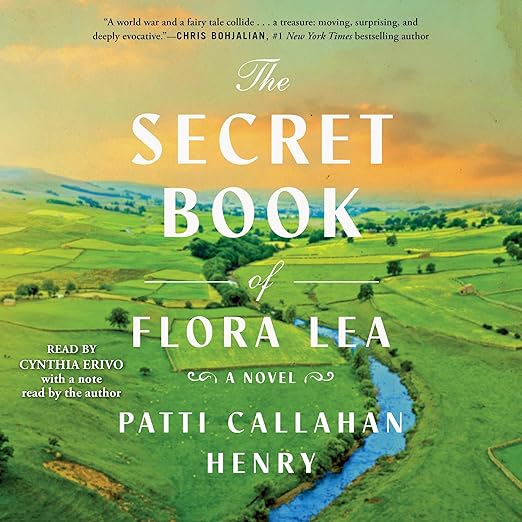
- Narration: Cynthia Erivo is a remarkable casting choice, her voice carries grief and hope in the same breath, and she handles the dual timeline with emotional precision.
- Themes: Wartime evacuation, sibling loss, fairy tales and memory, guilt and forgiveness
- Mood: Bittersweet and atmospheric, with a gentle mystery pulling through the sorrow
- Verdict: A beautifully produced audiobook anchored by Erivo's narration and a premise that honors both the specificity of wartime childhood and the persistence of grief into adult life.
I finished The Secret Book of Flora Lea on a rainy Wednesday evening, sitting in the kitchen with the lights low and the window fogged, which turned out to be exactly the right circumstances for what Patti Callahan Henry had built. This is a novel about a world imagined into being to protect a frightened child, and about what happens when that imagined world resurfaces twenty years after the child it was meant for has vanished. It is sad in the particular way that stories about siblings are sad, not with the clean break of tragedy but with the long aftermath of absence.
The setup runs across two timelines. In 1939, fourteen-year-old Hazel Linden and her five-year-old sister Flora are evacuated from London under Operation Pied Piper, sent to live with Bridie Aberdeen in a stone cottage along the Thames near the hamlet of Binsey. Hazel creates an imaginary world called Whisperwood and the River of Stars to comfort Flora, a place she tells to no one else, a private world that belongs only to the two sisters. Then Flora vanishes near the river, and the world that was meant to protect her becomes a marker of unresolvable guilt.
A Closer Look at The Secret Book of Flora Lea
Twenty years later, adult Hazel is working at a rare bookshop in London and preparing to leave for a position at Sotheby's when a parcel arrives containing a published illustrated book called Whisperwood and the River of Stars. The mystery of how anyone could have known about a world she created privately for a five-year-old is the engine that drives the contemporary timeline, and Henry manages the pacing of the reveal carefully enough that the explanation, when it comes, lands with appropriate weight.
Reviewer Rise and Shine found the book's resolution unrealistic, and they have a point, Henry's ending requires some tolerance for coincidence and for things working out in ways that feel more fairy tale than plausible. But this is, at its core, a book that uses the logic of fairy tales deliberately. Hazel used story to protect Flora; the novel uses story to protect Hazel. The genre choice is not accidental.
What Makes The Secret Book of Flora Lea Worth Hearing
Cynthia Erivo's narration is the central argument for audio over print here. Erivo is a performer of extraordinary range, her work on stage and screen reflects a precision with emotional register that translates directly into audiobook performance. She gives young Hazel a different quality than adult Hazel, and the fairy-tale passages of Whisperwood have a different sound entirely: slower, more incantatory, as though she understands that Hazel used language itself as a kind of shelter.
The WWII context is handled with more specificity than the genre often manages. Henry's research into Operation Pied Piper, the mass evacuation of British children to rural areas, gives the 1939 timeline a grounded quality. The experience of Hazel and Flora at Bridie's cottage, the disrupted rhythms of wartime childhood, the particular anxiety of being fourteen and responsible for a five-year-old in a strange place, all of it is rendered with care.
Things to Know Before Starting The Secret Book of Flora Lea
The romance between adult Hazel and Harry Aberdeen, who was Bridie's teenage son during the wartime sections, has divided readers. It is present and warm, but it is not the book's primary concern, and listeners who come expecting a love story as the central engine may find the mystery and the sibling relationship consuming more of the narrative than they expected. This is ultimately a book about sisters rather than a book about romance.
The blurbs on the book invoke Kristin Hannah and Kristin Harmel, which is accurate marketing but also worth parsing: Henry writes with more restraint than Hannah, and the book's emotional power builds more quietly than either of those reference points. Listeners who find Hannah's emotionality sometimes overwhelming may actually find Henry a more comfortable fit.
Who Patti Callahan Henry Is Writing For
This audiobook will most reward listeners who respond to dual-timeline historical fiction, to stories about women carrying secrets across long years, and to the specific grief of sibling loss. Cynthia Erivo's narration alone makes it a standout production in the WWII fiction category. Those who find fairy-tale logic in contemporary fiction frustrating, or who need their historical mysteries to resolve with strict plausibility, may want to read the critical reviews before committing to the twelve-hour runtime.
Before You Listen
How much of the audiobook takes place during WWII versus the present-day 1950s timeline?
The two timelines alternate throughout, with roughly equal weight given to 1939 Oxfordshire and 1950s London. The wartime sections establish the emotional foundation; the contemporary sections carry the mystery.
Is Cynthia Erivo's narration significantly different from a standard audiobook performance?
Yes, Erivo is a stage and film performer with exceptional emotional range, and it shows. The Whisperwood passages in particular benefit from her ability to shift register, making the fairy-tale sections sound genuinely different from the realistic ones.
Does the book require familiarity with Operation Pied Piper and WWII British history?
No prior knowledge is required, Henry provides enough context within the narrative. But listeners familiar with the evacuation program will find additional layers in how it shaped the specific vulnerability of the children involved.
Is the mystery of how the Whisperwood book exists central to the plot or more of a framing device?
It is genuinely central, the investigation into who published a book about a world Hazel told no one about drives the contemporary timeline and connects directly to Flora's disappearance. The resolution of that mystery is the novel's primary payoff.







