In Brief
- Narration: Roger Clark brings quiet, unhurried authority to Cal Hooper's outsider perspective, matching Tana French's deliberate, atmospheric prose with steady, controlled pacing.
- Themes: Small-town secrets and communal silence, the cost of reinvention, justice outside institutions
- Mood: Slow-burn and atmospheric, closer to psychological portrait than police procedural
- Verdict: A departure from French's Dublin Murder Squad that rewards patient listeners with something richer and more morally complex than a conventional crime novel.
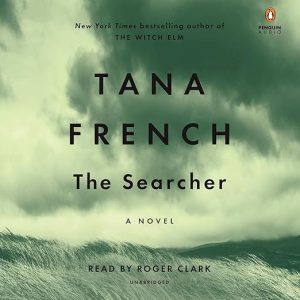
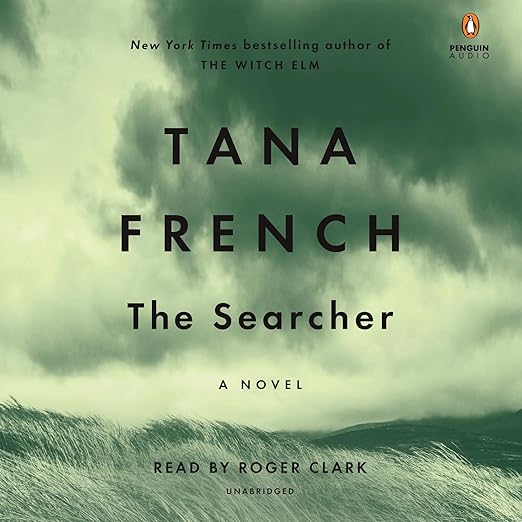
A retired Chicago detective buying a fixer-upper in rural Ireland sounds like the premise for a gentle cozy mystery. Tana French uses that setup to write something else entirely. The Searcher, the first audiobook in the Cal Hooper series, opens with a man who thinks he is definitively done with all of it - the police work, the American noise, the marriage that quietly dissolved around him - and who discovers, within weeks of arrival, that the decision to stop looking for things is not one anyone gets to make unilaterally. Roger Clark narrates with the kind of stillness the book requires: Cal is a man learning to listen more than he speaks, and Clark's voice understands that.
The village itself functions almost as a character in the novel. French has always written place with unusual precision - Dublin in the Murder Squad books is not backdrop but active texture - and the West of Ireland here is rendered with the same density of specific observation. The light, the landscape, the rhythm of pub conversation, the way people who have lived within a mile of each other for thirty years talk around the things they know and choose not to say: all of this is present in the prose and in Clark's delivery of it. The novel earned year-end recognition across multiple publications not because it solved a crime efficiently but because it built a place that felt completely real.
French's novels have always been less interested in the mechanics of crime than in the texture of the people orbiting it. The Searcher extends that preoccupation into territory the Dublin Murder Squad novels never reached. Cal Hooper is not a Dublin detective operating within institutions with colleagues, protocols, and the implicit backing of state authority. He is an American outsider in a West of Ireland village where the social codes are older than anything he recognizes, and where the community's relationship to official justice is complicated by history, distrust, and the specific calculus of small places where everyone knows what a report to the guards will cost the person who makes it. When a local teenager named Trey arm-twists Cal into looking for a missing brother, what begins as a reluctant favor becomes an excavation of the village itself - its silences, its loyalties, and the particular darkness it has decided collectively to absorb rather than expose.
French is interested in how small communities keep their secrets. Not through dramatic conspiracy but through the accumulated decisions of ordinary people who depend on each other and who understand, in a way that outsiders never quite grasp, that some questions carry costs. Clark's narration captures this register with precision. He gives Cal the right quality of presence: watchful and patient, recognizing that his American directness is an asset and a liability in equal measure. The relationship between Cal and Trey, which develops slowly and with genuine care, is the emotional center of the novel, and Clark differentiates the two voices without melodrama.
What Makes The Searcher Worth Hearing
Reviewers have been consistent that this is not an audiobook for listeners who want a fast-moving, plot-driven mystery. One reviewer stated directly: do not come to The Searcher expecting an easy whodunit. What French is doing here is closer to what literary fiction does with setting and character, using a disappearance as a means of exploring a community rather than treating it as a puzzle to be efficiently solved. Roger Clark's measured pace is the right vehicle for this. He does not accelerate toward revelations or signal urgency where the text calls for patience. That restraint is a feature. The novel's atmosphere - wet fields, suspicious neighbors, pub conversations with multiple registers of meaning - comes through in the audiobook with a completeness that Clark's voice contributes to actively. French earned considerable critical recognition for The Searcher, landing on multiple best-of-year lists for 2020, with The Washington Post's Maureen Corrigan calling it potentially French's best novel yet. That assessment reflects real critical consensus, and the audiobook format is the right way to experience the writing that earned it.
Things to Know Before Starting The Searcher
Listeners coming from the Dublin Murder Squad series will need to recalibrate. There is no ensemble of detectives, no institutional framework, no state apparatus working the case. Cal has none of his former resources, and French uses that absence deliberately to strip the genre down to something more elemental. Some Dublin Murder Squad fans have found this adjustment difficult. First-time French readers, by contrast, have found the book exactly as complete as it needs to be - there is no sense of missing prior context if this is your first French novel. The ending is characteristically French: morally unresolved, resistant to easy comfort, true to the world the novel has spent four hundred pages constructing. It does not deliver the cathartic clarity that genre conventions typically provide, and that refusal is not a failure of execution but a deliberate act of artistic integrity. Listeners who need clean resolution should know this before the final chapters.
Who Tana French Is Writing For
Listeners who responded to atmospheric, character-driven crime fiction - writers like Donna Tartt or Kate Atkinson serve as useful reference points for the kind of literary weight French brings to the genre - will find The Searcher precisely calibrated to that appetite. Anyone with an interest in rural Ireland as a literary setting, or in the particular dynamics of communities where historical distrust of authority shapes present-day behavior, will find French's observation precise and persuasive. This is also a sound entry point for French's work if you are new to her - unlike the Dublin Murder Squad, this novel requires no prior continuity. Avoid it if you need genre satisfactions delivered efficiently: the mystery resolves, but not in a way that provides the comfort the form usually promises. French is writing toward something harder than that, and Roger Clark's steady, unhurried narration is the right companion for the fourteen-hour commitment.
Good to Know
Is The Searcher audiobook a good starting point for Tana French, or should I read the Dublin Murder Squad first?
It's a valid and self-contained starting point. The Searcher has a different protagonist, a different Irish setting, and no Dublin Murder Squad continuity dependencies. Listeners new to French will not miss prior context. Some Murder Squad fans find the tonal shift requires adjustment, but it is not a prerequisite issue.
Does this audiobook stand alone, or does it end on a cliffhanger requiring the next Cal Hooper book?
It stands alone as a complete story. The Cal Hooper series continues, but The Searcher reaches a self-contained resolution. The ending is morally complex and refuses easy genre comfort, but it definitively concludes the central investigation. No cliffhanger.