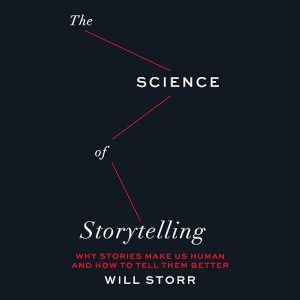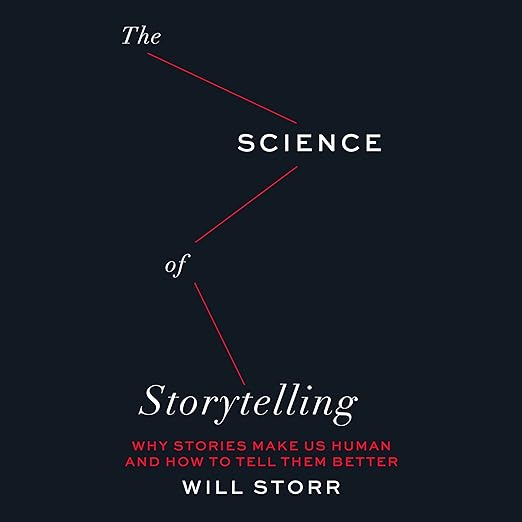
The Science of Storytelling by Will Storr approaches narrative craft from an angle that most writing guides skip: not what stories should do, but why human brains respond to them the way they do. This audiobook, at six hours and fifty-one minutes narrated by James Clamp, is part craft guide and part neuroscience lecture, and the combination is more effective than it might initially sound. Storr is a journalist and novelist whose other work includes Selfie and The Status Game, and he brings a researcher's instinct for sourcing alongside a practitioner's understanding of why the theoretical framework matters in concrete creative practice.
A Distorted Belief the Story Then Tests
Storr's central argument is that the brain is fundamentally a story-processing machine, and that the stories we find most compelling activate the same neural systems we use to navigate social reality. This is not an original position in cognitive science, but Storr synthesizes the research more cleanly and applies it to craft more usefully than most of the psychological literature manages. The book works through character psychology, the function of the dramatic question, the mechanics of plot and ending, and what Storr calls the Sacred Flaw Approach, a practical framework built around the idea that memorable characters are defined by a distorted belief about the world that the story then tests systematically.
Clamp Stays Measured and Lets Ideas Carry
The examples Storr selects are wide-ranging and consistently well-chosen. Harry Potter, Jane Austen, Alice Walker, Greek drama, Russian novels, Native American folk tales, King Lear, Breaking Bad, and children's stories all appear in service of the theoretical points being made. The range is not shallow eclecticism. Each example is doing specific evidential work in the argument. The Breaking Bad discussion of character transformation is particularly effective, and the treatment of Jane Austen's narrative machinery demonstrates that Storr is genuinely reading the texts rather than using canonical titles as illustrative decoration.
Chapters organized around concepts like the Dramatic Question and Plot, Endings, and Meaning give the book a logical progression that suits the audio format. Clamp's delivery is appropriately measured rather than theatrical, which serves the material well. This is a book where argument is the primary material, and Clamp stays out of the way and lets the ideas carry their own weight across the full runtime.
Grounding Show Don't Tell in a Mechanism
One reviewer, describing the book as useful for the publishing industry as well as for writers, notes that it answers the questions of what people want to read and why they want it. That framing is accurate. Another reviewer describes returning to the book multiple times due to its density of ideas, which is a fair warning about the pace of information delivery in audio format. A third, drawing on the ancient Greek observation that stories healed psychological ills in audiences, connects Storr's neuroscience to a much older intuition about narrative's social function. All three responses point at what the book does well: it provides a framework specific enough to use and general enough to apply across narrative forms and traditions.
The neuroscience framing gives Storr's recommendations a specificity that conventional craft advice lacks. Show don't tell as a writing rule is an instruction without a mechanism. Storr's version of the same principle connects to how the brain actually processes character interiority versus reported experience, and that grounding in mechanism makes the advice considerably more actionable. Writers who have absorbed traditional craft guides and found them insufficiently explanatory will find this audiobook the more useful resource.
An Appendix Built for a Second Pass
The practical appendix, structured as a step-by-step guide to the Sacred Flaw Approach, is where the book makes its most direct contribution to working craft. For audiobook listeners, this section may reward a second pass or note-taking during the first listen. The framework involves specific diagnostic questions about character belief systems and the way stories test those beliefs, and the questions are most useful with reference access rather than as audio absorbed once.
Precise Language for Diagnosing a Manuscript
The book's scientific framing has occasional limits worth acknowledging. Neuroscience and psychology research does not always map cleanly onto aesthetic experience, and Storr is careful enough to note when he is extrapolating rather than describing confirmed mechanism. But the core insight, that stories work because they simulate the social cognition we use in real life, is robust enough to sustain the practical applications built on it. The examples hold up under examination, and the framework is more testable against specific works than most craft instruction manages to be.
Writers who record themselves discussing their own work, or who teach in workshop settings, will find this audiobook a useful preparation. The terminology Storr introduces, particularly around the Sacred Flaw and the Dramatic Question, gives practitioners precise language for diagnosing problems in manuscripts and drafts that the more impressionistic vocabulary of conventional workshop feedback lacks. That diagnostic precision is, in the end, the book's most practical contribution.
Between a Manual and Pure Neuroscience
Writers of fiction at any stage will benefit from this audiobook, particularly those who have read widely but found existing craft guides too impressionistic or too dependent on appeals to tradition rather than explanation. The neuroscience framing is most useful for writers who want to understand why their instincts are correct rather than simply being told to follow them. Screenwriters, novelists, and playwrights are the primary addressees, though the claims about what makes stories work extend to any narrative form.
Listeners who want a traditional writing manual with exercises and prompts will find this more analytical than prescriptive outside the appendix. Listeners who want pure neuroscience without craft application will find the literary analysis too prominent. The book sits deliberately between the two, serving a writer who wants to understand why what they feel intuitively about narrative is actually true, and it does that with unusual precision for the genre.
Quick Take
- Read by: James Clamp's delivery is measured and clear, appropriate for a book that wants its ideas to be followed precisely rather than performed dramatically.
- At its heart: The neuroscience of narrative engagement, character psychology and the sacred flaw, how stories simulate social reality for the brain
- Vibe: Intellectually stimulating and practically useful, with a density that rewards active listening over passive consumption
- Short version: Will Storr's Science of Storytelling is one of the more rigorous accounts of why stories work, and the audiobook format suits its argument-driven construction well.