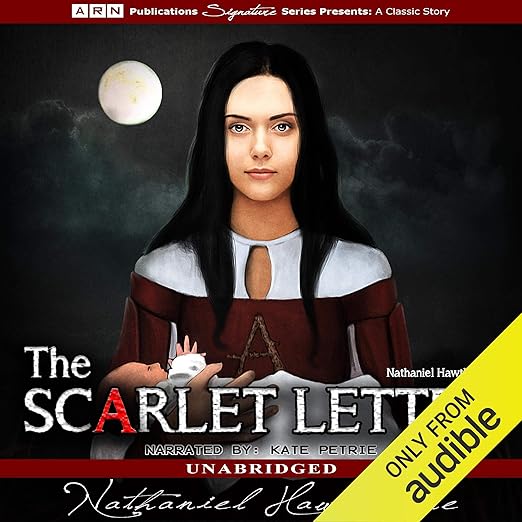
- Narration: Kate Petrie sustains Hawthorne's dense, indirect 19th-century sentences with clear, patient delivery across nearly seven hours.
- Themes: Public shame and private guilt, Puritan morality, hidden sin
- Mood: Slow-burning, interior, morally complicated
- Verdict: A genuinely rewarding classic for patient listeners, more accessible in audio than its reputation as difficult reading suggests.
Hester Prynne stands on the public scaffold for the opening scene of The Scarlet Letter and says almost nothing, which tells a listener everything about how Nathaniel Hawthorne builds this novel: around silence, inference, and what a Puritan community chooses not to ask rather than around confession. This audiobook, narrated by Kate Petrie, asks listeners to sit inside that restraint for nearly seven hours, and the results depend heavily on a taste for slow, interior, morally complicated fiction over plot-driven storytelling.
The Verdict, Briefly
Petrie's narration has no prior track record on file here, so this assessment rests on genre fit alone: the demand of this specific text is sustaining long, dense, syntactically indirect sentences, full of qualification and moral hedging, without letting a listener's attention drift during passages that reward patience more than urgency. Hawthorne's prose is famous for testing exactly that patience, especially in the novel's introductory Custom House essay, which has sent many print readers straight to skipping ahead.
One listener review admits choosing Cliff's Notes over the actual novel in school and finally reading it properly as an adult, calling it 'an easy read' once actually attempted and 'not near as dark' as expected going in. That reaction lines up with a broader pattern among adult listeners returning to assigned high school reading: the book is genuinely more accessible in practice than its reputation as difficult, dense classic literature suggests.
Hawthorne's own family history adds a layer worth knowing: one of his ancestors served as a judge during the Salem witch trials, and Hawthorne is widely understood to have added the w to his birth surname, Hathorne, partly to put some distance between himself and that legacy. That personal history helps explain the novel's genuine moral seriousness about Puritan self-righteousness; this is not an outsider mocking a distant community, it is a descendant reckoning with his own inheritance.
The Best Parts of The Scarlet Letter
The plot itself carries real momentum once it gets moving: Hester Prynne is sentenced to wear a scarlet A after having a child, Pearl, out of wedlock, and refuses to name the father even under prison sentence. Her long-absent husband returns to the colony under a false name, discovers the father is the outwardly respected Reverend Dimmesdale, and spends years quietly tormenting him rather than exposing him outright, a slow-burn psychological cruelty that gives the novel its genuine tension.
The eventual public confession, the deaths that follow it, and Hester's own choice to return to the colony at the end rather than stay away permanently give the novel a shape that rewards patience with real payoff, not just historical or literary obligation. One reviewer places the book alongside Mark Twain and John Steinbeck as canonical American literature, noting it is 'maybe not as accessible' as either but belongs firmly in the same tier of significance.
For listeners drawn to stories about public shame, private guilt, and the gap between a community's stated morality and its actual behavior, this remains a genuinely relevant novel nearly two centuries after publication, closer in spirit to work like Arthur Miller's The Crucible than its 19th-century setting might initially suggest.
Hester herself is frequently cited as one of the earliest fully realized, morally complex female protagonists in American fiction, someone the novel refuses to reduce to either victim or sinner despite the entire plot revolving around how her community insists on doing exactly that. Listeners approaching the novel expecting a simple morality tale about punished sin often find instead a much more ambivalent portrait, one where the community's judgment looks considerably less stable than Hester's own quiet endurance of it.
Points to Consider
The 19th-century syntax is real and will not be softened for modern ears; listeners who struggle with long, formal sentence structures should expect some genuine friction, especially in the introductory Custom House section before the actual narrative begins. This is not a simplified or adapted retelling, and it should not be approached expecting one.
At six hours and fifty-three minutes, the runtime is appropriately unabridged for the novel's actual length, not a shortened edition, so listeners are getting the complete text including the denser introductory material rather than a streamlined version.
The Custom House introduction, a lengthy autobiographical essay largely unconnected to the main plot, has tested even devoted readers in print for generations, and audio narration genuinely helps here: hearing it read aloud with clear pacing makes the digression easier to sit through than staring at dense paragraphs on a page, even though the material itself remains a slower on-ramp than the novel proper.
Who Should Pick Up The Scarlet Letter
This suits adults revisiting assigned high school reading with fresh eyes, classic American literature listeners generally, and anyone who prefers psychologically interior fiction over fast plotting. Petrie's clear narration makes a reasonable case for tackling the unabridged text in audio rather than defaulting to a summary or an old paperback gathering dust.
Skip it if dense 19th-century prose reliably frustrates you regardless of narration quality; no performance fully resolves that structural challenge. For everyone else curious whether this classic holds up outside a classroom setting, the answer here leans convincingly toward yes.
Few 19th-century American novels remain as consistently assigned in high school classrooms as this one, which explains both its outsized reputation for difficulty and the specific nostalgia, or dread, so many adult listeners bring to a second attempt. That classroom ubiquity has also produced multiple film adaptations and a general cultural shorthand, wearing a scarlet letter, that has outlived direct familiarity with the actual text for a surprising number of people who recognize the phrase without having read the book.
Good to Know
Who narrates The Scarlet Letter audiobook?
Kate Petrie narrates, sustaining Hawthorne's long, formal sentences with clear, unhurried pacing.
Is this audiobook appropriate for someone who never finished the novel in school?
Yes. It is specifically well suited to adults revisiting assigned reading they skipped or struggled with the first time around.