
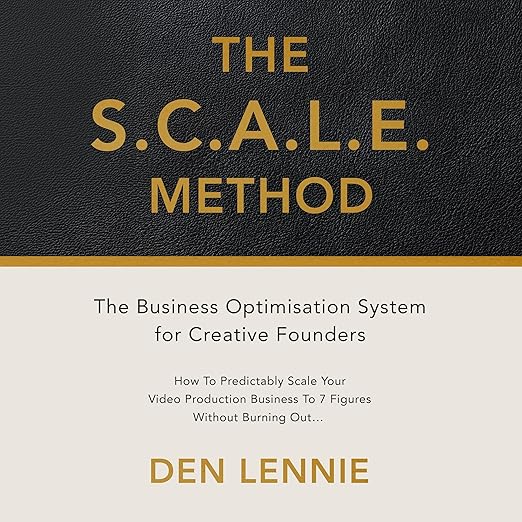
What happens when a video production business becomes successful enough to consume the person who built it? Den Lennie's audiobook The S.C.A.L.E. Method opens with that specific crisis, and it does so without generic business-book framing. Lennie is a coach who has worked with 178 video production businesses over eight years. His five-pillar framework, Survival, Control, Alignment, Leverage, and Expansion, was built from watching real companies get stuck at the same invisible ceiling: technically successful, consistently booked, but not free. Revenue has arrived. Freedom has not. The audiobook is about how to redesign a video business so that second problem gets solved without sacrificing the first.
The question that opens the listening experience is direct: did you start a video business to work 60-hour weeks? Lennie asks it not rhetorically but diagnostically. The answer most of his coaching clients gave, and the answer most listeners at the $200K-$300K annual revenue level will recognize immediately, is that the business has become a very demanding job rather than the venture they imagined. That gap between what was promised by growth and what growth actually produced is the real subject of the audiobook.
You Cannot Align Without Control First
Lennie's five pillars provide the structural backbone for the audiobook's argument. Survival is about narrowing focus to the right markets rather than chasing every project that arrives. Control is about building a small set of high-value client relationships that generate predictable work rather than constant new-business anxiety. Alignment means exiting vendor mode and becoming a partner to clients, which changes the pricing dynamic and the relationship dynamic simultaneously. Leverage introduces systems and a lean team that allows the business to operate without the founder's constant presence. Expansion then becomes possible because it adds revenue rather than chaos.
The logic of the sequence is clean. Each pillar creates the conditions the next one requires. You cannot expand without leverage. You cannot leverage without alignment. You cannot align without control. And control is unavailable if you are perpetually in survival mode. Reviewers have responded strongly to that internal coherence. One described the book as not only easy to read but extremely relevant, with key insights applicable immediately alongside a longer-term road map. Another specifically noted that Den's coaching background is evident on every page, a quality that distinguishes practitioner-built frameworks from theorist-built ones.
Lennie's Authority Reads as Documentary Truth
Lennie self-narrates, and that choice is the right one for this material. At just over 3 hours, the audiobook is compact for its genre, and Lennie delivers it with the directness of someone who has had these conversations in real coaching contexts rather than written for an imagined general audience. He speaks to video production business owners specifically. He does not hedge toward broader relevance. That specificity is a significant part of what makes the framework trustworthy. The case studies embedded throughout are drawn from actual client companies, which provides the kind of concrete grounding that most business methodology audiobooks substitute with generic hypotheticals.
The self-narration also means that when Lennie describes the operator-to-owner transition, the moment when a founder steps back from doing all the work and begins designing a business that runs without them, the weight of that description reflects someone who has guided 178 businesses through that specific transition. The authority is not performed. It is documentary.
Precise and Unusual at $200K to $300K
At 3 hours, the audiobook is intentionally compact. Lennie does not pad the content to meet a conventional business-book length. That brevity is mostly an asset, delivering a high signal-to-noise ratio in a genre notorious for filler. It does mean that certain elements of the framework, particularly the implementation specifics around building systems and the lean team configuration, are introduced at a level that leaves room for deeper follow-up through Lennie's coaching ecosystem. Listeners who want the full operational manual will find this audiobook provides the framework clearly but expects them to build the implementation detail themselves or through additional coaching.
The audience is deliberately specific: video production companies in the $200K-$300K annual revenue range. Listeners outside that specific bracket will find transferable principles in the operator-to-owner transition framework, but some sections are calibrated closely enough to production business realities that a service-business owner in a different field may need to adapt rather than directly apply. The case studies are production-specific, which is both the book's greatest strength for its target audience and a mild limitation for readers from adjacent service industries.
The audiobook's implicit argument, that most creative service businesses fail to scale not because of a talent or work ethic deficit but because of a structural design problem, is both accurate and underserved in the business literature aimed at this audience. Most business methodology books either address pre-revenue entrepreneurs or established enterprises at a significantly larger scale. Lennie's targeting of the $200K-$300K revenue band, the exact point where founders typically feel most trapped, is precise and unusual. That specificity is what makes the case studies land rather than feel like generic success stories adapted to fit a framework.
The Most Precisely Targeted Book in Its Space
Video production business owners who are generating solid revenue but feel trapped by operational demands that scale with income rather than diminishing as the business grows are the precise audience for this audiobook. If your income has increased but your time has not, and if being booked feels more like being imprisoned than being successful, Lennie's framework addresses that specific structural problem with unusual precision.
Creative service businesses more broadly, including photographers, agencies, and consultancies at comparable revenue stages, will find the core framework applicable even if the production-specific case studies require some translation. Listeners who are still in early-stage business development, before the $100K-$150K annual revenue mark, may find the scaling frameworks premature for their current situation, and the audiobook is explicit about targeting founders who are already technically successful but structurally stuck. For that specific listener, this is one of the most precisely targeted business audiobooks in the production and creative services space.
In Brief
- Narrator: Den Lennie self-narrates, and his 8 years of direct coaching experience with video production businesses makes the advice land with a practitioner's credibility that a hired narrator reading someone else's framework could not replicate.
- Subjects: Business structure over hustle, operator-to-owner transition, sustainable revenue without burnout
- Tone: Candid and practical, like a consulting session from someone who has worked inside the exact problem you are describing
- Bottom line: Lennie's five-pillar framework addresses a specific and common crisis in creative service businesses with unusual precision, and the case studies from real production companies make it actionable rather than theoretical.
Frequently Asked Questions
Does Den Lennie narrate The S.C.A.L.E. Method audiobook himself, and does that affect the credibility of the content?
Yes, Lennie self-narrates across the full 3 hours. Having an 8-year practitioner who has coached 178 real video production businesses deliver his own framework makes the material land with a conviction and specificity that a hired narrator reading someone else's methodology could not replicate. Reviewers consistently note that his direct coaching experience is evident throughout.
Is The S.C.A.L.E. Method audiobook applicable only to video production businesses, or does the framework transfer to other creative service industries?
The case studies and specific examples are built around video production companies in the $200K-$300K annual revenue range, which is the target audience. The underlying framework around the operator-to-owner transition, building systems, and moving from vendor to trusted partner transfers to other creative service businesses, but some adaptation is required. Production-specific listeners get the most direct application; adjacent industry listeners get transferable principles that need translation.
At just over 3 hours, is the audiobook detailed enough to be genuinely actionable?
The audiobook delivers the framework and its internal logic with high clarity and genuine case study support. It is compact by design, prioritizing signal over length. Implementation specifics, particularly around team building and systems design, are introduced at a framework level rather than as full operational manuals. Listeners may want to treat the audiobook as the strategic roadmap and then do additional work to build the implementation detail specific to their business.
Does The S.C.A.L.E. Method audiobook address burnout specifically, or is that just framing for a conventional growth guide?
Burnout is a genuine structural concern of the framework rather than marketing framing. Lennie's central argument is that conventional growth advice, hire more, take on more clients, hustle harder, produces a business that extracts from the founder rather than serving them. Each of the five pillars is designed to address a specific structural cause of that extraction, and the case studies describe founders who specifically reclaimed time and margins rather than just increased revenue.







