Quick Take
- Voice: Danni Deguire navigates Sabine's emotional whiplash between duty and desire without tipping into melodrama, giving the court intrigue sequences particular energy.
- Big ideas: Vengeance versus duty, found power in an unwanted crown, court politics as emotional warfare
- Atmosphere: Fast and emotionally intense, with romantic tension woven through the treachery
- Worth it?: A satisfying trilogy closer for readers already invested in Sabine's journey, though newcomers should start at Book 1 to feel the full weight of what this finale resolves.
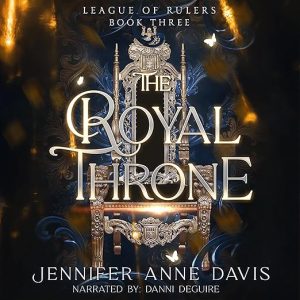
I have a pattern with fantasy trilogy finales: I read the ending first. Not out of impatience but because I find it clarifying to know whether an author has the nerve to follow through on what they set up. Sabine's story in Jennifer Anne Davis's League of Rulers series had set up enough competing loyalties, enough treacherous court dynamics, that the finale either needed to honor the complexity or collapse under it. I went back to the beginning, listened to all three, and found that The Royal Throne earns its place as a conclusion.
The setup is specific: Sabine returns to Lynk not for love but for justice, specifically to deliver consequences for her sister's murder and to stop her husband Rainer from triggering a war that would destroy the realm. The complication, as always in stories like this, is that the person she most needs to fight is also the person she is bound to, and the person she most wants to be with is the assassin-pirate-prince lurking in the court's shadows.
A Closer Look at The Royal Throne
What distinguishes Sabine as a protagonist is her resistance to the crown she has been given. One reviewer puts it well: she stumbles blindly from problem to solution to problem throughout the entire series, and it makes her actually relatable. This is not a heroine who discovers her power and immediately becomes competent. She is someone who remains aware of her own inadequacy while continuing to act anyway, which is a harder quality to sustain across three books than it might seem. Davis manages it. Sabine's self-awareness is never self-pity, and her refusal to own the role she has been assigned does not read as false modesty. It reads as an honest response to an impossible situation.
The court politics in this final volume are correspondingly dense. Treacherous allies, spurned lovers, rivals angling for advantage: the synopsis is not exaggerating when it describes Lynk's court as deadlier than ever. The plotting is intricate enough that listeners who have not read Books 1 and 2 recently will need a few hours to rebuild their map of who owes what to whom. But the payoff, for those who have followed the full journey, is genuine. The final battle for the throne delivers on its promise. Several reviewers who claimed they needed a fourth book after finishing this one may simply be expressing reluctance to leave a world that has rewarded their investment.
A note on series order: this is the third book in the League of Rulers trilogy, not a standalone. Picking it up without Books 1 and 2 means arriving mid-political crisis with no map of who holds which allegiance. The court of Lynk is populated with characters whose history with Sabine shapes every confrontation in this volume, and that history takes two prior books to accumulate. Do yourself the service of starting at the beginning.
Things to Know Before Starting The Royal Throne
Danni Deguire is well-matched to this material. Sabine's interior narration is dense with competing impulses, and Deguire keeps the hierarchy of those impulses audible: duty first, desire underneath, grief as the constant low register. The nine-hour runtime is lean for a fantasy trilogy closer, which is actually a compliment. Davis and Deguire do not linger. The pacing is propulsive enough that the emotional beats land harder for their brevity.
Who Jennifer Anne Davis Is Writing For
Finish the first two League of Rulers books before starting this one. The investment pays off in proportion to how well you know Sabine's history going in. If you are already a Sabine loyalist who has followed her from reluctant queen to something harder to name, this finale will give you what you have been waiting for. If you want action, court intrigue, and a romance that takes its time, this trilogy as a whole is worth the commitment. Skip The Royal Throne specifically if you have not read the earlier entries, and start at the beginning instead.
Can The Royal Throne be listened to as a standalone, or is the full League of Rulers trilogy required?
This is Book 3 of a trilogy and is not designed as a standalone. The character relationships, court dynamics, and emotional stakes all depend on events from the first two books. Starting here would mean missing the context that makes Sabine's arc in this finale meaningful.
How does Danni Deguire handle the dual pressures of Sabine's romantic storyline and the political thriller plot?
Deguire keeps both tracks distinct without subordinating one to the other. The assassin-pirate-prince scenes carry a different tonal energy from the court intrigue sequences, and Deguire negotiates between them cleanly. Several reviewers specifically mention being unable to put the book down, which suggests the pacing of the performance matches the material's urgency.