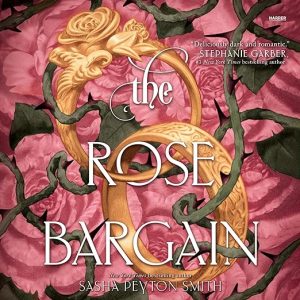
I started The Rose Bargain on a Thursday evening when I needed something with good bones and enough momentum to carry me through to Friday without demanding too much from a tired brain. By midnight I was considerably more awake than I had intended to be, and by Friday morning I had finished it and was genuinely annoyed about the cliffhanger, which tells you everything you need to know about whether the book is doing its job.
Sasha Peyton Smith has constructed something specific and enjoyable: an alternate 1848 London where England has been governed for four hundred years by an immortal fae queen who replaced the House of Lancaster during the Wars of the Roses. Queen Mor maintains an illusion of benevolence by granting each subject one bargain for their heart's desire. When Mor announces a competition for Prince Bram's hand, Ivy Benton, whose family's social ruin makes a crown the practical solution, signs up immediately. What she does not anticipate is that Bram's rakish, complicated brother Emmett will become her most useful ally, at a cost she negotiates without reading the full terms.
Is The Rose Bargain Worth Your Time?
The Bridgerton and Cruel Prince comparisons that reviewers reach for are accurate but not complete. The Bridgerton surface, balls, social competition, gossip, period fashion, is here, handled with Smith's evident pleasure in the materiality of 1848 London. The Cruel Prince architecture is also here: a fae political structure that is beautiful and murderous in equal measure, bargains with teeth hidden in fine print, and a romantic dynamic between a mortal girl and a fae-adjacent prince that is charged with mutual calculation. What Smith adds that is her own is the alternate history premise, which gives the world a specific texture neither of those comparisons quite captures.
Emmett is the book's most effective creation. He is drawn as someone who has spent his entire life in the shadow of the competition for a throne he is ineligible for, which gives his help-for-a-price offer to Ivy a layered motivation. Reviewers who praised the character dynamics over the plot were pointing at exactly this: Emmett and Ivy's negotiations and eventual grudging alliance are more interesting than the Bachelor-style competition, and Smith knows it, centering their dynamic at the book's emotional core.
The Best Parts of The Rose Bargain
Emily Mount navigates the book's tonal range with agility. The comedy of the competition sequences, five girls, varying agendas, one increasingly complicated prince, needs different handling than the scenes where the trials turn genuinely vicious, and Mount shifts registers cleanly. The Victorian period dialogue, which Smith writes with enough formality to feel authentic without becoming stiff, benefits from Mount's delivery, which gives it rhythm without losing the humor that runs underneath it.
At just over twelve hours this is a substantive listen, and the pacing justifies the length, Smith uses the competition structure to develop character contrasts between the contestants in ways that make the later trial sequences more emotionally loaded. The world's fae rules are established early and applied consistently, which is a basic obligation that not all romantasy debuts manage.
Before You Commit to The Rose Bargain
The YA classification creates a mild tonal ambiguity. Reviewers have noted that one scene reads as inconsistent with the YA designation, whether that matters depends on your reason for choosing or avoiding YA content. The love story development has been the most common critique: Emmett and Ivy's dynamic moves at the right pace but Ivy's feelings for Prince Bram resolve in ways that feel compressed rather than earned. The alternative history's four-hundred-year fae rule is fascinating as a premise but the book does not fully explore its implications, the social architecture of a London that has lived under fae governance for centuries is suggestive rather than developed. A stronger second novel could do significant work with that gap.
Should You Listen to The Rose Bargain?
For listeners who want period-set YA romantasy with genuine atmosphere and a competition narrative that doubles as a character study. Fans of The Cruel Prince who want something lighter in emotional weight but similar in fae political texture will find it satisfying. Those who specifically want fully resolved romantic arcs should note that this ends on a cliffhanger requiring Book 2. At the time of this review, Smith has indicated a sequel; knowing whether it exists and when it arrives is worth checking before you start.
The Short Version
- Narrator: Emily Mount keeps the Victorian period atmosphere grounded while navigating the fae competition's heightened drama, a strong performance in a book that risks tonal inconsistency.
- Subjects: Bargains and their true costs, class and social performance, desire versus duty
- Tone: Effervescent and glittering on the surface with genuine menace building underneath
- Bottom line: A fun, fast Victorian-fae romantasy that delivers on atmosphere and witty dynamics even where its YA scaffolding shows.