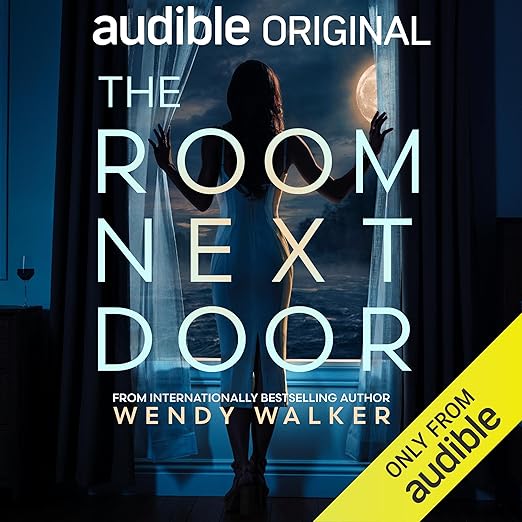
Fifteen Years Since Eve Shay Vanished on July Fourth
Eve Shay vanished on the Fourth of July in 2010, and for fifteen years her disappearance shaped the lives of two women who loved her in very different ways. Wendy Walker's audiobook The Room Next Door runs nearly nine hours and carries an acclaimed cast, with Julia Whelan central to the narration. Whelan's particular skill with first-person female interiority makes her well-suited to a novel where two women's perspectives interlock around a single absent third. The thriller structure is propulsive: an anonymous tip, a body hauled up by a fishing boat, and a hotel guest in the room next door who turns out to be Brooke Lowry, the third member of that inseparable trio from 2010.
The setup is tightly constructed. Carrie Hollis, now Chief of Police in a small East Bay Rhode Island town, has never been able to close Eve's case despite her body having been found and her death officially ruled accidental drowning. The obsession that drove her into law enforcement is also the thing that makes her dangerous as an investigator. She is too close to the case and too certain of the answer she is looking for. Walker builds Carrie's perspective with enough procedural specificity that her dual role as investigator and emotionally invested friend feels genuinely uncomfortable rather than merely dramatic.
Whelan Threads Three Distinct Voices at Once
Julia Whelan is one of the most reliable narrators in psychological thriller, and her handling of the parallel structure here, Carrie's present-tense investigation, Brooke's scramble to cover the affair she cannot disclose, and Eve's retrospective voice rising from the past, demonstrates the craft that has made her a consistent award nominee in the genre. The three voices are distinct without being caricatured, and Whelan manages the emotional gradient between them precisely: Carrie's controlled intensity, Brooke's escalating panic, and Eve's knowing retrospective sadness occupy different registers that clarify the novel's architecture even when the timeline deliberately obscures it.
One reviewer described the production as 'like listening to an actual movie at times' and attributed this to the background aesthetics throughout. The audiobook has production design elements beyond narration that contribute to an immersive experience. The same reviewer found the book probably ten chapters longer than necessary, and this is a fair structural observation. At nearly nine hours, The Room Next Door has room to develop its three perspectives fully but also enough space that certain mid-book sections build tension less efficiently than the opening and the final act achieve.
The novel's core complication, that Brooke heard something violent through the hotel wall but cannot say so without revealing an affair she has hidden for reasons that become clear only later, is the kind of moral knot that thriller fiction handles well when the author is willing to sustain rather than quickly resolve the character's impossible position. Walker sustains it for long enough that Brooke's choices read as psychologically consistent rather than conveniently dramatic. The constraint on her testimony creates a genuine narrative engine, and Whelan's narration of Brooke's mounting calculation across the middle sections is some of the production's most technically accomplished work.
Whelan's casting for this type of material is worth noting more broadly. She handles the gap between what characters know and what they acknowledge, a crucial register in psychological thriller where subconscious recognition often precedes conscious admission, with a precision that many narrators flatten into straightforward suspense. In the scenes where Carrie is accumulating evidence she does not yet have language for, Whelan allows that uncertainty to sit in the delivery rather than pushing toward resolution ahead of the text.
Eve's Retrospective Voice Asks for Reader Faith
Another reviewer noted the book as 'a good story with a weak ending,' and the concern is worth acknowledging for listeners who find third-act resolution crucial to their satisfaction with thrillers. The review described the setup and execution as strong without being specific about the ending's weakness, which limits how much weight to assign to the observation, but it is consistent with a certain type of thriller construction where the accumulating complexity outpaces what any single resolution can satisfyingly address. The 'spectacular twist' promised in the synopsis will land differently depending on how predictable listeners find the mid-book clues.
Eve's voice emerging from the past is the novel's most distinctive structural element and the one that requires the most faith from the listener. Her perspective is retrospective and knowing in ways that other thriller POVs typically are not, and the novel uses this to deliver information the other narrators cannot access without it feeling like authorial cheating. Whether this device fully earns its place is a matter of reader tolerance for non-linear omniscient interludes in otherwise procedural thriller structure.
Whelan's Narration Alone Is Reason Enough
This audiobook suits listeners who enjoy psychological thrillers structured around multiple women's perspectives, who value strong narration in their thriller listening, and who can sustain engagement across a longer runtime without requiring constant plot movement. Julia Whelan's performance alone is reason enough for established fans of her narration to give the book a listen. Listeners who prioritize tight, stripped-down thriller plotting over character-rich parallel structure may find the pacing in the middle third tests their patience. The content warning for mature themes applies broadly: the novel covers violence, infidelity, and a long-term murder case in detail throughout its nearly nine hours.
Quick Take
- Read by: Julia Whelan voices three distinct perspectives with the tonal control the parallel structure demands; her handling of Carrie, Brooke, and Eve's very different emotional registers is the production's primary asset.
- At its heart: Female friendship and obsession, secrets and their costs, the reliability of official verdicts
- Vibe: Tense and layered, with the immersive production of a prestige thriller rather than a stripped genre listen
- Short version: A Julia Whelan narration that rewards listeners who can stay with a nine-hour character-rich thriller even when the plotting eases its foot off the accelerator in the middle sections.
A Few Questions About The Room Next Door
How does Julia Whelan handle the three-narrator structure in this audiobook?
Whelan differentiates Carrie, Brooke, and Eve through distinct emotional registers rather than through vocal tricks. Carrie's controlled intensity, Brooke's rising panic, and Eve's retrospective sadness are each sustained consistently across their sections, making the structure legible on audio even during timeline shifts.
Does the audiobook's acclaimed cast mean multiple narrators or is Julia Whelan the primary voice throughout?
The synopsis references an acclaimed cast, and the production includes audio design elements beyond solo narration. Whelan is the primary narrative voice, with the production values contributing to what one reviewer described as a cinematic listening experience.