
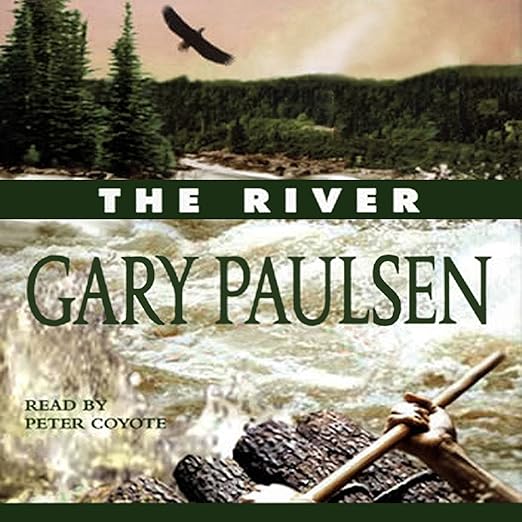
I listened to the original Hatchet years ago on a long train journey, and Peter Coyote's voice became inseparable from my memory of the Canadian wilderness Paulsen builds. Coming back to The River, Brian's second trip into that wilderness, this time not alone, this time with a man's life depending on him, felt like returning to a place I had not quite left. The book is shorter than Hatchet at two and a half hours, but it is not a lesser thing. It is a compression, a sequel that understands exactly what made the first book work and then turns the pressure up by a single, specific degree.
The government wants Brian back in the bush to study what he did to stay alive. That conceit could have been a clumsy framing device. Paulsen handles it economically, Derek Holtzer is rendered quickly and credibly, and his sudden unconsciousness after the freak lightning storm arrives early enough that the survival problem it creates is the novel's entire shape. Brian has to build a raft. Brian has to navigate a hundred miles of unknown river. And Brian has to do it while keeping an unconscious man alive.
The Verdict, Briefly
What makes The River more than a sequel is the shift in moral weight. Hatchet was about whether Brian would survive. The River is about whether Brian can be responsible for someone else's survival. That is a more demanding question, and Paulsen does not pretend it is easy. The problem-solving sequences, the raft construction, the river navigation, the improvised medical decisions, are rendered with the same practical specificity that made Hatchet's survival details so compelling. Paulsen clearly knew how to build a fire, gut a fish, and read a current, and that knowledge gives the fiction its density.
Reviewer Josh noted that his son, who had never voluntarily picked up a book, stayed hooked through the entire story. That observation matters. The River is one of those rare novels that works simultaneously as children's literature and as genuine adventure fiction with adult stakes. The reluctant reader and the experienced one meet at the same river.
The Best Parts of The River
Peter Coyote's narration is the only version of this story that makes sense to me now. He reads Paulsen's prose the way the wilderness reads: without hurry, without ornament, with the understanding that the details are the story. When Brian assesses the river, Coyote does not dramatize the assessment, he reports it, flatly and precisely, and the tension comes from the accuracy of the observation rather than from vocal performance. It is a restrained approach that suits the material completely.
The two-and-a-half-hour runtime is a feature, not a limitation. Paulsen writes without filler, and Coyote does not add any. The result is a listening experience that feels as efficient as Brian's own thinking in a crisis.
Points to Consider
Pay attention to the moments when Brian's confidence wavers. Hatchet established him as someone who could endure. The River tests whether endurance translates to leadership, and Paulsen is careful to show that the answer is not automatic. Brian makes decisions in The River that he cannot reverse, and the novel sits with that weight rather than resolving it into triumph too quickly.
The river itself is the book's central character after Brian. Paulsen describes it with the same respect he gave the Canadian forest, as a system with its own logic that Brian must read rather than overcome. The navigation sequences are the novel's best passages, and they reward close listening.
Who Should Listen to The River
Anyone who finished Hatchet wanting more time with Brian Robeson should come here next, this is the direct continuation, and it deepens the character without undermining what Hatchet established. It is equally suited to younger listeners and to adults returning to the series. Coyote's narration works for both audiences.
Those who have not read or heard Hatchet should start there first. The River assumes familiarity with Brian's backstory and does not re-explain it. Without that foundation, some of the emotional weight of Brian's returning to the wilderness will be lost.
A Few Questions About The River
Do I need to have listened to Hatchet before starting The River?
Yes. The River picks up directly from Hatchet's events and assumes you know Brian's history in the wilderness. Starting here without that context will diminish the sequel's emotional impact.
Is Peter Coyote the narrator for all the Brian's Saga books?
Coyote narrates several entries in the series. His voice has become closely associated with the character, and listeners who connect with his performance in Hatchet will find the same approach here.
At only two and a half hours, does The River feel complete or rushed?
It feels complete. Paulsen writes economically throughout the series, and the shorter length reflects the novel's focused single-problem structure rather than any cutting of corners.
Is The River appropriate for younger listeners given the survival intensity?
Yes. The peril is real but never gratuitous. The novel was named an IRA-CBC Children's Choice and was recognized by Parents Magazine, it is genuinely written for younger readers without being sanitized.







