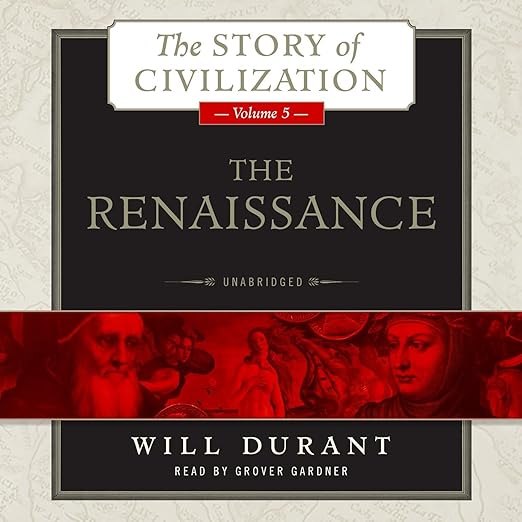
Before You Press Play
- Read by: Grover Gardner is one of the finest voices in historical audiobooks, and his measured, authoritative delivery is a nearly perfect match for Durant's elevated prose style.
- At its heart: the birth of humanism, art and power in Renaissance Italy, the church and political ambition
- Vibe: Expansive and intellectually rich, best absorbed in long dedicated sessions
- Short version: A monumental work of popular historical scholarship, made more accessible than ever by Gardner's narration, though its encyclopedic sweep occasionally sacrifices analytical depth for coverage.
Thirty-seven hours is a serious commitment, and I do not recommend approaching The Renaissance the way you might approach a contemporary narrative nonfiction title - in short bursts between tasks. Durant rewards sustained attention. I listened to large sections of this fifth volume of the Story of Civilization over the course of two weeks on evening walks, and what struck me most was how little the experience of listening to great historical prose has changed since Durant wrote this in the mid-twentieth century. The man could write. Whatever your view of his analytical frameworks, his sentences are events in themselves.
Grover Gardner narrates, and if you have spent time in the Audible catalog you will know his voice immediately: measured, slightly formal, with a warmth that keeps the academic material from calcifying. One reviewer described being able to listen to Gardner read the phone book, which overstates the case only slightly.
Durant's The Renaissance covers Italy from 1304 to 1576, which means it encompasses Petrarch and Boccaccio at one end and the last years of Titian at the other. In between you get Leonardo, Michelangelo, the Sforzas and the Borgias, the popes of Avignon and Rome, Machiavelli's political thought, and the Italian Wars. The scope is genuinely astonishing. Durant works by accumulation: biography, cultural description, artistic analysis, and political history layered one on top of another. The result is something like a very large and very well-organized memory palace of the Italian Renaissance.
Why It Works in Audio
This is the fifth volume in an eleven-volume series that Durant and his wife Ariel worked on for most of their adult lives, winning the Pulitzer Prize in 1968. The audiobook release makes this kind of long-form historical synthesis newly accessible to readers who would never sit down with a physical 800-page volume. Gardner's narration also does something important: it paces the material in a way that lets listeners absorb the density without feeling overwhelmed. The chapter transitions are handled cleanly, and Gardner's voice modulates naturally between Durant's more lyrical passages and his denser biographical catalogues.
What to Watch For in The Renaissance
One reviewer with an Art History background offered what I think is the most useful honest critique of this volume: it reads at times like a series of entries on Italian Renaissance artists without sufficient historical and critical synthesis. That reviewer wanted more on Italy's place within Europe and Europe within the world - the larger structural analysis that might explain why the Renaissance happened where and when it did. That is a fair observation. Durant is at his best doing portrait-painting of individuals and cultures; he is less interested in the kind of systemic historical argument that later twentieth-century historiography made central. If you come to this expecting the analytical architecture of a Braudel or a Burckhardt, you will find Durant's approach more impressionistic than you might wish.
Who Will Get the Most From It
General readers with an appetite for richly detailed historical narrative will find this among the most satisfying long audiobooks available. It rewards listeners who can commit to the full run rather than dipping in selectively. Art history enthusiasts, Italophiles, and anyone who has been to Florence and wanted deeper context for what they saw will find Durant's portrait of that world vivid and illuminating. Academic historians who want contemporary analytical frameworks will need to supplement this with more recent scholarship, but as a grand narrative synthesis of the Italian Renaissance, it remains genuinely distinguished work. There is also something to be said for listening to a text written by someone who genuinely loved the period he was studying - Durant's enthusiasm for the artists and thinkers of fifteenth-century Italy is never less than palpable, and Gardner's narration transmits that enthusiasm intact. There is also something to be said for listening to a text written by someone who genuinely loved the period he was studying - Durant's enthusiasm for the artists and thinkers of fifteenth-century Italy is never less than palpable, and Gardner's narration transmits that enthusiasm intact.
How does Grover Gardner's narration handle the density of Durant's historical prose?
Gardner is one of the most experienced readers of serious historical nonfiction in the Audible catalog and his pacing is well calibrated to Durant's style. He manages both the lyrical passages and the denser biographical catalogues with equal assurance.
Is this the abridged or unabridged version?
The Blackstone Audio release narrated by Gardner is the unabridged version, running 37 hours and 9 minutes.
How does Durant's approach to Renaissance history compare to more recent scholarship?
Durant works primarily through biographical portrait and cultural description rather than systemic historical analysis. For more recent and analytically rigorous approaches to the period, works by scholars like Lisa Jardine or Christopher Hibbert provide useful complements.