Quick Take
- Narration: Jonathan Yen’s warm and unhurried delivery matches the book’s wide-ranging curiosity, he reads like someone who actually finds this material fascinating.
- Themes: Botanical science, the economics and culture of flowers, human relationships with the natural world
- Mood: Expansive and delighted, a book that keeps discovering new things to love about its subject
- Verdict: Stephen Buchmann’s enthusiasm for flowers is completely contagious, and Jonathan Yen’s narration makes fourteen hours feel like an extended conversation with a very knowledgeable friend.
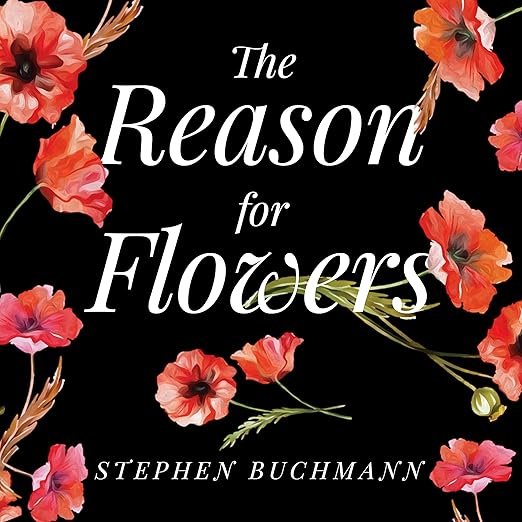
I started The Reason for Flowers on a Saturday morning in late spring, sitting on my fire escape with coffee, watching the potted jasmine I’d been neglecting finally push out a handful of small white blooms. I don’t think I could have chosen a better entry point. Stephen Buchmann writes with the kind of infectious enthusiasm that makes you want to look more carefully at everything around you, and by the time Jonathan Yen had read me through the opening chapters about flower evolution and pollinator relationships, I was regarding my struggling jasmine with considerably more respect.
Buchmann is an entomologist and pollination ecologist by training, and his expertise shows, but not in the way academic expertise usually shows in popular science writing, which is to say not as a barrier between the reader and the subject. He moves through the subject of flowers with the confidence of someone who has spent his career in this territory and can afford to be generous with what he knows. The book covers an extraordinary range: the evolution of flowering plants, the mechanics of pollination, the global cut-flower industry, the perfume trade ($30 billion annually, Buchmann notes with evident relish), the role of flowers in art and literature across cultures, edible flowers, medicinal plants, flowers in crime forensics. One reviewer described it as a wonderful book on the natural history, economics, and beauty of flowers, which is a perfect summary.
Our Take on The Reason for Flowers
What Buchmann does that most popular science writers don’t is integrate the scientific and the cultural without privileging either. A chapter on what colors different pollinators can see transitions naturally into a discussion of how painters have represented flowers throughout art history, and neither section feels like padding for the other. The book’s thesis, that flowers are genuinely essential to human civilization, not merely pretty, is demonstrated rather than argued. By the time Buchmann has taken you through the food systems, the medicines, the perfumes, the textiles, and the art that flowering plants have made possible, the case is made without any of it feeling like a lecture.
The research trips scattered through the book are among its best passages. Buchmann has traveled extensively in pursuit of his subject, and when he describes particular fieldwork encounters, with specific pollinators, specific farming communities, specific perfumers, the writing sharpens from survey into memoir. Those moments give the book its human texture and prevent it from becoming purely encyclopedic.
Why Listen to The Reason for Flowers
Jonathan Yen is an excellent narrator for this material. He conveys Buchmann’s enthusiasm without exaggerating it, and his pacing is well-suited to a book that covers a lot of ground: quick enough to maintain momentum, slow enough that the more technical sections land without confusion. At fourteen hours, this is a longer listen than most popular science audiobooks, but the internal variety, the shifts between botany, economics, history, art, and personal narrative, prevents any particular stretch from feeling repetitive.
One reviewer noted that you can open the book anywhere and read about a topic without having to read page by page, which reflects the book’s encyclopedic organization. This also means the audiobook rewards both linear listening and more casual chapter-hopping on topics of interest. Gardeners will find the agricultural and horticultural sections particularly rewarding; perfume enthusiasts will want to linger in the chapters on scent; readers with an interest in ecological systems will find the pollinator material rich and occasionally alarming.
What to Watch For in The Reason for Flowers
The book’s breadth is also its primary limitation. Some chapters are more developed than others, and the sections on flowers in art and literature, while interesting, are less rigorous than the natural history chapters. Buchmann is more persuasive about the science of flowers than about their cultural significance, and occasionally the cultural sections read as enjoyable digressions rather than fully integrated arguments.
The publication date of 2015 means some of the statistics, particularly around the cut-flower industry and pollinator population data, have been superseded by more recent research. The fundamental science is sound, but listeners with professional interests in pollination ecology or agricultural economics may find some of the quantitative claims dated.
Who Should Listen to The Reason for Flowers
Gardeners, naturalists, and anyone interested in the intersection of science, culture, and commerce will find The Reason for Flowers consistently rewarding. It works particularly well for listeners who enjoy popular science in the tradition of Michael Pollan’s The Botany of Desire, a book Buchmann’s work resembles in both scope and sensibility, though Buchmann is more technical and less literary than Pollan. Jonathan Yen’s narration makes the audiobook an ideal format for this material: a long walk through a very well-stocked garden with a guide who genuinely loves what he’s showing you. The 4.5 rating from 137 listeners reflects a readership that met the book where it lives, curious, generous, and interested in being surprised by something they thought they already understood.
Frequently Asked Questions
Do I need a scientific background to follow the botany and ecology sections?
No. Buchmann writes for a general audience with genuine care about accessibility. Technical concepts are explained clearly without being condescending, and the book’s range of topics means that even readers without scientific backgrounds will find many sections immediately accessible.
How does Jonathan Yen handle the diversity of topics across 14 hours?
Very naturally. Yen’s delivery conveys genuine engagement with the material and adjusts its pacing to the different registers, more measured for the ecological science, more conversational for the cultural and historical sections. The fourteen hours pass without fatigue.
How does this compare to Michael Pollan’s The Botany of Desire?
Both explore human relationships with plants, but Buchmann is more comprehensive and more scientifically rigorous. Pollan is more literary and structurally elegant. If you enjoyed The Botany of Desire, The Reason for Flowers is a natural companion, broader in scope, more encyclopedic, and equally enthusiastic about its subject.
Is the book dated given it was published in 2015?
Some statistics, particularly around pollinator populations and cut-flower industry figures, may be outdated. The fundamental natural history and evolutionary science is sound, and the cultural material is not time-sensitive. For current research on pollinator decline, supplement with more recent sources.