Quick Take
- Narration: Roger Wayne’s voice suits the immersive, character-driven journalism of this book, he handles both the lyrical descriptive passages and the harder investigative material with equal steadiness.
- Themes: Digital disconnection, Appalachian community identity, the hidden costs of constant connectivity
- Mood: Layered and quietly unsettling, with the atmosphere of a New Yorker long-read extended into a full book
- Verdict: Kurczy’s portrait of Green Bank, West Virginia is far stranger and more morally complex than its premise suggests, and Roger Wayne’s narration does justice to both the beauty and the darkness.
One of the reviews I kept returning to while preparing this piece came from a listener who noted, with excellent self-awareness, that he had listened to The Quiet Zone ironically on his phone. That observation captures something essential about this book: it asks you to sit with the paradox of consuming, through the very technology it questions, an extended meditation on what it means to live without that technology. Kurczy seems to have planned for this. The irony is not incidental; it is structural.
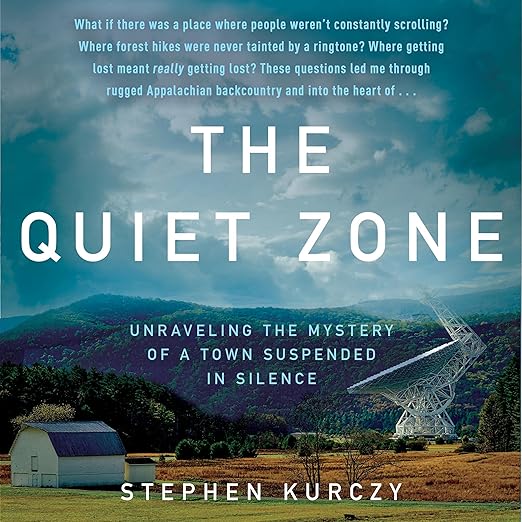
Green Bank, West Virginia, which sits inside the National Radio Quiet Zone, is a genuinely unusual place. The Green Bank Observatory’s telescopes are sensitive enough to detect signals from billions of light-years away, and that sensitivity requires near-total suppression of radio frequencies in the surrounding area. No WiFi, no cell phones, no Bluetooth, no smart devices. Residents who want these things must drive to the nearest town. People who cannot tolerate wireless radiation, the so-called electrosensitives, have migrated there for relief. So, more troublingly, has at least one neo-Nazi encampment. And the observatory’s astronomers are searching for signals from civilizations that may no longer exist.
The Cast of Characters That Earns the Book Its Stars
Kurczy embedded in Green Bank for an extended period, and the result is a portrait that could not have been written at a distance. He shops at the general store, attends church services, goes target shooting with a seven-year-old, square-dances with locals, and samples the moonshine. These are not color details; they are methodology. The book works because Kurczy has made himself genuinely present, and because the community is large enough to contain contradictions that tourism journalism would smooth over.
The cast of characters is extraordinary. A tech buster who patrols for illegal radio waves with specialized equipment. A sheriff’s department with a string of unsolved murder cases stretching back decades. Residents who moved there for simplicity and found something more complicated. The electrosensitives, whose condition is not recognized by mainstream medicine but whose suffering appears genuine and whose relocation to Green Bank represents a kind of invisible migration story. And the astronomers, who represent the opposite of small-town insularity, people searching for the universe’s most distant whispers, living among people who have deliberately withdrawn from their nearest neighbors’ signals.
The Dark Thread Running Through the Idyll
Bill McKibben’s endorsement, that The Quiet Zone will live on in your memory, is specifically about this: the book is not a celebration of disconnection. The places where quiet can serve as a cover for something darker, mentioned in the synopsis without specificity, turn out to include both the unsolved murders and the neo-Nazi presence, and Kurczy handles both with the care of someone who knows how easy it would be to sensationalize either. He does not. The darkness is present and documented but not exploited for atmosphere.
Roger Wayne’s narration manages this tonal complexity well. Kurczy writes with genuine literary ambition in his descriptive passages, Appalachian landscape, rural American pace, the specific quality of silence that the absence of RF emissions actually creates, and Wayne does not flatten these into generic nonfiction delivery. He reads the atmospheric passages with more breath and space, and the investigative sections with corresponding directness.
The Question at the Center
The book’s animating question, is a less connected life desirable, and is it even possible, never receives a simple answer because the answer is genuinely not simple. The people who have chosen Green Bank for various reasons are not uniformly happier or more present or more communally connected than people elsewhere. Some are, some are not. The community contains as much isolation as it does togetherness, as much suspicion as warmth. What it does not contain is the particular kind of distraction that Kurczy had been living inside before he arrived, and the absence of that distraction creates space for the full complexity of human behavior to be visible in ways that constant connectivity tends to blur.
Reviewer Frances Kaplan called it not your grandpa’s dull history book and totally engrossing, which is accurate for a certain kind of reader. This is a book for people who want to think while they listen, who enjoy narrative nonfiction that does not resolve its tensions neatly. Kirkus called it captivating. BookPage gave it a starred review and called it deeply reported and slightly eerie. Those assessments are all true simultaneously, which is what makes the book memorable.
Who Should Listen, Who Should Skip
The Quiet Zone is for listeners who enjoy immersive long-form journalism, character-driven nonfiction, and books that use a specific place to ask broader questions. It rewards attentive listening more than background listening: the atmospheric passages benefit from being actually present in them. Skip it if you want a straightforward argument for or against digital disconnection; Kurczy is too honest a reporter to make that argument. Also be prepared for the book to be darker than the premise might suggest.
Frequently Asked Questions
Is The Quiet Zone primarily a nature-and-community memoir or investigative journalism?
Both, and the combination is what makes it unusual. Kurczy’s embedded reporting produces genuine community portraiture while his investigative instincts surface the darker elements, the unsolved murders, the extremist presence, that a more celebratory treatment would have avoided.
How does Roger Wayne’s narration handle the book’s range from lyrical landscape description to hard investigative reporting?
With notable skill. Wayne modulates his delivery for the different registers without making the shift obvious. The atmospheric passages have more space and breath; the investigative passages are more direct. It is a professional narration that earns the material rather than merely delivering it.
Does the book take a position on whether digital disconnection is good for communities?
Not simply. Kurczy is too careful a reporter to make a clean argument either way. Green Bank contains both the genuine benefits of quiet and significant social problems that the absence of connectivity does not solve. The question remains open at the book’s close, which is the honest answer.
Who are the electrosensitives mentioned in the synopsis, and how does Kurczy treat their accounts?
Electrosensitives are people who report adverse physical symptoms from exposure to wireless radio frequencies. Their condition is not recognized by mainstream medicine. Kurczy treats them with journalistic care: their suffering appears genuine and their accounts are presented without mockery, but he does not validate the medical claim. It is one of the book’s more careful balancing acts.