The Short Version
- Narration: Myriam Berger's delivery is calm and measured - the pacing feels deliberately unhurried, which mirrors the book's core philosophy of not forcing change. An appropriate match for reflective material.
- Themes: emotional resilience, self-compassion, managing uncertainty without forced positivity
- Mood: Gentle and grounding, like a long exhale
- Verdict: A short but well-structured companion for emotional exhaustion - best for listeners who need permission to slow down rather than a roadmap to overhaul their lives.
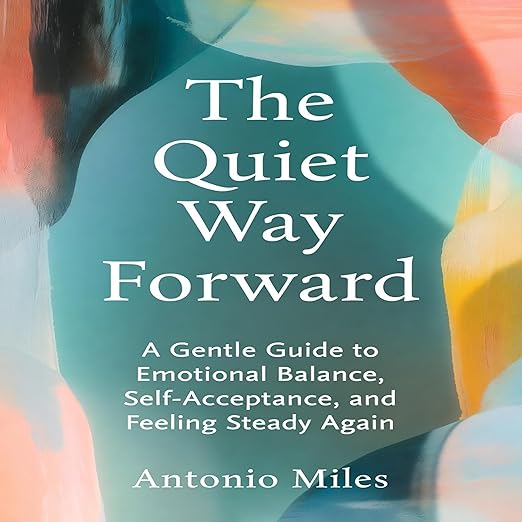
Antonio Miles wrote The Quiet Way Forward for a specific kind of reader: not someone in acute crisis, but someone who is holding everything together on the outside while feeling quietly depleted on the inside. The audiobook, narrated by Myriam Berger, opens with that acknowledgment directly - this is for the days when you are functioning but not flourishing, when the gap between how you appear and how you feel has become its own source of exhaustion. At 1 hour and 13 minutes, it is one of the shorter personal development listens on the market, and that brevity is itself a design choice. Miles is not trying to overhaul your life. He is offering a set of smaller moves for returning to steadiness.
Emotional Anchors Replace Empty Affirmations
The organizing concept in The Quiet Way Forward is what Miles calls "emotional anchors" - small, specific habits that create a sense of psychological safety in ordinary circumstances without requiring dramatic change or sustained willpower. The framing is explicitly anti-perfectionist: the book opens with the direct statement that this is not about fixing yourself, and it maintains that position throughout. What distinguishes this from other gentler wellness audiobooks is the precision of its targets. Miles addresses the specific experience of self-judgment as an obstacle to self-awareness - the way a critical inner voice compounds difficulty rather than motivating resolution. He offers the practice of replacing that voice not with empty affirmation but with what he calls "supportive self-awareness," a distinction that requires some care to unpack. The idea is that genuine self-awareness includes both what is difficult and what is working, and that a supportive orientation toward that awareness - rather than a judgmental or performatively positive one - is what creates sustainable change. That framing is more nuanced than the phrase "self-compassion" usually implies, and Miles earns the distinction by working through it rather than assuming it. Berger's narration is well-suited to this material: her pace is calm without being soporific, and she reads with enough warmth that the reflective invitations in the text land as genuine rather than scripted.
Quiet Authority Instead of Motivational Uplift
The short runtime - just over an hour - makes this audiobook unusually accessible for the audience it targets. People who are emotionally stretched and time-poor are not always able to commit to a 10-hour personal development listen, and Miles seems to have built the book with that constraint in mind. The content moves through its framework efficiently: calming emotional noise, replacing self-judgment with self-awareness, pausing without guilt, building flexible balance rather than rigid control, creating emotional anchors for daily stability, and navigating uncertainty without suppressing joy alongside hard days. Each section is short enough to absorb in a single commute segment and specific enough to be applied the same day. The audiobook avoids the motivational uplift register that makes much of this genre feel hollow on reflection - Miles writes with a quieter authority, acknowledging difficulty rather than papering over it. The specific framework of emotional anchors is the book's most practical contribution: the idea that small habitual actions, chosen deliberately, can provide a sense of psychological ground during uncertain periods is both well-supported in psychological literature and underrepresented in popular self-help writing. For listeners who respond better to permission than prescription, the tone will feel like a relief. The high 4.9 rating reflects a small but strongly engaged readership that found exactly what they were looking for.
Best Suited to Readers Who Already Self-Reflect
The brevity that makes this audiobook accessible also means it cannot go deep on any of its topics. The emotional anchor framework is introduced and illustrated but not developed with the clinical detail that some listeners may want. Miles draws on self-help and mindfulness traditions rather than clinical psychology, and the book is transparent about that - this is not a therapeutic intervention or a CBT-based program with evidence summaries and structured protocols. Listeners who need more structured or evidence-based support for significant mental health challenges should treat this as supplemental reading rather than a primary resource. The book also works best for listeners who already have some capacity for self-reflection and are looking for language and structure to organize what they already sense. Listeners encountering concepts like emotional anchors or supportive self-awareness for the first time without any prior exposure to mindfulness or reflective practice may need more scaffolding than Miles provides. The audiobook's brief duration means that the framework is gestured toward rather than exhausted, and some listeners may find the listen valuable primarily as an introduction that points toward deeper exploration elsewhere.
Berger's Narration Suits Low-Grade Emotional Fatigue
This audiobook suits adults who are managing the low-grade emotional fatigue of sustained pressure - work demands, caregiving, relational difficulty - and want a gentle, non-demanding framework for returning to steadiness rather than a program requiring significant daily commitment. The short runtime makes it particularly suited for listeners with limited time or energy. Myriam Berger's narration adds real value to the audio format, lending the reflective passages an appropriate quiet weight. Skip this one if you need clinical structure, evidence-based frameworks for mental health conditions, or an audiobook long enough to explore its topics in depth. And skip it if you are looking for high-energy motivational content - the entire point of The Quiet Way Forward is to be the opposite of that approach.
Before You Listen
How does narrator Myriam Berger's performance shape the listening experience of The Quiet Way Forward audiobook?
Berger's unhurried, warm delivery matches the book's philosophy almost exactly. She does not rush through the reflective passages, and the pacing creates the kind of breathing room the material is asking for. For a book about slowing down and listening to yourself with kindness, the narration reinforces rather than contradicts the message.
Does The Quiet Way Forward audiobook require any prior knowledge of mindfulness or personal development to benefit from?
No prior knowledge required. Miles explains his concepts from first principles and the language is accessible without being dumbed-down. Listeners already familiar with mindfulness or CBT concepts will recognize some of the underlying ideas but will find the framing fresh. It works as an entry point as well as a refresher.