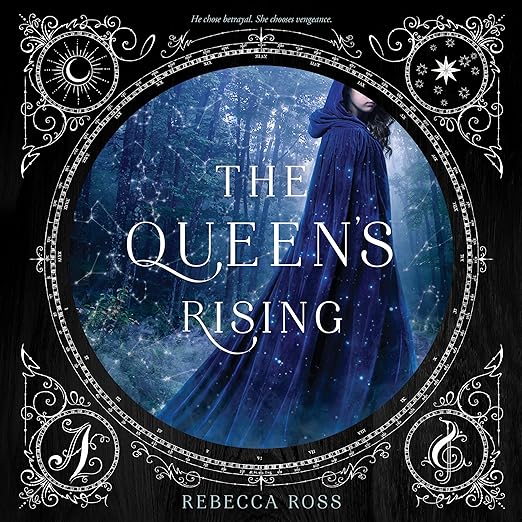
Brienna's story in The Queen's Rising begins not with a sword but with a failure, and that is exactly what makes this audiobook compelling from its opening minutes. Rebecca Ross's debut fantasy, narrated by Suzanne Elise Freeman, places us inside Magnalia House, where young women study one of five passions - art, music, dramatics, wit, and knowledge - in hopes of securing a patron. Brienna can master none of them until, almost by default, she chooses knowledge. What could easily have been a setup for wish fulfillment becomes instead a meditation on what it means to belong nowhere, and what that cost looks like when the world is about to demand everything from you. Freeman's voice carries this opening section with the gentle authority of someone who understands that the quiet scenes are as load-bearing as the action sequences. The series, which continues with The Queen's Resistance, establishes its world here with unusual confidence for a debut.
What Rebecca Ross Delivers
Ross draws on Renaissance France for her primary kingdom of Valenia, and the result is a world that feels culturally specific rather than generically medieval. The passion system - which functions somewhere between a guild education and a formal apprenticeship - is inventive enough to carry the early chapters without leaning on conflict. When a disgraced lord named Cartier finally offers Brienna his patronage, the novel shifts registers: suddenly the intellectual exercises she has been practicing have a clandestine application, and the plot to restore the rightful queen of the rival kingdom of Maevana to her throne brings magic, political intrigue, and personal loyalty into collision. Reviewers have praised how the worldbuilding never stalls the pacing, and listening confirms that Ross threads this needle carefully. Freeman sustains a consistent emotional temperature - never over-performing the reveals, never letting the slower passages lose their tension. At twelve hours and fifty-one minutes, the audiobook earns its runtime through accumulation rather than spectacle.
What Rebecca Ross Gets Right
The particular pleasure of listening to this book rather than reading it comes from Freeman's handling of the memory sequences - moments where Brienna experiences recollections that are not entirely her own, fragments of the queen whose cause she will eventually serve. These passages require a narrator who can signal the shift in consciousness without tipping into melodrama, and Freeman does it through subtle pitch and tempo changes rather than any theatrical announcement. The result is a listening experience that rewards attention. Readers coming to this after Ross's later work, particularly Divine Rivals, will notice the same characteristic care with romance - kept at a slow burn, earned through shared purpose rather than declared feeling. One reviewer noted they stayed up late turning pages after the first few lines caught them; the audiobook version generates a similar pull through Freeman's pacing, which makes the quieter chapters feel like the calm before something important rather than padding.
Where Rebecca Ross Loses Some Ground
Ross uses a device that takes a chapter or two to fully orient yourself to: Brienna's ancestral memories surface during her passion studies and gradually reveal the political stakes of the Maevanan conflict. Listeners unfamiliar with this technique may find the early memory sequences initially disorienting. Stay with them. The payoff is a second narrative strand running beneath the primary story, one that gives the Maevanan rebellion historical and emotional weight rather than leaving it as abstract backdrop. There is also a deliberate ambiguity around Cartier's true intentions that Freeman plays carefully - never telegraphing the reveal, but not entirely withholding it either. The final act, where Brienna must choose between the loyalty she was trained for and the blood she discovers she carries, resolves with a moral clarity that avoids easy answers. Fans of Grave Mercy and Red Queen, as the synopsis suggests, will find the tonal register familiar; those new to this kind of political fantasy will find the entry point well constructed.
Who Should Pick Up The Queen's Rising
This audiobook works well for listeners who enjoy historical-adjacent fantasy with a strong female lead navigating institutional structures - think less battle epic and more political apprenticeship. It suits readers who responded to Bonnie Garmus's Lessons in Chemistry in its attention to the slow build of female competence against a system designed to limit it, though the register here is fantasy rather than satire. Those expecting wall-to-wall action will find the first third requires patience. Listeners who give the passion-house chapters the attention they deserve will find the back half of the book considerably richer for it. The series continues, so readers who prefer fully self-contained stories should know the ending here is satisfying but deliberately opens toward The Queen's Resistance.
The structural choice to set Brienna's education at Magnalia House before moving to the political conflict in Maevana mirrors a pattern in fantasy writing that is often undervalued: the novel invests substantially in establishing what its protagonist wants before placing her in a situation that makes wanting anything complicated. Freeman's narration honors that investment. When Brienna arrives in Maevana and the story shifts from apprenticeship to rebellion, the listener already cares about what she is risking, which is the work the first third of the book quietly does. For readers who find the opening act slow, a second listen to those early chapters in light of the ending reveals how much groundwork Ross was laying. The series pair - this book and The Queen's Resistance - rewards binge listening more than most YA duologies because the emotional arc needs both volumes to complete itself fully.
The structural choice to set Brienna's education at Magnalia House before moving to the political conflict in Maevana mirrors a pattern in fantasy writing that is often undervalued: the novel invests substantially in establishing what its protagonist wants before placing her in a situation that makes wanting anything complicated. Freeman's narration honors that investment. When Brienna arrives in Maevana and the story shifts from apprenticeship to rebellion, the listener already cares about what she is risking, which is the work the first third of the book quietly does. For readers who find the opening act slow, a second listen to those early chapters in light of the ending reveals how much groundwork Ross was laying. The series pair - this book and The Queen's Resistance - rewards binge listening more than most YA duologies because the emotional arc needs both volumes to complete itself fully.
Before You Listen
Is the audiobook of The Queen's Rising suitable for adult listeners or strictly YA?
Several reviewers explicitly note that the complexity of the worldbuilding and political plotting holds up for adult fantasy readers. The romance is restrained and the thematic content - identity, inherited guilt, political betrayal - rewards adult engagement. The YA classification reflects the protagonist's age and coming-of-age arc, not a ceiling on the material.
Does Suzanne Elise Freeman handle the dual-narrative structure well in the audiobook?
Freeman's narration is one of the stronger arguments for the audio format here. The ancestral memory sequences require tonal differentiation without breaking immersion, and she achieves this through pacing and pitch modulation rather than overt character voices. Listeners who found those sequences interesting in print tend to find them more atmospheric when listened to.
Do I need to listen to any other books before starting The Queen's Rising?
No. This is the first book in the series and functions as a complete entry point. It introduces all the worldbuilding from scratch, and while it opens toward a sequel, the primary conflict and central character arc reach a genuine resolution by the end.
How does the magic system in the audiobook compare to typical fantasy?
The magic in Maevana is tied to the royal bloodline and to specific women whose abilities have been suppressed by the ruling king. It is less a system of spells and more a form of inherited power that Brienna slowly comes to understand. The audiobook's treatment makes the magic feel like a political right rather than a technical ability, which is consistent with the book's broader themes about who gets to hold power and why.