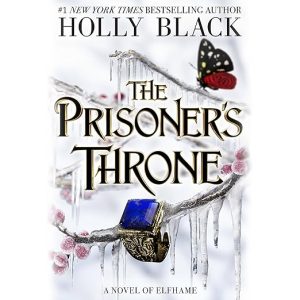
The Short Version
- Voice: Barrett Leddy takes over from Saskia Maarleveld for Oak's POV chapters, his narration gives the prince a different texture that works better as the story progresses.
- Big ideas: Loyalty and betrayal, the ethics of manipulation, identity under constraint
- Atmosphere: Darker and more claustrophobic than the first book, with flashes of dark humor
- Worth it?: A satisfying duology conclusion for those invested in Wren and Oak, though readers who struggled with Wren's characterization in Book 1 may not find resolution here.
I started The Prisoner's Throne the morning after I finished The Stolen Heir, which is probably the only way to read this duology, as a continuous experience rather than two books with breathing room between them. The shift in perspective from Wren to Oak in the opening chapters is immediately disorienting in a useful way: what Wren withheld from us about herself becomes visible the moment we are inside someone else's head looking at her.
Prince Oak is in a cell in the frozen north, imprisoned by Wren, now declaring herself queen of a reconstituted court, and relying on exactly the qualities that made him untrustworthy in the first book to survive. He is charming and calculating, and the novel forces him to keep performing charm for an audience who knows his performance is a performance. Meanwhile, Cardan and Jude are mobilizing in the south, willing to start a war to retrieve their stolen heir. The duology's final question is not whether Oak escapes but what kind of person will be left when survival no longer requires the performance.
How The Prisoner's Throne Holds Up
Holly Black makes a structural gamble by centering this finale on Oak rather than Wren. After a first book that worked hard to establish Wren's fractured perspective, shifting that perspective away from her in the conclusion means we see her through Oak's lens instead of our own, and his lens is admittedly complicated. Readers who struggled to connect with Wren will not suddenly find her more accessible here; they will find her filtered through someone who wants her and fears her in roughly equal measure.
What this achieves is a different kind of emotional texture. The book is about what it costs Oak to acknowledge that his charm is not a gift but a tool he learned to deploy in a court that would otherwise discard him, and that revelation, delivered through accumulated scenes of captivity and choice, gives him a weight he lacked as a secondary figure in the Cruel Prince trilogy. Reviewers who loved the Jurdan cameos and Madoc's presence are not wrong to flag them; Black writes the older generation of Elfhame characters with a casual authority that the newer ones are still earning.
Barrett Leddy's performance as Oak is the strongest argument for this format. The prince's charm needs to read simultaneously as genuine and constructed, and Leddy walks that line with control, he can make the same line sound like a real feeling and a tactical move depending on who Oak is performing for in a given scene. The claustrophobic quality of the northern prison setting is served by the audio format; there is very little visual spectacle to carry a reader's attention here, and Leddy's pacing keeps the stakes alive through interiority rather than action.
The duology's conclusion delivers on its New York Times number-one status. Black does not soften the final confrontations into tidy resolution, the Wren who emerges from this book has not been fixed or healed so much as she has made a choice about what kind of queen she will be, which is a significantly more honest ending than the genre typically provides.
Weak Spots in The Prisoner's Throne
The Wren characterization remains divisive. Reviewers split clearly between those who found her arc devastating and those who found her difficult to root for across both volumes. If your patience for characters who act from damage rather than clarity was strained in The Stolen Heir, Book 2 will test it further before the final act provides catharsis. The pacing in the middle third slows considerably as Oak and Wren circle each other in the prison context, this is deliberate, but it requires patience. The war mobilization subplot involving Cardan and Jude moves in parallel and provides the book's most propulsive sequences.
Who Should Listen to The Prisoner's Throne
This is for readers who have already listened to The Stolen Heir and want the conclusion. It does not function as a standalone and should not be started without the first volume. For those who loved The Stolen Heir and Maarleveld's narration, the transition to Leddy as Oak takes an adjustment period but ultimately serves the shift in perspective. Fans who specifically want more Jude and Cardan content will find them present but clearly in support roles rather than center stage.
Questions Listeners Ask
Why does the narrator change between The Stolen Heir and The Prisoner's Throne?
The perspective shifts from Wren to Oak, which prompted the use of Barrett Leddy in place of Saskia Maarleveld. This is a deliberate casting choice aligned with the POV change rather than a production error.
How much page time do Jude and Cardan get in The Prisoner's Throne?
They appear in a meaningful subplot involving the war mobilization from Elfhame, but they are supporting players rather than central figures. Their scenes are among the book's most propulsive but they do not carry the primary emotional arc.
Does The Prisoner's Throne provide a satisfying conclusion to Wren's trauma arc?
Readers are divided. Black gives Wren a resolution that is honest rather than tidy, she makes choices and claims an identity rather than being healed. Listeners who want cathartic healing arcs may find it unsatisfying; those who want honest character work will likely appreciate it.