Before You Press Play
- Performance: Bob Souer delivers a clean, accessible read that keeps pace with the material's intellectual density without over-dramatizing; his voice suits the popular-science register of Quanta Magazine's editorial voice.
- What it covers: prime number theory, the nature of mathematical proof, the boundary between pure and applied mathematics
- Feel: Intellectually stimulating and genuinely surprising
- Our call: Listeners who enjoy popular mathematics writing and want access to current research frontiers will find this Quanta collection a more substantial ten hours than most science audiobooks offer.
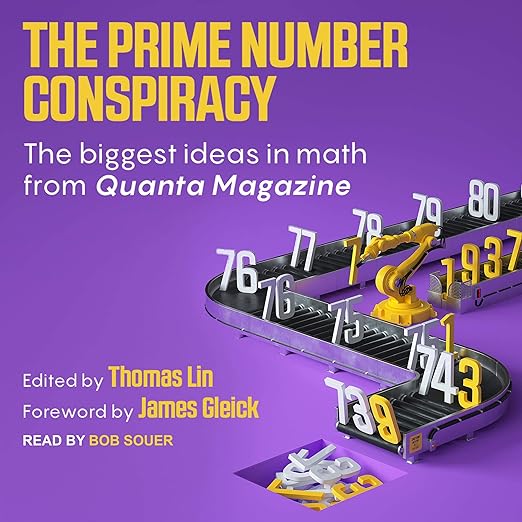
Prime numbers have been hiding a statistical preference for centuries. Not a conspiracy in any human sense, but a genuine discovered bias - a pattern in which digit a prime tends to prefer in the prime that immediately follows it - and the story of how mathematicians Kannan Soundararajan and Robert Lemke Oliver found this preference in 2016, years after anyone thought such a basic pattern could still be unknown, is the kind of thing that should not be possible but demonstrably is. The Prime Number Conspiracy, edited by Thomas Lin and narrated by Bob Souer in this audiobook, collects Quanta Magazine's best mathematics writing, and that titular discovery is one of more than a dozen stories of mathematical surprise packed into these ten hours.
Where This One Lands
Quanta Magazine occupies a distinctive position in science journalism. Unlike outlets that treat mathematics as either inaccessibly abstract or merely applicable, Quanta takes mathematical ideas seriously on their own terms while investing heavily in the human stories of researchers working at the frontier. The result, in this collection, is writing that explains what a pentagon tiling proof actually demonstrates and why no one had solved it in a century, without losing the texture of the people who found the answer. Editor Thomas Lin's framing - that listeners are headed on breathtaking intellectual journeys to the bleeding edge of discovery strapped to the narrative rocket of humanity's never-ending pursuit of knowledge - is florid, but the pieces that follow largely justify the ambition.
The collection covers a range of mathematical terrain. The prime number story gives the book its title and provides the clearest narrative hook. From there the book moves through a unified theory of randomness, infinity's measurable structure, a century-old geometry problem solved by an amateur mathematician named Marjorie Rice, and the philosophical question of whether mathematics is invented or discovered. The breadth is one of the collection's strengths, but it means the listening experience is genuinely heterogeneous; some pieces are primarily narrative, others are primarily conceptual, and the intellectual demands shift from chapter to chapter.
Souer's narration is steady and clear throughout. Popular mathematics writing presents specific challenges for audio: equations cannot be read aloud, and abstract spatial or numerical relationships that are easy to follow with a diagram require careful verbal construction to remain coherent in sound alone. Souer navigates this well; he paces himself through the more demanding conceptual passages rather than rushing forward, and the result is that even complex material like the limits of computation or the Langlands program's unified mathematical landscape remains followable on a first listen. At ten hours, the audiobook is a reasonable investment for this kind of material - long enough to develop each story properly, not so long that the collection starts to feel repetitive.
One reviewer explicitly notes that this is not as strong as Quanta's physics collection, Alice and Bob Meet the Wall of Fire, and that observation is worth registering. The prime number discovery piece and the geometry chapters are among the strongest; a few of the more abstract theoretical pieces - particularly those dealing with foundational questions in logic and computation - require more concentration than the audio format easily supports. Listeners who lose the thread in those sections should not feel they are missing something essential to the collection as a whole; the pieces are independent, and the book rewards selective re-listening.
Weak Spots in The Prime Number Conspiracy
The chapter on measuring infinity is one of the collection's most satisfying. The counterintuitive nature of Cantor's transfinite arithmetic - the idea that some infinities are larger than others, and that this can be proved rigorously - is the kind of mathematical result that seems like a joke until you see the proof, and Quanta's writers explain the proof's logic clearly enough that a careful listener will actually grasp why it works rather than simply being told that it does. That distinction between understanding and being told is what separates good popular mathematics writing from the kind that leaves readers impressed but no more knowledgeable than when they started.
The philosophical piece asking whether mathematics is good for you - whether pure mathematical research has a social obligation to seek applications - is a useful bookend for the collection. It sits outside the specific research narratives and asks a broader question about the discipline's identity. For listeners who have come through the book's specific discoveries feeling energized by mathematical beauty, that closing question lands with more weight than it would in isolation. One reviewer describes it as a fun romp through more recent math discoveries told in an exciting manner, and that informal description captures what the best chapters actually achieve.
Recommended For
Listeners who enjoy popular science writing and want something more rigorous than the average audiobook in that space will find this collection delivers. Regular Quanta Magazine readers will know exactly what they are getting - the same quality of reporting, in audio form. Listeners without a mathematics background should not be deterred; multiple reviews note that the pieces are accessible to people who have not progressed past Calculus I, and the researchers' human stories carry the chapters where the pure mathematics becomes demanding. The audiobook is not suited for listeners who want sustained narrative or a single through-line - it is a magazine collection, and it reads like one. Treat it the way you might treat an anthology: some pieces will hit harder than others, and that is expected and fine.