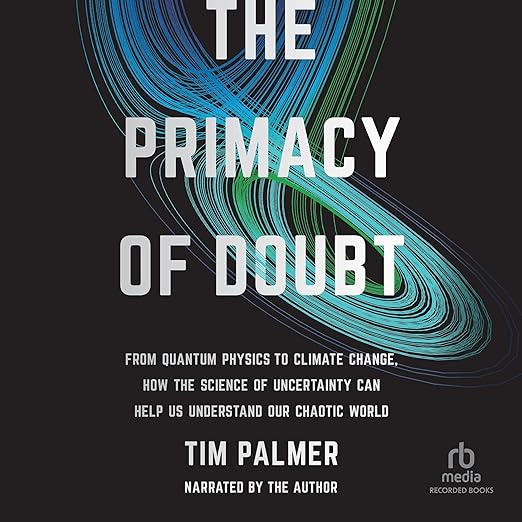
I don't review science books as often as I review fiction, but every so often a work arrives that sits in the borderland between scientific argument and philosophical inquiry in a way that demands engagement on multiple fronts. The Primacy of Doubt is that kind of book. Tim Palmer is an award-winning physicist who pioneered the introduction of uncertainty into weather and climate prediction, which is why your weather app gives you probabilities rather than definitive forecasts. He has spent his career working with what forecasters call ensemble models, running multiple slightly-different simulations to map the range of possible futures rather than committing to a single prediction. His argument is that this approach, treating doubt not as a failure of knowledge but as a fundamental feature of reality, should reshape how we think about everything from quantum mechanics to consciousness to free will. That is an ambitious claim. The book earns most of it.
Palmer opens in familiar territory: the ensemble forecasting approach he developed for weather prediction at the European Centre for Medium-Range Weather Forecasts. This is wise, because it gives the listener a concrete, verifiable application of his core idea before he extends it into more contested territory. You can see, in the weather app on your phone, evidence that uncertainty modeling works better than deterministic prediction. That demonstrated success does real argumentative work when Palmer later applies similar thinking to quantum mechanics and the geometry of chaos.
The connections he draws are genuinely surprising. The link between fractal attractors and the structure of quantum probability isn't an obvious one, and Palmer explains it with enough mathematical grounding that listeners with high school level familiarity with the relevant concepts can follow the logic. One reviewer with expertise in downscaling ensemble weather forecasts reported that reading the book gave him the philosophical background for his own research work, which speaks to the level of engagement the book enables across different levels of technical preparation.
Why Listen to The Primacy of Doubt
Halfway through the book, Palmer turns to questions that most physicists avoid: free will, moral responsibility, and the reconciliation of determinism with lived human experience. His approach is to argue that the geometry of chaos, specifically the structure of strange attractors in dynamical systems, provides a way to hold both determinism and genuine indeterminacy simultaneously. The universe runs on deterministic laws, but those laws produce behavior so sensitive to initial conditions that prediction is structurally impossible in certain regimes.
This is not a new insight in chaos theory. What Palmer does that's relatively new is argue that this structure explains the relationship between quantum randomness and classical determinism in a way that doesn't require many-worlds interpretations or hidden variables. Whether this argument is ultimately correct is a matter for physicists and philosophers to work out. As presented in the audiobook, it is the most coherent account of quantum indeterminacy and free will that I have encountered in popular science writing, which is not a small compliment. One reviewer suggested the argument might be the new Principia. That's probably too much. But the willingness to engage with the deepest questions while remaining anchored in rigorous science is admirable and deserves more attention than most popular physics receives.
What to Watch For in The Primacy of Doubt
The narration is the book's main practical limitation. Palmer is a scientist, not a professional voice actor, and his delivery reflects that. The pacing is academic in the original sense: careful, precise, and unhurried in a way that takes some acclimatization if you're used to more animated popular science narration. What you gain is complete confidence that the person explaining these ideas understands them at a level that goes beyond what the text requires. Palmer doesn't reach for a word and settle for an approximate one. He knows exactly what he means, and it shows.
For listeners who find self-narrated science books rewarding for this reason, the nine hours and forty-one minutes will feel like a graduate seminar with someone who is both brilliant and genuinely committed to making their work accessible. One reviewer who works on research directly connected to ensemble forecasting found the philosophical background provided by the book immediately applicable, which is about as good a real-world endorsement as popular science writing gets.
Who Should Listen to The Primacy of Doubt
This free audiobook will deeply reward listeners who are genuinely curious about the foundations of physics and who are willing to follow an argument that requires full attention. It is not casual listening. The rewards are commensurate with the investment. Those who prefer their science served at a brisker pace or with simpler conclusions may find it demanding. Those who have read popular physics from Brian Greene or Carlo Rovelli and want something that pushes further into the connection between uncertainty and human agency will find this the most rigorous and far-reaching argument currently available in accessible form. It will give you something to think about long after the listening is done.
In Brief
- Performance: Tim Palmer reading his own work brings conviction and precision to the scientific arguments, though some listeners may find his academic delivery slower than a professional narrator's.
- What it covers: Uncertainty as a scientific principle, connections between chaos theory and quantum mechanics, free will and determinism reconsidered
- Feel: Intellectually demanding and exhilarating, patient with complexity
- Our call: A genuinely original scientific argument presented with enough clarity that curious non-specialists can follow, though it asks more of the listener than most popular science books do.