Quick Take
- Narration: Julian Rhind-Tutt brings an understated British composure that suits the book’s tone perfectly, letting the strangeness of the material speak for itself.
- Themes: Parapsychology and institutional psychiatry, the limits of scientific method, premonition as historical phenomenon
- Mood: Quietly eerie, methodical, melancholic
- Verdict: A meticulously researched piece of narrative nonfiction that works best if you approach it as history rather than proof of anything supernatural.
I finished The Premonitions Bureau on a gray Tuesday afternoon, sitting in a chair I had moved closer to the window because the light was failing. That felt appropriate. Sam Knight’s book has the atmosphere of a November afternoon that never quite brightens: not threatening, exactly, but carrying a persistent chill that you cannot shake off after the fact.
Knight is a staff writer at the New Yorker, and his approach to this material is rigorously journalistic. He is not trying to convince you that premonitions are real. He is trying to explain what happened when a British psychiatrist in 1966 decided to take them seriously, and what the consequences were. That distinction matters enormously for setting your expectations about what kind of book this is.
John Barker and the Bureau That Shouldn’t Have Existed
Dr. John Barker ran Shelton Hospital in Shrewsbury, a Victorian psychiatric institution that Knight describes with grim precision. Barker was not a fringe figure. He was a credentialed, conventionally trained psychiatrist whose curiosity about the boundary between psychology and the paranormal eventually consumed him. After the 1966 Aberfan disaster, in which a coal tip collapsed onto a Welsh village school and killed 116 children, Barker became convinced that people had dreamed about the disaster before it happened. He began collecting accounts.
What followed was the Premonitions Bureau, a systematic attempt to log, categorize, and eventually act on premonition reports sent in by the public. The two central figures who emerged from Barker’s network, a London switchboard operator named Kathleen Middleton and a meteorologist named Alan Hencher, are the book’s most haunting presences. They reported visions with a frequency and apparent specificity that Barker found impossible to dismiss. Rhind-Tutt’s narration is particularly effective when handling the correspondence between Barker and his percipients. He gives these exchanges a quiet weight they deserve.
What the Rating Debate Reveals
The book carries a 3.8 rating, which reflects a genuine critical divergence. Some listeners found Knight’s refusal to reach a verdict frustrating. One reviewer noted that of 3,000 logged premonitions, the methodology for checking them was never explained. That criticism is not entirely unfair. Knight is a narrative journalist, not a parapsychologist, and he is more interested in the texture of Barker’s obsession than in adjudicating whether the predictions held up to statistical scrutiny.
If you come to The Premonitions Bureau expecting a conclusion, the book will disappoint you. If you come to it expecting an elegantly constructed account of a strange episode in postwar British history, it delivers something rare: a portrait of a man who genuinely did not know what to make of what he was seeing, and who kept looking anyway until the Bureau’s most disturbing warning proved correct.
The Narration as Atmospheric Tool
Julian Rhind-Tutt is an English actor with a voice that carries natural restraint and precision. He does not ornament the prose or nudge the listener toward any particular emotional response. That restraint is exactly right for this material. Knight’s writing is precise and occasionally beautiful, and it benefits from narration that trusts the sentences to do their work. The PDF companion is available in Audible Library and contains supplementary source material, though the audio functions completely independently.
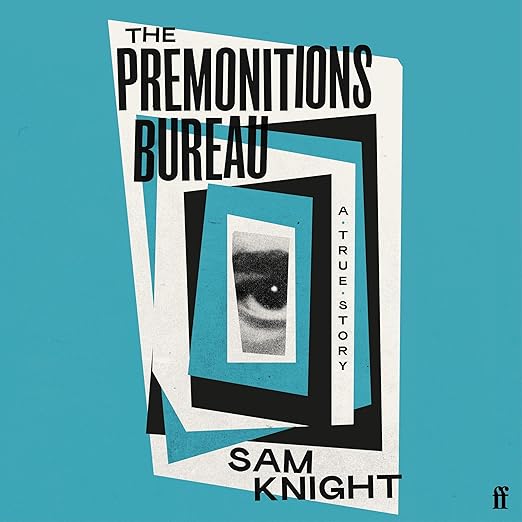
The Hilary Mantel blurb on the cover says simply: fascinating. That is the right word. Not harrowing, not revelatory, not life-changing. Fascinating, in the original sense: something that holds you in place and will not quite let go.
Who Should Listen and Who Should Skip
Listen if you enjoy narrative nonfiction about unconventional corners of twentieth-century history, or if the history of British psychiatry and its relationship to the paranormal genuinely interests you. Listen if you appreciated books like Erik Larson’s work, where the atmosphere is as important as the argument. Skip if you need a book to take a position on whether premonitions are real. Knight is agnostic, deliberately so, and some listeners find that evasive rather than scrupulous.
Frequently Asked Questions
Does The Premonitions Bureau argue that premonitions are real, or does it stay neutral?
Knight stays firmly neutral. He documents what happened and lets the strangeness accumulate without drawing a paranormal conclusion. This is journalism about a psychiatric experiment, not an endorsement of precognition.
Is Julian Rhind-Tutt’s narration well suited to this kind of atmospheric nonfiction?
Yes. His understated, composed delivery suits Knight’s prose well. He does not inflate the eerie passages for effect, which makes the genuinely strange moments land more effectively.
Does the book explain how John Barker verified the premonitions he received?
Partially, and this is one of the book’s acknowledged limitations. Knight describes the logging process but does not provide rigorous statistical analysis of how many predictions were checked and how. Readers wanting methodological detail will need to look elsewhere.
Do you need to read or listen to anything before The Premonitions Bureau, or is it completely standalone?
Completely standalone. No prior knowledge of the Aberfan disaster or British psychiatric history is required, though a brief Google of Aberfan before listening adds useful context for the book’s opening.